Leonard Knight: The Man Who Built Salvation Mountain
A failed balloon, a rebuilt hillside, and the volunteers keeping one man’s desert message alive.

At the edge of Slab City, near Niland and the Salton Sea, color rises out of the desert. Painted flowers, blue waterways, and the words “God Is Love” cover Salvation Mountain. Its maker, Leonard Knight, turned an intensely personal Christian message into a place strangers could walk through.
Our Camp Dunlap story followed the military foundations beneath Slab City. This story begins with a different kind of persistence: a man who wanted to send a message into the sky, then spent much of his life building it into the ground.
- A person behind the landmark. Leonard Knight was a self-taught artist born in Vermont in 1931.
- The balloon came first. His effort to carry a religious message aloft preceded the mountain.
- Failure changed the materials. After an early collapse, adobe and straw became central to the work.
- Preservation is ongoing. Volunteers repair the physical site; a photographic 3D model preserves earlier surfaces.
Before the mountain: a Vermont beginning
Leonard Knight was born on November 1, 1931, near Burlington, Vermont. His biography describes farm work, an early departure from school, and years of ordinary jobs. Painting cars and teaching guitar were among the ways he supported himself.
His later work grew from religious conviction rather than formal art training. The phrase that dominates the mountain was the message he wanted to share, in the simplest language he could find. Understanding that purpose gives the bright surfaces a human center. [1, 4]
The balloon that never carried the message
Before there was a mountain, there was an enormous handmade balloon. Knight hoped to send his message overhead. A breakdown brought him to Nebraska, where people helped with the long sewing project.
PBS’s Nebraska Stories revisits that chapter through Knight’s recorded interviews and people who knew him there. The film makes the labor tangible: fabric, sewing, assistance, and an ambition far larger than one person’s resources. The balloon never achieved the successful flight he imagined. In the desert, a small monument became his next way of communicating. [2, 3]
Watch the 12-minute PBS film about Knight and his balloon project.
Building a mountain—and starting again
Knight began his desert monument in the mid-1980s. The first version used cement and sand. After several years, it collapsed. He rebuilt with adobe clay and straw, covering the growing form with donated paint.
The new material changed the work. Knight could shape rounded slopes, painted channels, flowers, and rooms, adding to the environment over time. Paint supplied both color and a protective covering. What visitors encountered was a place continually being made. [2, 5]
Explore the stages of Knight’s story
Select a stage to follow the change from a traveling dream to a place that needed caretakers.
1931 · Leonard Knight
A Vermont beginning
Knight was born near Burlington, Vermont, on November 1, 1931.
- What changed
- His biography begins with farm life and practical work.
- Why it matters
- The artist’s life started far from the California desert.
Source 1; references below.
Before the mountain · The balloon project
A message meant for the sky
Knight spent years trying to make a balloon carry his religious message.
- What changed
- People he met helped him pursue an ambitious handmade project.
- Why it matters
- The failed flight preceded his desert monument.
Sources 1–3; references below.
Mid-1980s · Beginning near Slab City
The first desert monument
A small monument grew into an early mountain built with cement and sand.
- What changed
- The message acquired a permanent place on the ground.
- Why it matters
- Accounts give different starting years.
Sources 1–2, 10; references below.
Rebuilding · Adobe, straw, and paint
A different way to build
After the early structure collapsed, Knight rebuilt using adobe and straw.
- What changed
- Rebuilding became an opportunity to change the materials.
- Why it matters
- Accounts differ on the collapse year; the sequence is consistent.
Source 2; references below.
2002 · A senator’s tribute
Recognition in Washington
Senator Barbara Boxer praised Knight and his work in the Congressional Record.
- What changed
- His work received public recognition beyond the region.
- Why it matters
- “National treasure” was praise in a tribute, not a monument designation.
Source 6; references below.
2014 onward · Preservation and documentation
A shared responsibility
Knight died in 2014. Caretakers, volunteers, and documentation projects carry the story forward.
- What changed
- The site requires continuing repair and care.
- Why it matters
- The historical 3D model combines imagery from 2009 and 2022.
Sources 4, 7–8; references below.
Early construction dates vary by account; the stages show the documented sequence.
A life spent making and welcoming
Knight lived in a truck at the site, without running water or electricity. Visitors met the person responsible for the colors around them. KPBS’s account of his life emphasizes that daily presence as well as the scale of his work.
His appearance in the 2007 film Into the Wild brought a wider audience to a place that already drew travelers. Knight died on February 10, 2014, at 82. The question afterward was practical as well as emotional: who would keep repairing something its maker had tended for decades? [4]
What “national treasure” means here
In May 2002, Senator Barbara Boxer praised Knight and Salvation Mountain in the Congressional Record, describing the work as a national treasure. The tribute recognized an unusual artist and his contribution to California’s cultural landscape.
That phrase is often repeated as though it were the name of a federal designation. The cited record is a senator’s tribute. It should not be presented as an act creating a national monument or formal landmark status. The recognition is meaningful on its own terms. [6]
Explore the mountain in 3D
Preserving the mountain also means documenting surfaces that change. Photographer Aaron Huey and collaborator Devlin Gandy created a model supported by SPACES and the Kohler Foundation. Its main painted face uses photographs from 2009; surrounding areas incorporate 2022 drone scans.
Use the viewer to rotate and zoom. Look closely at the painted face, then pull back to see how the mountain relates to the surrounding structures. This is a historical reconstruction from photography, with parts recorded in different years. It does not show current walking access. [7]
Model by Devlin Gandy, with Aaron Huey’s photography. Open the 3D model on Sketchfab or read the preservation project’s account at SPACES.
The work after Leonard
For an outdoor environment made from earth, straw, and paint, maintenance is part of survival. Sun, rain, cracks, and foot traffic all affect what remains. The SPACES archive places Salvation Mountain within the larger history of environments built by individual artists, where preserving intent and preserving material can become difficult questions.
Salvation Mountain, Inc. describes its mission as maintaining and preserving Knight’s work. Volunteers and donations support that effort. A visit is an encounter with his creation and with the labor of people carrying it forward. [5, 8]
Visiting with the story in mind
The official visitor page lists Salvation Mountain at 603 Beal Road, Niland, with free admission and sunrise-to-sunset visiting hours. Donations are optional. Check that page before traveling, and follow the signs and caretakers’ instructions when you arrive. A route visible in an older photograph or the 3D model may be closed today.
Use designated parking, respect the painted surfaces, and keep pets leashed. Visiting hours and access can change; the official page linked below is the place to check. [9]
Back at the entrance, the mountain’s scale is striking. Its longer story rests in smaller acts: a seam sewn, a bucket carried, a crack repaired, and a stranger welcomed.
More places around the Salton Sea
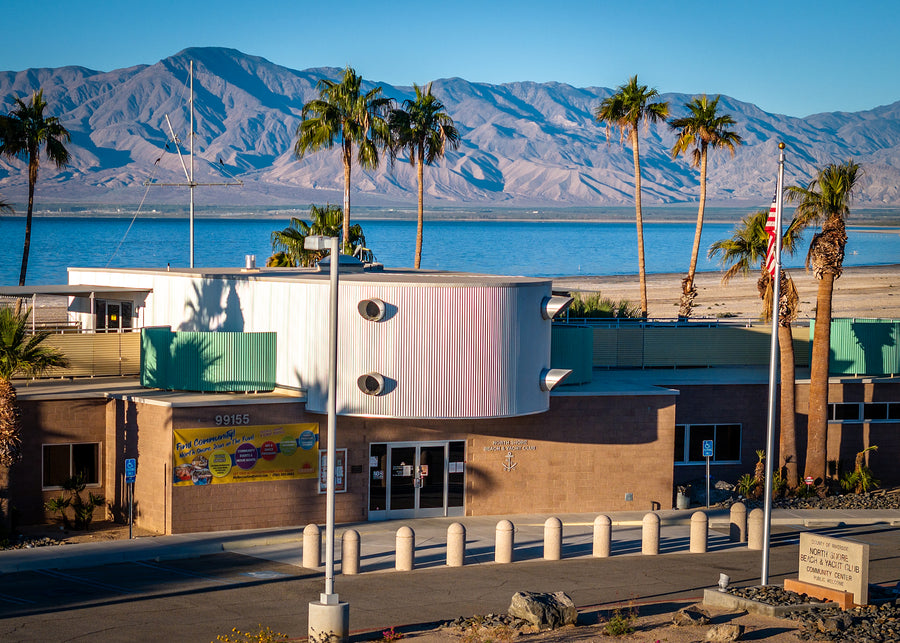
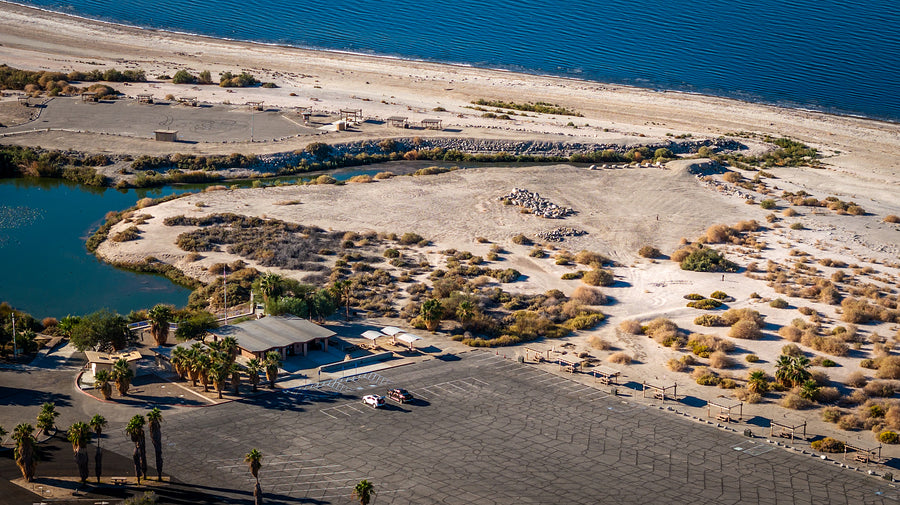
Build a present-day visit with the North Shore Beach and Yacht Club for architecture, Salton Sea State Recreation Area for shoreline recreation, and Sonny Bono Salton Sea National Wildlife Refuge for birdwatching. These are separate destinations around the sea; check each guide for access and allow time between stops.
Leonard Knight and Salvation Mountain questions
Who built Salvation Mountain?
Leonard Knight, a self-taught artist born in Vermont in 1931, created Salvation Mountain near Niland and Slab City. His Christian message, “God Is Love,” is central to the work.
Why did Leonard Knight build the mountain?
He wanted to share his religious message. A handmade balloon project came first; after it failed to achieve flight, he turned to a monument in the desert.
What is Salvation Mountain made from?
The rebuilt mountain uses adobe clay, straw, and layers of paint. Knight’s earlier cement-and-sand structure collapsed.
Is Salvation Mountain a federally designated national monument?
The 2002 Congressional Record cited here contains Senator Barbara Boxer’s tribute calling it a national treasure. That tribute is not a federal national-monument designation.
Can I visit Salvation Mountain today?
The official visitor page lists free admission and sunrise-to-sunset hours. Check it before traveling and follow current signs and caretakers’ instructions. Paths shown in historical images may be closed.
Sources, photograph credit & preservation records
- Salvation Mountain, Inc., About Leonard Knight
Official biography: Vermont origins, early work, religious purpose, and balloon project. Some text is historical and should not be read as a current account of Knight’s life.
- Salvation Mountain, Inc., About Salvation Mountain
Official account of the first structure, collapse, and adobe rebuilding. Early dates vary across published accounts.
- Nebraska Public Media, Leonard Knight – Salvation Mountain
Nebraska Stories, April 27, 2023; 12 minutes. Recorded interviews and recollections document the Nebraska balloon chapter.
- Angela Carone, Leonard Knight, Creator Of Salvation Mountain, Dies
KPBS, February 10, 2014. His life at the site, work, film appearance, and death at age 82.
- SPACES Archives, Salvation Mountain
Artist-built-environment archive entry. Context for the art, materials, and continuing preservation needs.
- Congressional Record, Leonard Knight and Salvation Mountain
May 15, 2002, pp. S4383–S4384. Senator Barbara Boxer’s tribute; cited as recognition, not a formal federal designation.
- Aaron Huey, Salvation Mountain – Now in 3D
SPACES Archives. Documents work with Devlin Gandy combining 2009 photographs and 2022 scans; source of the embedded Sketchfab model. This is photographic reconstruction, not a present-day access map.
- Salvation Mountain, Inc., Our Mission
Official description of the organization’s preservation and maintenance purpose.
- Salvation Mountain, Inc., Visit Salvation Mountain
Current visitor guidance checked October 17, 2026. Hours, admission, parking, pets, and respectful access; recheck before a trip.
- Bob “Doc” Sims, Leonard Knight biography
Historical official-site biography, 2004. Provides an earlier account of his life and project; chronology differs from the newer site.
- Carol M. Highsmith, Salvation Mountain, Calipatria, California
Photograph, 2012, Library of Congress, LC-DIG-highsm-21014. Rights advisory: no known restrictions on publication. Featured photograph shows Knight’s painted truck with part of the mountain behind it. Credit: The Jon B. Lovelace Collection of California Photographs in Carol M. Highsmith’s America Project, Library of Congress, Prints and Photographs Division.
Research reviewed October 17, 2026. The featured image is an actual 2012 photograph. The 3D model combines imagery from different years; neither establishes current access.