Layers of a Desert Lake: Birds of Lake Cahuilla in Winter
A winter morning at Lake Cahuilla reveals gulls, a shrike, pelicans and grebes hunting across four layers of one desert ecosystem.

One January morning at Lake Cahuilla revealed four hunting worlds at once: gulls working the sky, a shrike watching from the trees, a pelican patrolling the surface and grebes disappearing beneath it.
On January 14, 2026, I arrived expecting a quiet winter birding session. Instead, the lake became a lesson in how many ecological layers can exist in one small stretch of desert water.
More than a thousand Ring-billed Gulls appeared to rotate between resting and flight. A Loggerhead Shrike used the park’s tallest trees as lookout towers. An American White Pelican moved across the water with the weight and patience of a battleship. Western Grebes hunted in the dimension I could barely see.
This is a field essay rather than a complete species checklist. It records one morning, the behavior I witnessed and what the photographs taught me about watching birds more carefully.
- The lake was active in four vertical layers: sky, trees, surface and underwater.
- Well over a thousand Ring-billed Gulls were present, with some resting while others continuously circled the lake.
- The Loggerhead Shrike hunted from elevation, using the tallest trees near the playground to scan the ground below.
- The American White Pelican and Western Grebes shared the water differently: one worked the surface while the others pursued prey below it.
- Patience produced the strongest photographs. The best moments came after watching patterns instead of chasing birds.
Reading the habitat
Four Layers of One Desert Lake
A lake can look flat from the shoreline, but birds reveal its vertical structure. Every species I followed that morning occupied a different hunting zone and used a different kind of patience.
Circling, scanning and returning to the water as the flock shifted between flight and rest.
Watching exposed ground from a high perch, then waiting for prey to reveal itself.
Moving deliberately through the shallows with its bill ready below the waterline.
Diving out of sight, pursuing fish and surfacing somewhere new seconds later.
Layer one · Sky
Ring-billed Gulls: The Network Above the Water
Lake Cahuilla held well over a thousand Ring-billed Gulls. Hundreds rested on the water while others circled quietly overhead. From the shore, the movement felt organized: the flock never stopped scanning, settling and lifting again.
Ring-billed Gulls are more closely associated with inland water than many people realize. Reservoirs, lakes, ponds and agricultural landscapes are normal winter habitat. What I could document was the constant rotation between water and air. My impression of a “living network” is an interpretation of that visible pattern—not a claim that every bird had been assigned a role.
That distinction matters in wildlife storytelling. The behavior was real; the meaning emerges from watching it carefully without pretending we can know every motive inside the flock.
Layer two · Trees
Loggerhead Shrike: High Ground, Absolute Focus
I noticed the opportunity before I saw the bird. A small group of birders stood near the playground, cameras aimed at the top of a tall tree—always a good sign. At the highest point sat a Loggerhead Shrike, calm and composed, singing into the open desert air.
The shrike was not simply resting. Between short bursts of song, its head turned deliberately as it scanned the ground. That posture matches the species’ characteristic hunting method: Loggerhead Shrikes often watch from exposed perches before dropping onto insects, reptiles, small mammals or birds below.
It was a textbook combination of habitat and behavior—the right perch above open ground, and a predator built to watch, wait and strike.
Layer three · Surface
American White Pelican: Battleship on the Surface
It is hard not to stop and stare when an American White Pelican glides past. Watching this enormous bird move around the lake looking for a meal, my immediate thought was: it looks like a battleship.
Low in the water, steady and deliberate, the pelican moved with quiet authority. American White Pelicans do not plunge-dive like Brown Pelicans. They feed from the surface, dipping their bills into the water, sometimes working alone and sometimes coordinating with other birds.
The visual power came from the contrast. The lake was quiet and the movement subtle, yet the bird itself felt immense—slow, heavy and perfectly adapted to the water it was working.
Layer four · Underwater
Western Grebes: Ghosts Beneath the Surface
If the pelican ruled the surface, the Western Grebes owned what lay beneath it. A small group moved quietly across the lake, surfacing briefly before disappearing again in smooth dives.
Their feet sit far back on the body, making them awkward on land but powerful in water. Once submerged, a grebe can pursue fish and reappear far from the place where it vanished. From a photographer’s perspective, that uncertainty is the challenge.
I watched from my car, waited for one bird to dive, then moved down to the shoreline and held still. Seconds later, the grebe surfaced where the light, angle and distance finally came together. One chance. No repeat. The photograph felt earned because the moment depended on anticipation rather than pursuit.
One Lake, Many Hunters
Same lake. Same morning. Four radically different strategies.
The gulls occupied the water and air as a crowd. The shrike claimed the high ground and watched alone. The pelican methodically worked the surface. The grebes disappeared into an underwater world that only became visible for a few seconds at a time.
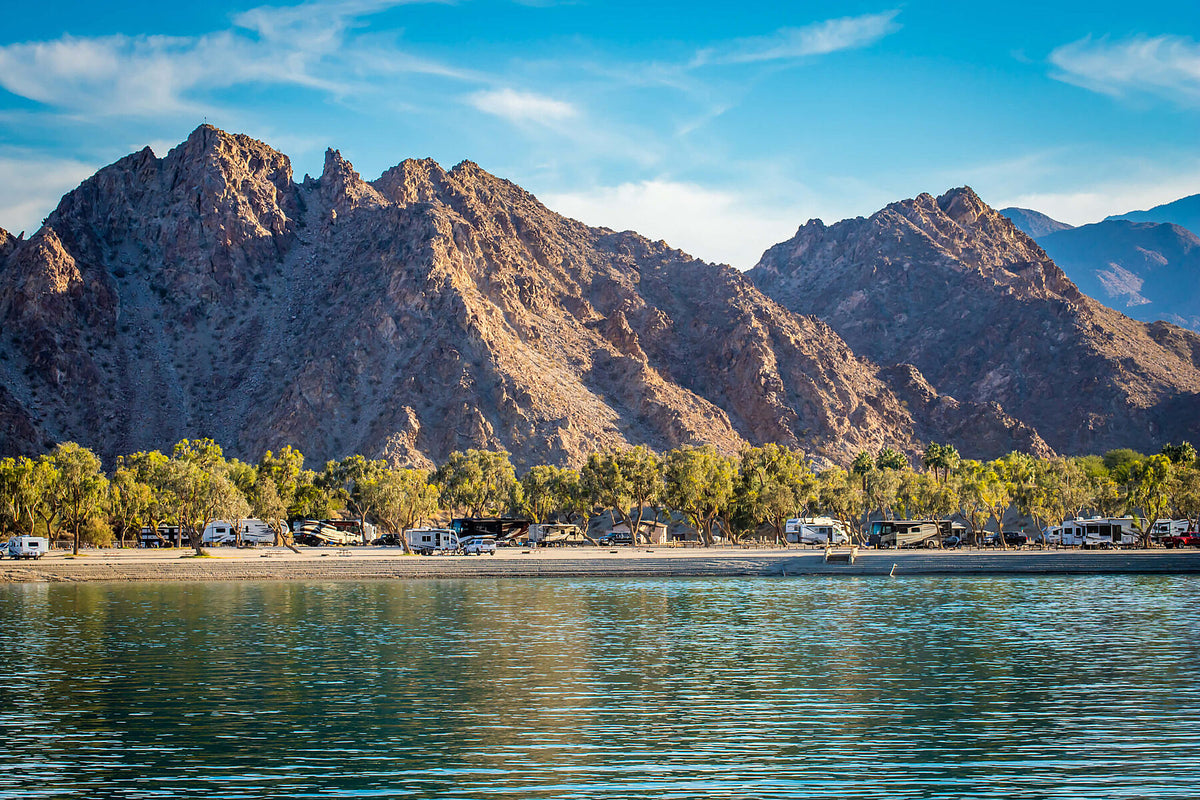
That was the connection I had missed before this visit. Lake Cahuilla is not just water in the desert. It is a layered system, with the sky, trees, surface and underwater habitat all active at once. The birds made those layers visible.
How to Photograph the Lake’s Different Layers
Watch before moving
Spend several minutes identifying repeated flight paths, favored perches and dive intervals before choosing a position.
Let distance work
A long lens protects the bird’s space and gives behavior time to unfold without forcing a reaction.
Change your visual layer
Look up for gull patterns, scan isolated treetops for shrikes, follow the waterline for pelicans and watch for where grebes resurface.
Keep the habitat
Wide photographs can explain the relationship between bird and lake more clearly than a tight portrait alone.
For current access and hours, check the official Riverside County Parks page before leaving. The park identifies birdwatching as an available activity, but operating conditions can change.
Frequently Asked Questions
When is the best time to watch birds at Lake Cahuilla?
Winter mornings generally offer comfortable temperatures, softer photography light and seasonal waterbird activity. Bird numbers vary, so no single species or flock size is guaranteed.
What birds were photographed during this visit?
The article documents Ring-billed Gulls, a Loggerhead Shrike, American White Pelicans and Western Grebes during a winter field session at the lake.
Is Lake Cahuilla Veterans Regional Park the same as ancient Lake Cahuilla?
No. The modern recreational lake is a managed reservoir. Ancient Lake Cahuilla was a much larger natural lake that repeatedly filled the Coachella and Imperial valleys in the past.
Can visitors go bird watching at Lake Cahuilla?
Yes. Riverside County Parks lists birdwatching among the park’s activities. Check the official park page for current day-use hours, fees and temporary notices before visiting.
What is the best photography approach around diving birds?
Watch the bird’s dive rhythm, leave ample space and pre-focus near the area where it is likely to resurface. Remaining still usually creates a better opportunity than repeatedly repositioning.
Sources and field-note methodology
- Riverside County Parks — Lake Cahuilla Veterans Regional Park
- Cornell Lab of Ornithology — Ring-billed Gull life history
- Cornell Lab of Ornithology — Loggerhead Shrike life history
- Cornell Lab of Ornithology — American White Pelican life history
- Cornell Lab of Ornithology — Western Grebe life history
- Firsthand observations and all photographs: Mark Miller at Lake Cahuilla, January 14, 2026.