St. Francis of Assisi Church La Quinta: History Guide
How a parish born in borrowed spaces became a La Quinta landmark shaped by Assisi, Hollywood, local art, and more than fifty years of growth.

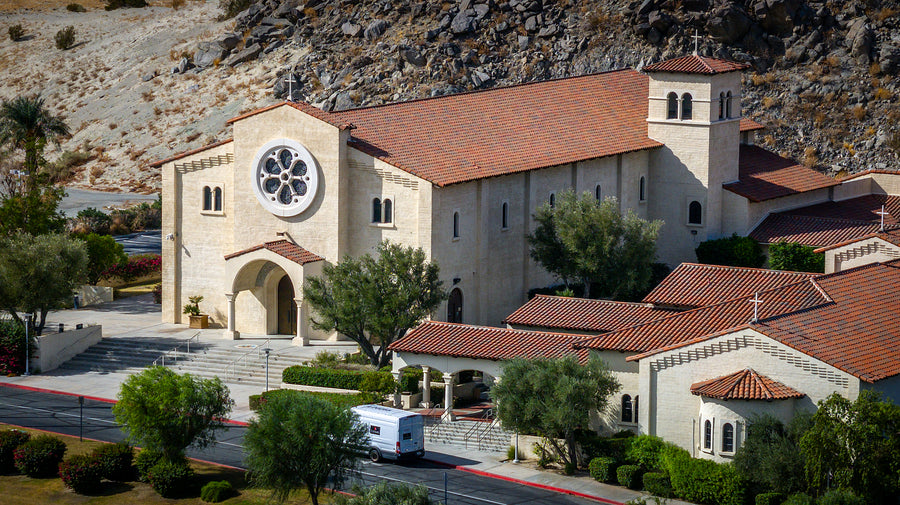
At first glance, St. Francis of Assisi Catholic Church in La Quinta looks as if it has always belonged beneath the Santa Rosa Mountains. Its pale walls, red tile roof, arched entry and rose window give the building the presence of an old landmark.
The parish story is younger—and more surprising. St. Francis began in 1974 without a permanent sanctuary. Mass was celebrated in borrowed spaces, including a bank and an automobile dealership, before the present church opened in 1984.
Its history connects Italian sacred architecture, a local artist, Hollywood figures and the rapid growth of La Quinta. More than 50 years after the parish was founded, the campus is still evolving.
- The parish began without a church building. Early Masses were held at Crocker Bank and Simon Motors, inspiring the nicknames “St. Crocker” and “Our Lady of the Cars.”
- The present church opened in 1984. Its first Mass was celebrated on Holy Thursday, April 19, and the building was formally dedicated on November 25.
- The architecture looks toward Assisi. Parish history credits Fr. Raymond Bluett and Italian director Franco Zeffirelli with shaping an Italian Romanesque-inspired basilica for the desert.
- Art is central to the interior. Alexander Rosenfeld painted murals inspired by Giotto, while a hand-carved pepperwood crucifix was created in northern Italy.
- The campus is expanding again. As of September 2026, the City of La Quinta lists a 27,334-square-foot parish hall and administrative-building project as under construction.
Three moments explain how St. Francis became a landmark
Move through the parish’s three defining eras: borrowed spaces, a permanent sanctuary and the expansion now reshaping the campus.
Borrowed spaces
Fr. Raymond Bluett led the new parish while worship moved through practical local venues. The bank and dealership nicknames capture both the uncertainty and the community spirit of the first decade.
The parish existed for about ten years before the present sanctuary was dedicated.
Assisi in the desert
The new building paired Romanesque influence with the desert setting. Its first Mass brought Frank Sinatra and Gregory Peck to the readers’ lectern; formal dedication followed in November.
The building opened as La Quinta itself was still a very young incorporated city.
Making room again
The City of La Quinta lists a 27,334-square-foot expansion as under construction. The parish hall is intended to add classrooms, gathering space, a commercial kitchen and ministry capacity.
The parish currently lists November 2026 as the hall target; administrative offices remain dependent on funding.
A desert landmark with a deeper story
Before the sanctuary stood on Washington Street, a small Catholic community gathered wherever it could. The Diocese of San Bernardino records that St. Francis of Assisi was established in 1974, when the parish was still part of the Diocese of San Diego. Fr. Raymond Bluett served as founding pastor.
That beginning explains the character of the institution today. St. Francis was not placed into a finished city as a completed monument. It developed alongside La Quinta.
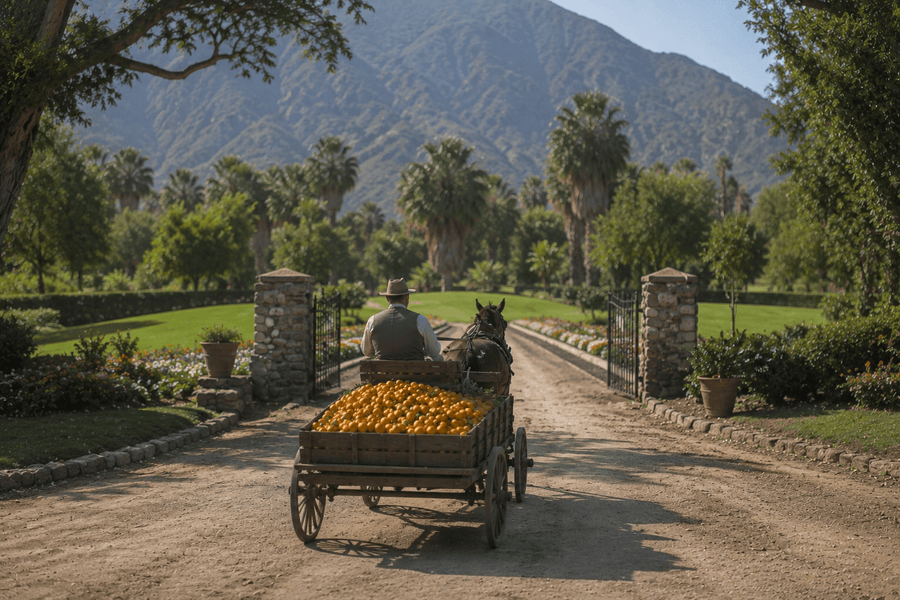
The land itself connects the parish to an older layer of local history. The church site was part of the historic Clarke Ranch at Point Happy, once owned by Chauncey and Marie Clarke. Arabian horses, Deglet Noor dates, citrus and gardens occupied a landscape that would later become one of La Quinta’s busiest corridors.
From “St. Crocker” to a permanent church
Parish history preserves affectionate names for the temporary venues. Mass at Crocker Bank became “St. Crocker.” Worship at Simon Motors became “Our Lady of the Cars.” The humor reflects a mission-like period when the congregation had an identity but no permanent home.
Construction of the present church began in 1983, when parish accounts describe the surrounding area as largely open desert. The first Mass in the new sanctuary was celebrated on Holy Thursday, April 19, 1984. Bishop Philip Straling formally dedicated the church on November 25.
St. Francis timeline
| Date | Milestone | Why it matters |
|---|---|---|
| 1974 | Parish established under Fr. Raymond Bluett | Begins the institutional history. |
| 1974–1984 | Masses held in a bank, auto dealership and other borrowed spaces | Shows how the congregation formed before it had a sanctuary. |
| 1983 | Construction of the present church begins | Starts the physical history of the landmark seen today. |
| April 19, 1984 | First Mass celebrated in the new church | Marks the earliest liturgical use of the sanctuary. |
| November 25, 1984 | Church formally dedicated | Completes the transition to a permanent parish home. |
| 1998–1999 | Hall enlarged; pastoral center and chapel added | Responds to the first major wave of parish growth. |
| 2016 | Parish history lists 5,661 families and 16,327 parishioners | Documents the scale reached after four decades. |
| 2016–2017 | New expansion design approved and capital campaign authorized | Moves a future campus plan into organized fundraising. |
| July 26, 2022 | La Quinta Planning Commission approves expansion | Provides municipal entitlement for the project. |
| May 28, 2024 | Planning Commission approves a time extension | Keeps the entitled project active. |
| October 4, 2024 | 50th anniversary and groundbreaking ceremony | Connects the parish’s history to its next building phase. |
| September 2026 | City continues to list the expansion as under construction | Confirms the current public status at this article’s update. |
| November 2026 target | Parish hall completion goal | This remains a target, not a guaranteed completion date. |
Franco Zeffirelli and an Italian idea for the desert
Most churches have an architectural story. St. Francis has one connected to Franco Zeffirelli, the Italian director known for films and opera productions with a strong visual sense of history and sacred drama.
Parish history says Zeffirelli and Fr. Bluett first imagined a church inspired by the medieval religious complex associated with St. Francis in Assisi. A direct reproduction proved impractical, and the idea evolved into a basilica-style building with a vaulted interior and Romanesque influence.
The result should not be reduced to generic “Mission style.” Its arches, symmetry, long nave and rose window look toward Italian sacred architecture, while pale walls, red tile and intense desert light root it in Southern California.
Hollywood, La Quinta and the first Mass
The first Mass in the new church joined the parish story to the Coachella Valley’s long relationship with Hollywood. Parish accounts identify Frank Sinatra and Gregory Peck as the first two readers on Holy Thursday, April 19, 1984.
The same history credits support from Frank Sinatra, Frank Capra, Bob Hope and the Annenbergs. Their involvement belongs to a specific period when La Quinta was becoming more visible through resort life, residential development and the cultural network surrounding La Quinta Resort.
The celebrity names are memorable, but they should not overpower the larger fact: a local congregation had spent a decade creating the permanent spiritual home in which that first Mass could occur.
Murals, Giotto and a pepperwood crucifix
The exterior makes St. Francis recognizable. The interior gives the church its deeper artistic identity.
La Quinta artist Alexander Rosenfeld painted 16 murals, including 14 scenes from the life of St. Francis. Parish history says he worked from faded copies of Giotto’s frescoes in Assisi and, while in his 90s, painted nine hours a day, six days a week, for roughly two and a half years.
The murals are more than decoration. They connect the La Quinta sanctuary to the visual tradition of Assisi while preserving the disciplined work of a local artist inside a living sacred space.
The altar crucifix has a similarly unusual origin. Parish history attributes it to northern Italian sculptor Ivo Demetz, who carved it from a single 700-pound block of pepperwood except for Christ’s extended left arm. The work was then shipped to California by air.
A 1986 Los Angeles Times travel feature also noted the murals, Irish stained glass and Italian-carved altar piece. Together, the features make the building both a house of worship and an important local art site.
A church that grew with La Quinta
St. Francis did not begin inside a finished city. La Quinta incorporated in 1982, two years before the church opened, and both the city and parish grew rapidly through the following decades.
By 1998, parish history reported about 2,200 families and nearly 5,000 parishioners. That growth prompted an enlarged hall, a pastoral center and a chapel. By 2016, the same history listed 5,661 registered families and 16,327 registered parishioners.
Those numbers are historical snapshots rather than a current census. Their value is that they show scale: the congregation grew far beyond the small community that once gathered inside a bank and dealership.
More homes, seasonal residents, families and retirees reshaped La Quinta and nearby Indian Wells. The parish expanded in response, becoming one of the major Catholic communities in the eastern Coachella Valley.
The parish today
St. Francis remains an active parish, not a preserved historic site. Its public schedule reflects the diversity of the valley, with Masses offered in English, Spanish and Vietnamese, plus a periodic Tagalog Mass.
The institution also supports religious education, music, pastoral care, outreach and a wide range of liturgical ministries. These daily rhythms distinguish the parish from the architecture visitors see from Washington Street.
Why the church is expanding again
The expansion is driven by a practical problem: the parish has outgrown its meeting, ministry and parking capacity.
As of September 2026, the City of La Quinta lists the project as under construction. Its planning record describes a 22,499-square-foot parish hall and a 4,835-square-foot administrative building, totaling 27,334 square feet.
The parish’s current expansion FAQ describes ten classrooms, a large event room, a commercial kitchen and a choral room. Parking is planned to increase from 398 spaces to 512, including more accessible stalls and nine EV charging stations.
The same FAQ lists an $18.4 million total project cost divided between the parish-hall phase, related operating and fundraising expenses, and a future administrative-building phase. It lists November 2026 as the parish hall target, while the administrative offices remain dependent on funding.
That language matters. November 2026 is the parish’s stated goal, not a guarantee. Construction schedules and fundraising can change, so readers following the project should use the parish and city pages for the latest status.
Why St. Francis matters to La Quinta
St. Francis tells several La Quinta stories at once.
It is a story of faith: a congregation that formed before it had a permanent home. It is a story of architecture: an Assisi-inspired idea translated into desert light. It is a story of art: Rosenfeld’s murals and Demetz’s crucifix connecting local labor with European traditions.
It is also a story of the valley’s Hollywood era, with Sinatra, Peck, Capra, Hope, Zeffirelli and the Annenbergs appearing in parish memory. Most importantly, it is a story of La Quinta’s growth—from ranch land and open desert to a large residential and resort city.
The expansion adds the final layer. St. Francis is still making room for the community it serves.
St. Francis at a glance
| Key fact | Detail |
|---|---|
| Parish established | 1974 |
| Founding pastor | Fr. Raymond Bluett |
| Early venues | Crocker Bank, Simon Motors and other borrowed spaces |
| First Mass in present church | Holy Thursday, April 19, 1984 |
| Formal dedication | November 25, 1984 |
| Architectural influence | Italian Romanesque-inspired basilica associated with the religious heritage of Assisi |
| Murals | 16 works by Alexander Rosenfeld, including 14 scenes from the life of St. Francis |
| Crucifix | Hand-carved in northern Italy by Ivo Demetz from pepperwood |
| Current project status | Listed by the City of La Quinta as under construction in September 2026 |
| Parish hall target | November 2026; administrative offices remain dependent on funding |
Frequently asked questions
Where is St. Francis of Assisi Catholic Church in La Quinta?
The church is on Washington Street near Point Happy, at the base of the Santa Rosa Mountains. Its red tile roof, tower, rose window and mountain backdrop make it one of La Quinta’s most recognizable religious landmarks.
When was St. Francis of Assisi Catholic Church founded?
The parish was established in 1974. It spent about a decade worshipping in temporary locations before celebrating the first Mass in the present church on April 19, 1984. The building was formally dedicated on November 25, 1984.
What makes the church’s architecture unusual?
Parish history connects the concept to Fr. Raymond Bluett and Italian director Franco Zeffirelli. The building is best understood as an Italian Romanesque-inspired basilica adapted to the Southern California desert rather than as a simple Mission-style church.
What is the church’s Hollywood connection?
Parish accounts identify Frank Sinatra and Gregory Peck as the first two readers at the first Mass in the new sanctuary. The parish also credits support from Frank Capra, Bob Hope and the Annenbergs, while Franco Zeffirelli influenced the building concept.
Is St. Francis of Assisi Church expanding?
Yes. As of September 2026, the City of La Quinta lists a 27,334-square-foot parish hall and administrative-building expansion as under construction. The parish lists November 2026 as the hall target, while the office phase depends on available funding.
Sources and further reading
View research sources and verification notes
The historical narrative relies primarily on parish and diocesan accounts, checked against municipal planning records and contemporary reporting. Celebrity involvement, the early worship venues, the first Mass, murals and crucifix are attributed to institutional parish history. Historic membership figures are snapshots from those records and should not be read as current enrollment.
Construction figures are time-sensitive. This article was checked on September 1, 2026. At that time, the City of La Quinta listed the project as under construction, while the parish FAQ continued to identify November 2026 as the hall target. Readers should treat that date as a goal and consult the official project pages for later changes.
Official and primary sources
- Diocese of San Bernardino parish history
- St. Francis of Assisi parish history and trivia
- St. Francis of Assisi expansion FAQ
- City of La Quinta: St. Francis Parish Hall Expansion
- Inland Catholic Byte: 50th anniversary and groundbreaking