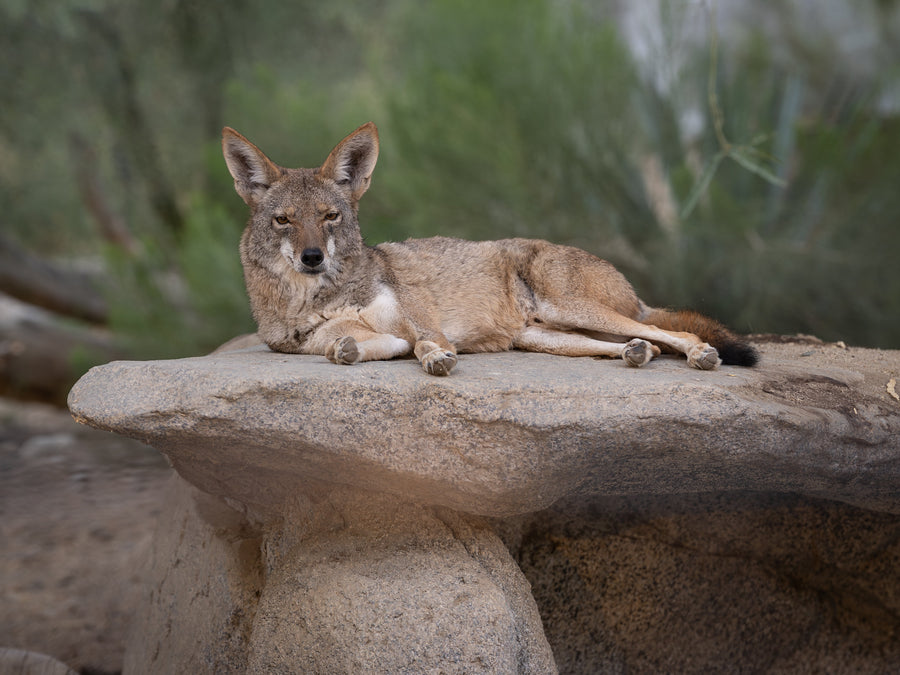
Coyotes in California: Why They Thrive—and What We Really Know About Their Numbers
A century of expansion, remarkable adaptability, and a practical guide to living alongside a native predator.

A coyote can move through open desert, cross an agricultural field and disappear into a city neighborhood. That ability to make a living in such different places is what makes this animal so fascinating to me.
It also raises a reasonable question: are there more coyotes than there used to be?
The answer depends on the scale. Their expansion across North America is well documented. Their presence in California cities is unmistakable. But a steady, measurable increase in the total number of California coyotes is a different claim—and the evidence reviewed for this guide does not establish a reliable year-by-year statewide curve.
- Coyotes are native members of the dog family. California classifies them as nongame mammals, not rodents.
- Continental range expansion, local abundance and increased sightings are three different things.
- Food, habitat, learning, family territories, births, deaths and dispersal all affect their success.
- California permits some coyote hunting and damage-control trapping. That does not make shooting or trapping lawful in every neighborhood.
- Keep wildlife wild: secure food, supervise pets and respond to concerning behavior rather than judging danger by the time of day alone.
Is California’s coyote population increasing?
There is strong evidence of a long-term expansion in where coyotes live, but no dependable annual statewide population series was identified for this article. California was already part of their native range long before European colonization. CDFW’s life-history account describes them as common to abundant throughout the state, citing work dating to 1937. California is not a newly colonized state. [1] [2]
A widely repeated estimate places California’s population between 250,000 and 750,000. El Dorado County still publishes that range and attributes it to CDFW. The page does not identify when or how the original estimate was made. It cannot tell us how many coyotes live here in 2026, or how much the population has changed. [3]
Local increases remain possible—and recolonization can be real. But more doorbell videos, howling or neighborhood reports can also reflect greater visibility, repeated observations of the same family, or changes in reporting. A San Francisco study analyzed 3,904 sighting records from 2012 through mid-2022 and explicitly identified reporting biases, including changes in signage and the introduction of an online form. Those are records of encounters, not 3,904 different coyotes. [4]
Population
How many individuals live within a defined area? Repeated, comparable surveys are needed to estimate change.
Range
Where does the species occur? Colonizing a city or region is a geographic change.
Sightings
What did people observe and report? Useful information, influenced by people as well as wildlife.
The long view: California coyotes through time
Open a milestone to see what it establishes. Dates of research publication are distinguished from the years the animals were studied.
Long before 1900Native to California
Archaeological and museum evidence places coyotes in California and the arid West throughout the Holocene. The familiar story that coyotes originated only on the Great Plains is too narrow. [2]
1900–2016A continental expansion
Hody and Kays reconstructed expansion northward, eastward and southward across North and Central America. They identified landscape change and the removal of larger predators as likely enabling factors. Their 2018 paper maps range, not California head counts. [2]
1980s–1990Local populations fluctuate
Research at California’s Naval Petroleum Reserves recorded changing coyote abundance indices and a subsequent control program. Prey availability mattered; a local increase did not establish a trend for the whole state. Results were published in 1992. [13]
2002A return to San Francisco
The Presidio Trust dates the return of coyotes to 2002, following a long local absence. This is a clear example of recolonization within a state where coyotes were already native. [5]
2020–2025Cities come into sharper focus
January–May 2026An extraordinary dispersal story
A male appeared on Alcatraz in January. In May, the National Park Service and UC Davis reported a DNA match to Angel Island. The likely crossing demonstrates movement ability; one remarkable animal is not evidence of a statewide population surge. [11]
Why coyotes are so successful
Intelligence helps, but their success comes from several traits working together. A flexible diet allows them to hunt small animals, scavenge and eat fruit. Behavioral flexibility allows them to use very different landscapes. CDFW describes them in rural, residential and urban areas; these are animals that can adjust to opportunities rather than depend on one narrow habitat. [19]
We change the menu and the landscape
Unsecured garbage, fallen fruit, outdoor pet food and feeding wildlife can make a neighborhood rewarding. Food conditioning means learning to associate people or their surroundings with food. Habituation means reduced response to repeated, nonthreatening contact. They can occur together, but they are not the same process. [19]
Buildings do not simply erase every route available to a coyote. Open space, roads and other infrastructure influence movement, and the pattern is more complex than “more houses equals more coyotes.” A 2025 Los Angeles research summary from UC Berkeley describes movement models that improved when social and environmental conditions were considered together. [22]
Territories put limits on growth
Coyotes commonly live in family groups centered on a breeding pair. Families defend territories, and young animals may disperse. The Presidio Trust explains that these social and spatial limits help regulate local numbers. Births do not all become additional permanent residents of the same neighborhood. [5]
What do California coyotes eat? Compare the evidence
The most useful answer is local. These charts show how often selected food items were detected in scat samples. A sample can contain several items, so bars do not add to 100%. They are not percentages of calories, body weight or pets killed.
Explore two studies
Los Angeles area: urban and suburban sites
Published 2020 · 1,541 urban and 1,606 suburban scat samples · physical examination of food remains.
Ornamental fruit & seeds
Trash-associated remains
Domestic cat
Pocket gopher
Common 0–100% scale. Selected items only. “Trash” was identified from associated remains such as packaging; soft human food can escape visual detection. The paper also used a separate isotope method, which is not plotted here. [6]
San Francisco: DNA detects a varied menu
Samples September 2019–April 2022 · published 2025 · 707 samples retained for dietary analysis.
Domestic chicken
Botta’s pocket gopher
Domestic pig
Raccoon
Domestic cat
Common 0–100% scale. DNA can identify an animal ingredient without identifying its route into the diet: chicken might come from discarded food, pet food or a live animal. Different methods, years and places mean these bars should not be used as a controlled comparison with Los Angeles. [7]
Bakersfield adds an important counterpoint
A 2025 study examined 231 samples collected around Bakersfield in 2021–2022. Rabbits and rodents were the main foods across urban, peri-urban and non-urban sites. Urban coyotes there did not appear dependent on human-associated foods. That is a useful check on the assumption that every California city produces the same kind of coyote diet. [8]
How smart are coyotes?
Calling a coyote clever is reasonable. Calling it one of the smartest animals on Earth is an opinion, not a ranking established by the research.
In a 2019 captive study in Utah, coyotes that observed another coyote solve a food puzzle were faster and more successful in one experiment. Persistence also mattered. Results differed with the task, and many animals did not solve more difficult problems. This supports specific learning abilities without turning “intelligence” into a single score. [9]
Research comparing urban and rural coyotes also found differences in boldness and exploration. A willingness to investigate people or unfamiliar objects is a behavioral trait—not proof that a particular animal is smarter, tame or safe to approach. [10]
A year in the life of a coyote family
California coyotes generally mate from January through March, with most births from March through May after roughly 63 days of gestation. They ordinarily have one litter a year. Timing overlaps and varies by location; these seasons are a guide, not a calendar appointment. [1]
Winter into early springCourtship and breeding
Territorial behavior may be more noticeable. Give animals space and keep dogs close; a breeding pair is not a newly formed hunting mob.
SpringBirths and dens
Adults spend time around den sites. Leave dens and pups alone and follow any seasonal trail closures.
Late spring through summerRaising young
Parents must feed growing pups and may react strongly to dogs near a den. Increase distance and leave the area; do not approach to investigate.
Late summer through fallGrowing independence
Some young coyotes explore or leave the family territory. Additional animals seen briefly do not automatically represent a lasting increase in neighborhood density.
Seasonal context: CDFW life history and Presidio Trust guidance. Den defense can persist beyond the months in which pups are born. [1] [5]
Howling is communication, not a census. Coyotes use yips, barks and howls, and a family can be conspicuous without containing a large number of animals. Watching quietly from a distance gives a more useful picture than trying to estimate a population from sound alone. [19]
Why removing coyotes does not always provide a lasting solution
Population change is the balance of births, deaths and animals moving in or out. Removing individuals changes only part of that balance. Vacant habitat can be occupied again, especially if attractive food remains available.
Recovery is real, but the slogan “killing coyotes always creates more coyotes” goes beyond the evidence. A 2025 population study at South Carolina’s Savannah River Site documented a substantial decline during intensive removal and a rebound afterward. That is evidence of resilience and recovery, not proof that every removal immediately increases numbers. It is also outside California. [12]
California research offers another caution. The 1992 Naval Petroleum Reserves paper found no compensatory reproductive increase during the program it studied; prey availability appeared important. These different outcomes are why management needs a defined objective, a local assessment and follow-up. [13]
Removing a specific animal involved in dangerous behavior and trying to suppress all coyotes across a region are different decisions. Addressing food access and protecting pets remain useful regardless of which management response authorities choose.
Can coyotes be hunted, trapped or poisoned in California?
They are nongame mammals, not rodents, and they are not covered by a blanket prohibition on hunting. The following summarizes rules checked October 26, 2026. A state-level allowance never replaces local ordinances, landowner permission or site restrictions.
Hunting: allowed under conditions
Title 14, section 472 generally allows coyote take at any time of year and in any number, subject to other restrictions. A hunting license is generally required. Firearm take requires nonlead ammunition, and place, time and method restrictions still apply. [15]
Neighborhood shooting: a separate question
Many cities restrict weapon discharge. The state’s 150-yard safety-zone rule has specified owner, possessor and permission exceptions; it does not mean everything outside 150 yards is lawful. A large lot alone is not permission to shoot. [17]
Trapping: restricted, not entirely prohibited
California bans recreational and commercial fur trapping. Certain damage-control trapping remains possible under applicable laws, licensing and method restrictions. A homeowner should not assume that setting a trap and relocating the animal is lawful. [16]
For a property-specific conflict, contact local animal control or CDFW. Avoid reducing the legal picture to either “coyotes cannot be controlled” or “coyotes can be killed anywhere.” Both are misleading.
Their ecological role—and the risks they face
Coyotes eat rodents and other small mammals and can contribute to ecosystem function. But their effects depend on the setting: the San Joaquin kit fox research also documents predation on an endangered native species. A native predator can be ecologically important and still create a serious local management challenge. [19] [13]
They are not invulnerable. Roads are an important mortality source in the Bay Area. Disease and toxic exposure also complicate the picture. [20]
A study first published in November 2024 detected anticoagulant rodenticide exposure in 98.1% of 365 urban/suburban coyote carcasses from Southern California, compared with 41.7% of 120 rural carcasses. These selected carcasses are not a random statewide sample, and detecting a chemical is not the same as establishing that it caused an animal’s death. The result nevertheless demonstrates a substantial exposure problem in the sampled animals. [14]
Living with coyotes: what to do at home and on a walk
Reduce the reward
- Secure trash and food waste.
- Bring pet food indoors and collect fallen fruit.
- Never feed or lure coyotes.
- Reduce spilled birdseed that attracts small mammals.
Protect pets and children
- Keep cats indoors or in secure enclosures.
- Supervise small pets outside, including in fenced yards.
- Walk dogs on a short leash and do not let them chase wildlife.
- Keep small children close when a coyote is nearby.
If a coyote approaches
Keep your group together, bring children and pets close, and back away slowly without running. Make yourself look larger and use a firm voice, clapping or another loud noise. Give the animal an escape route. If a dog encounters a protective coyote near a den, leave the area rather than trying to force the animal away from its pups. [19] [5]
If contact or an attack occurs, fight back and seek immediate help. Call 911 for an immediate emergency, and report aggressive behavior to animal control or CDFW. Any bite or scratch warrants prompt medical care; a veterinarian should assess an injured pet. [19] [20]
Daylight alone does not diagnose danger
Coyotes can be active during the day. Pay attention to behavior: persistent approaches, following that continues as you retreat, attacks, disorientation or apparent injury deserve attention. Report the location, time, behavior and whether pets or food were involved. Keep a safe distance rather than approaching for a better photograph. [20]
Reading the coyote’s place in the Coachella Valley
The larger California story is easy to recognize at our desert’s edges: fields, washes, open space and neighborhoods sit close together. My coyote photograph from Thermal records one animal in that setting. It does not establish how many live nearby or whether their number is rising.

Explore the landscape through the Coachella Valley Preserve, Whitewater Preserve and our jackrabbit and cottontail guide. These are habitat and natural-history connections, not promises of a wildlife sighting. Follow each location’s access rules and photograph animals without baiting, calling them closer or approaching dens.
How to judge the next “coyote population explosion” claim
Ask what was measured, where, over which years, and with what method. Was it a count of identified individuals, an abundance index, an expansion in occupied habitat, or a list of complaints? Did the reporting system or survey effort change? Were births balanced against mortality and dispersal?
This guide reviewed agency guidance, historical accounts and research published from 1992 through 2026, including a reconstruction reaching back thousands of years. The strongest supported story is one of native persistence, continental expansion and local adaptation. A new, comparable California population series could refine that conclusion; a dramatic headline or a cluster of neighborhood videos cannot substitute for one.
California coyote questions, answered
Are coyotes native to California?
Yes. They are members of the dog family, Canidae, and have a long history in California. “Nongame mammal” is their legal classification; it does not mean rodent.
How many coyotes are in California?
A range of 250,000–750,000 is widely repeated by public agencies, but the reviewed page does not provide the original estimate’s date or method. Treat it as a broad historical estimate, not a verified 2026 count. We did not find a reliable annual statewide series.
Does seeing a coyote during the day mean it is rabid or dangerous?
No. Daytime activity can be normal. Keep your distance and assess behavior; persistent approaches, aggression, disorientation or injury should be reported. Do not attempt to diagnose or handle the animal.
Can you legally hunt or trap a coyote in California?
Some hunting and damage-control trapping are lawful under specific conditions. State rules, licensing, legal methods, land access and local restrictions all matter. Recreational and commercial fur trapping are prohibited. Poison is prohibited as a method of taking coyotes.
Will removing coyotes permanently stop a neighborhood problem?
Not necessarily. Other coyotes may occupy suitable habitat, especially when food remains available. However, evidence does not support saying every removal automatically increases population. Dangerous individual behavior and widespread population suppression require different assessments.
Sources, dates & chart methods
Research and legal checks completed October 26, 2026. Dates below distinguish publication from sampling. Agency pages can change; follow current local guidance for an actual encounter or property issue.
CDFW · Coyote life-history account
Updated May 2000; historical account. Read sourceStatewide occurrence, taxonomy, habitat and reproduction. Older life-history descriptions are interpreted alongside current agency guidance.
Hody & Kays · Mapping the expansion of coyotes across North and Central America
ZooKeys, 2018; range reconstruction through 2016. Read sourceArchaeological, museum and other records establish an ancient western range and subsequent continental expansion. This is a distribution study, not a California population census.
El Dorado County · Avoiding Wildlife Problems
Undated page; accessed October 26, 2026. Read sourceRepeats the 250,000–750,000 estimate attributed to CDFW. No original estimation date, method or annual series is supplied; it is not treated here as a new census.
Wilkinson et al. · Coexistence across space and time
People and Nature, 2023; reports January 2012–June 2022. Read sourceSan Francisco reports, conflict patterns and the limitations of community reporting.
Presidio Trust · Coyotes in the Presidio
Current guidance; accessed October 26, 2026. Read sourceReturn in 2002, territorial family groups, seasonal den protection and encounter guidance.
Larson et al. · Effects of urbanization on resource use and individual specialization
PLOS ONE, February 5, 2020. Read sourceSouthern California scat and stable-isotope study. Chart uses published scat frequency of occurrence, not biomass or calories. Urban n=1,541; suburban n=1,606.
Caspi et al. · Impervious surface cover and number of restaurants shape diet variation
Ecosphere, 2025; samples September 2019–April 2022. Read sourceDNA dietary analysis of 707 retained scat samples. Chart uses Table 1 frequency of occurrence; 111 individuals identified in the genotyped subset.
Cypher & Kelly · Coyote food item use along an urban gradient
California Fish and Wildlife Journal, August 28, 2025; samples August 2021–July 2022. Read source231 samples from urban, peri-urban and non-urban sites around Bakersfield; strong regional variation in food use.
Young et al. · Persistence and conspecific observations improve problem-solving abilities of coyotes
PLOS ONE, July 10, 2019. Read sourceCaptive experiments in Utah; social learning and persistence, with task-dependent results. Not a ranking of animal intelligence.
Breck et al. · The intrepid urban coyote
Scientific Reports, February 14, 2019. Read sourceUrban–rural comparisons of boldness and exploration; behavior is not equivalent to general intelligence.
National Park Service / UC Davis · Alcatraz Coyote Wasn’t a City Boy After All
May 5, 2026. Read sourceDNA linked the male documented on Alcatraz in January 2026 to Angel Island. A dispersal event, not a population trend.
Gaya et al. · An integrated population model of a high-density coyote population in South Carolina
Ecosphere, 2025. Read sourceLongitudinal evidence of decline during intensive removal and subsequent recovery. Outside California; used only to explain mechanisms.
Cypher & Scrivner · Coyote control to protect endangered San Joaquin kit foxes
Vertebrate Pest Conference, March 1992; program 1985–1990. Read sourceLocal California abundance indices, prey effects, and an example without a detected compensatory reproductive increase.
Stapp et al. · Patterns of exposure of coyotes to anticoagulant rodenticides
First published November 18, 2024; Journal of Wildlife Management, 2025. Read sourceCarcasses of 365 urban/suburban and 120 rural coyotes; exposure is not equivalent to poisoning as cause of death or a statewide prevalence estimate.
CDFW · 2026–2027 Mammal Hunting Regulations
Effective July 1, 2026–June 30, 2027; checked October 26, 2026. Read sourcePages 109–110: Title 14 sections 472, 474 and 475. Downloaded and text checked for coyote take, poison prohibition, trapping cross-references and nonlead ammunition.
CDFW · California Trapping Laws and Regulations
Revision May 1, 2025; checked October 26, 2026. Read sourceRecreational and commercial fur-trapping restrictions, lawful exceptions and methods. Read with the current code and regulations.
CDFW · Can I shoot a coyote with a compound bow?
California Outdoors Q&A, 2023. Read sourceLicensing, a legal place to hunt, local restrictions and the qualified 150-yard safety-zone rule.
California DPR · Chlorophacinone and Warfarin restrictions
December 20, 2024; effective January 1, 2025. Read sourceRestrictions on anticoagulant rodenticides, including specified exceptions. Separate from permission to take coyotes.
CDFW · Human-Wildlife Conflicts: Coyotes
Current guidance; accessed October 26, 2026. Read sourceNative status, food conditioning, prevention and response to an approaching coyote.
NPS · Coyotes, Golden Gate National Recreation Area
Updated January 8, 2026. Read sourceDaytime activity, family territories, mortality and visitor/pet safety.
UC Statewide IPM · Coyote
Updated March 2007; historical management synthesis. Read sourceIdentification, signs, food availability and historical management context. Current laws and encounter advice are checked against newer agency sources.
UC Berkeley · How Urbanization Shapes Coyote Behavior and Connectivity in LA
2025. Read sourceResearch summary connecting coyote movement with infrastructure, landscape and social conditions.
Visual methods: All bar lengths use a 0–100% scale and values transcribed from the cited papers. Values are rounded to one decimal for display. Categories can overlap within samples. No population trend has been interpolated or invented. The cover is an AI-generated illustration; the Thermal image is Mark Miller’s photograph.