
Common Sunflower (Helianthus annuus)
A bright, branching wildflower with golden rays, brown centers and rough, toothed leaves. Common sunflower (Helianthus annuus) invites a closer look at the small details that distinguish one yellow wildflower from another....
- In this guide
- Native
- Explore the collection
- Desert flora guide
A closer look.
Open a photograph to see the details. Use the arrows or swipe to explore the gallery.


Photographs from Desert Oasis Insider’s plant collection. Locations are shown where recorded in the original gallery.
Get to know this plant.
About this classification: Native
Native to the California desert region or nearby mountains. The setting listed above matters: a mountain native may not belong to the hot valley floor.
A bright, branching wildflower with golden rays, brown centers and rough, toothed leaves. Common sunflower (Helianthus annuus) invites a closer look at the small details that distinguish one yellow wildflower from another.
Photography: Mark Miller captured all three photographs at Oak Glen Preserve on October 1, 2026. The photographed plant is identified here as likely common sunflower from its visible features; a photo-based identification is not a botanical specimen determination.
- A California-native annual in the sunflower family, Asteraceae.
- Wild forms often branch and carry many smaller heads.
- Each “flower” is actually a community of tiny flowers.
- Regional occurrence depends on habitat, moisture and elevation.
At a glance: plant facts
- Scientific name
- Helianthus annuus
- Common names
- Common sunflower, annual sunflower, wild sunflower
- Life cycle
- Annual: grows, flowers and produces seed within one growing season.
- Size
- Often several feet tall; height varies greatly with growing conditions and cultivated forms.
- Flowers
- Yellow ray florets surrounding many brownish disk florets.
- Habitat
- Sunny, open ground, roadsides, disturbed areas and places with sufficient seasonal moisture.
Learn to recognize it
Start with the leaves and stems, then examine the flower head. Color alone cannot reliably identify a sunflower.
Clue 1: What should I notice about the leaves?
Look for broad, egg-shaped to heart-shaped leaves with toothed edges and a rough, hairy surface. Leaf shape changes along the stem. Photograph a lower leaf and its stalk as well as an upper leaf.
Clue 2: Why are there so many flowers?
Many wild forms are branched. Multiple heads on one plant are entirely consistent with common sunflower; the huge, single-headed garden sunflower is only one familiar cultivated form.
Clue 3: What is inside the brown center?
The center contains numerous disk florets. The yellow outer rays are also florets. Together they form a composite head, characteristic of the daisy family.
From Oak Glen to the mountains around the valley
Oak Glen Preserve sits in the mountain region west of the Coachella Valley. These photographs document Mark’s visit there, rather than a sighting in the desert valley itself. They do not establish whether this particular patch was planted or naturally established.
Common sunflower occurs across California, including Riverside and San Bernardino counties. Regional plant checklists include it in the San Jacinto Mountains, the lower Palm–Andreas–Murray–Tahquitz canyon area and Deep Canyon in the Santa Rosa Mountains. Those records connect this species to the broader landscape surrounding the Coachella Valley.
Exploring Idyllwild, Mountain Center and nearby mountain communities?
Use this guide when comparing sunflowers in the region, especially in sunny openings rather than dense forest shade. Regional records are not a promise that common sunflower grows along every trail or in every town. Check the actual plant and a local observation record before labeling a sighting. Higher San Jacinto Mountain surveys also document slender sunflower, a different species.
Compare similar yellow flowers
| Plant | Useful clues | What to check |
|---|---|---|
| Common sunflower H. annuus |
Broad, rough, often toothed leaves; annual growth; frequently branched. | Lower leaves, leaf stalks and the green bracts behind the head. |
| Slender sunflower H. gracilentus |
A different perennial sunflower documented in the nearby mountains. | Use a botanical key and leaf/flower-back photographs; a yellow head alone is insufficient. |
|
Brittlebush Encelia farinosa |
Woody shrub with characteristically pale, silvery foliage. | Look at the whole plant and foliage, not only the yellow flowers. |
Follow the plant’s life cycle
Open each stage to see how the plant changes.
Growing: building stems and leaves
The annual plant builds its leafy framework before reproduction. Sunlight and available moisture affect its size and branching.
Flowering: feeding visiting insects
Sunflower heads provide pollen and nectar for visiting insects. Watch quietly for bees and butterflies; notice which part of the head they explore.
After flowering: seed and renewal
Developing fruits replace the fertilized disk florets. Seeds provide food for birds. The annual plant eventually dies; later generations arise from seed.
Try a five-minute field observation
Stay on permitted paths and observe without picking. Use these temporary checkboxes as a checklist while studying the photo or a plant in the field.
Checkboxes reset when the page reloads. Keep your date, location and photographs in your own field notes.
Test yourself: Is that brown center one flower?
No. It contains many tiny disk flowers. The complete head looks like a single flower from a distance.
Test yourself: Do many small heads rule out common sunflower?
No. Branching plants with multiple heads are common among wild forms.
Frequently asked questions
Is common sunflower native to California?
Yes. Calflora treats it as a California-native annual.
Is this the same species as garden sunflowers?
Many familiar garden and crop sunflowers are cultivated forms of Helianthus annuus. Their size and branching may look very different.
When can I see flowers?
Timing varies by moisture, elevation and planting. These Oak Glen Preserve photographs show flowering on October 1, 2026; that date is a documented observation, not a region-wide bloom calendar.
Is it definitely common sunflower in these photos?
The broad, toothed leaves and branching heads support that identification. The exact species remains a photo-based identification; close views of the bracts behind the head would strengthen it.
Can I collect seeds at Oak Glen Preserve?
Leave plants and seed heads in place and follow the preserve’s rules. Photographs and observations let you study the plant without removing it.
Sources and identification notes
Reviewed October 6, 2026. Photography and location supplied by Mark Miller.
- Calflora: common sunflower — California native status and regional observation mapping.
- Royal Botanic Gardens, Kew — morphology and annual life cycle.
- California Flora Nursery — wild-form growth and wildlife value.
- Tom Chester: lower San Jacinto canyon flora — regional record.
- Deep Canyon flora checklist — Santa Rosa Mountains record.
- Tom Chester and Dave Stith: San Jacinto Mountain checklist — sunflower species and elevation context.
More native plants to know.
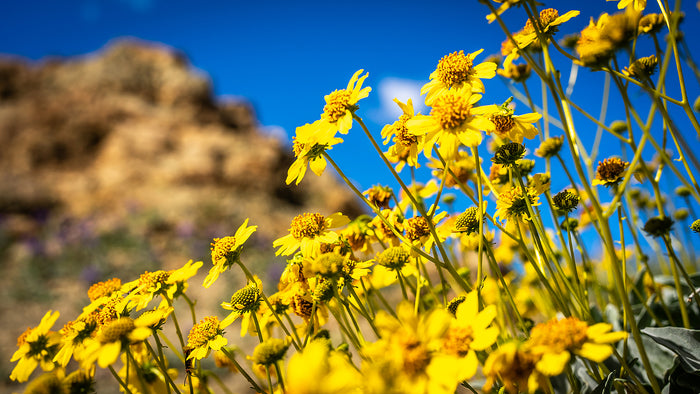
Brittlebush
Silver leaves and bright yellow flowers make this a familiar desert shrub.
Meet this plant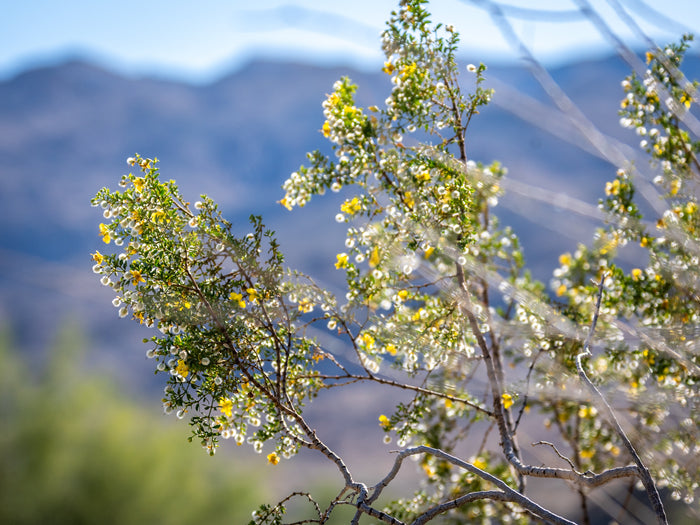
Creosote Bush
Small resinous leaves and yellow flowers belong to one of the desert’s defining shrubs.
Meet this plant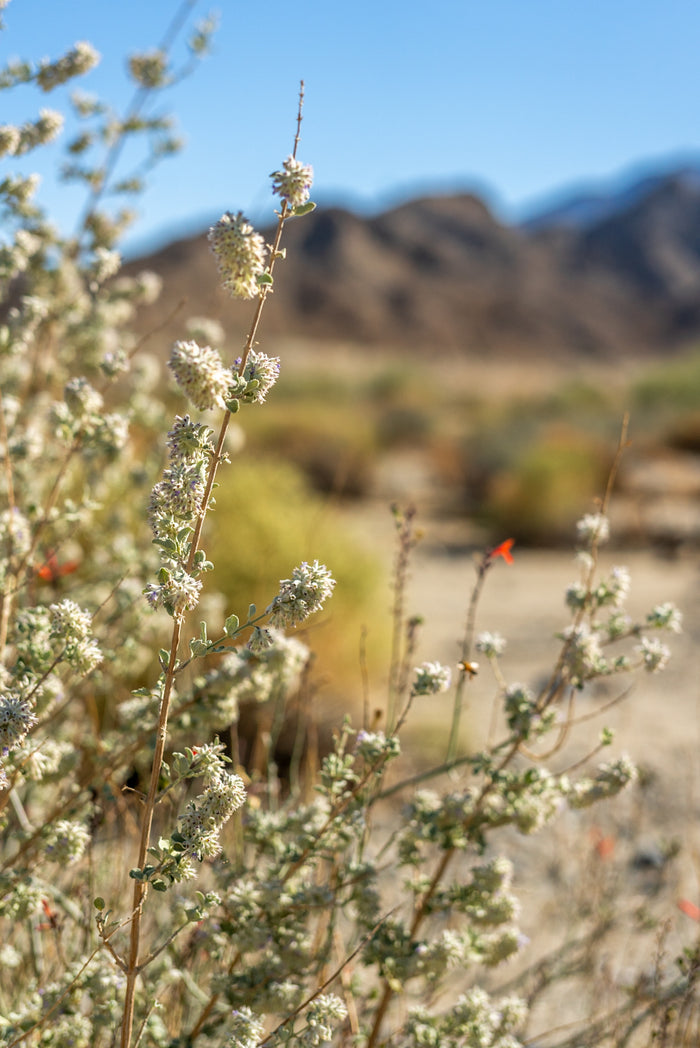
Desert Lavender
Pale purple flowers and soft gray foliage distinguish this aromatic desert shrub.
Meet this plantFollow the story outside.
Bighorn Sheep of the Coachella Valley
Discover the bighorn sheep that share this landscape and the desert plants connected to their lives.
Read the story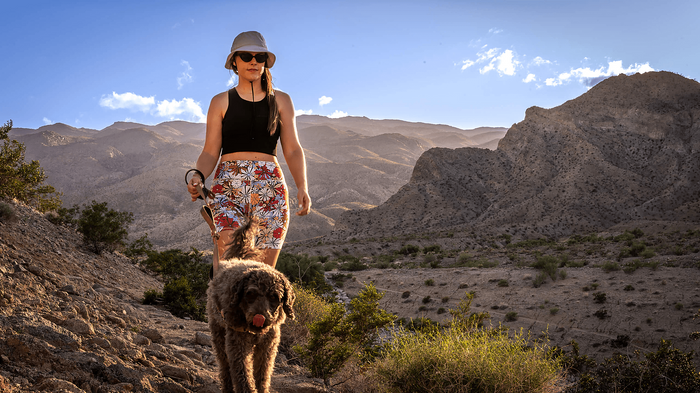
La Quinta Cove Hiking Trails: Three Routes and What to Know Before You Go
Take the plant guide into the landscape with a closer look at the trails around La Quinta Cove.
Read the story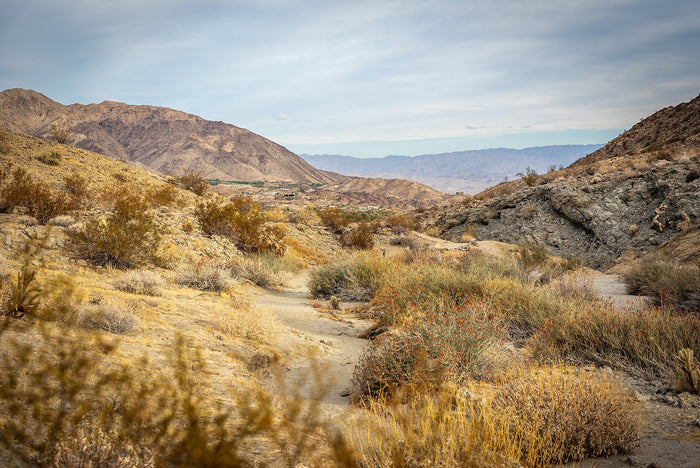
Hiking in Palm Desert: Trails, Views & Safety Guide
Continue exploring Palm Desert’s trails, open views and the outdoor spaces just beyond town.
Read the story