How Dates Built the Coachella Valley
From Imported Palms and Desert Agriculture to Shields and the National Date Festival

Before the Coachella Valley became known for resorts, golf courses and festivals, one of its most recognizable landscapes was agricultural: long rows of date palms lifting feathery crowns above the desert floor.
The trees were newcomers, imported from North Africa and the Middle East during an era of ambitious agricultural experimentation. Yet the industry they created became deeply local. Growers learned which varieties could survive the valley’s extreme climate. Water districts and irrigation systems made commercial orchards possible. Skilled workers climbed, pollinated, thinned, protected and harvested the fruit by hand. Roadside stands turned a crop into an attraction, while Indio made the date a centerpiece of its public identity.
This is how an ancient fruit helped build a modern desert economy—and how the work behind it is still visible in the valley today.
- Date palms are not native to the Coachella Valley; federal plant explorers and private growers imported selected varieties around the turn of the 20th century.
- The hot, dry growing season suited the fruit, but groves depended on reliable irrigation and intensive human labor.
- Commercial date palms are hand-pollinated, thinned, protected and harvested through repeated trips into the crown.
- Medjool and Deglet Noor became the best-known varieties, while smaller farms still preserve rarer cultivars.
- Shields Date Garden turned cultivation into roadside theater; the date shake carried the crop into popular culture.
- Indio’s date festival transformed a harvest celebration into a lasting civic identity.
Before the date palm
The valley was not an empty desert waiting for imported agriculture. It lies within the homelands of Cahuilla peoples, whose lives were shaped by desert springs, native plants and seasonal movement long before commercial farms appeared. The native California fan palm, Washingtonia filifera, already grew around desert oases. Its broad, fan-shaped leaves are visually different from the long, featherlike fronds of the cultivated date palm, Phoenix dactylifera.
That distinction matters. The rows of date palms now associated with Indio, Coachella, Thermal and La Quinta are a twentieth-century agricultural landscape layered onto a much older human and ecological one.
An imported crop finds an American desert
Date palms had been cultivated for thousands of years in the Middle East and North Africa when American agricultural explorers began looking for promising crops abroad. Seeds could produce new palms, but they could not reliably reproduce a prized variety. The valuable cargo was therefore living plant material: offshoots cut from selected palms, packed for long travel and replanted in the Southwest.
Experiments took place in several hot regions. The Coachella Valley offered the rare combination date fruit requires: a long, intensely hot season, low humidity and access to irrigation. Private importer Bernard Johnson brought offshoots from Algeria in 1903 and returned with much larger shipments in the following decade. Government scientists, nurseries and growers tested varieties, propagation methods and handling practices. By the 1910s, the experiment was becoming an industry.
The story was international from the beginning. The biological material and much of the cultivation knowledge came from communities where date culture was ancient. The valley’s growers adapted those traditions to local soils, water systems, markets and labor conditions.
The Medjool survival story
The Medjool’s American history is especially dramatic. In 1927, a small group of offshoots from the Boudnib oasis in Morocco arrived under quarantine because disease threatened North African groves. Nine survived. After years of observation, the palms were moved to a federal station near Indio in 1934, where their offshoots could be propagated.
That slow process explains why date varieties are living inheritances. A Medjool seed does not grow into a genetic copy of its parent. To preserve the variety, growers cultivate offshoots—or use modern tissue culture—so the next palm is a clone. Every established grove therefore represents years of propagation, selection and care.
Imported offshoots and field trials show that selected date varieties can thrive in the Southern California desert.
Local farmers and residents organize the Coachella Valley County Water District as groundwater levels become a growing concern.
A community celebration of the date harvest begins the tradition that will grow into Indio’s signature fair.
Floyd and Bess Shields establish Shields Date Garden in Indio.
The date milkshake is generally credited to Russell Nicoll’s Valerie Jean Date Shop south of Thermal.
Surviving Moroccan Medjool palms are transferred to the federal date station near Indio for propagation.
The harvest celebration becomes an annual county fair and National Date Festival tradition.
The Coachella Canal is completed in 1948; the first Colorado River water deliveries arrive the next year.
Water came before the canal
The earliest commercial groves did not begin with Colorado River water. Farmers initially depended heavily on wells and artesian groundwater. By the 1910s, falling groundwater levels were already alarming enough to help spur creation of the local water district in 1918. The district pursued imported water for decades before the Coachella Canal was completed in 1948 and delivered its first water in 1949.
The canal changed the scale and security of valley agriculture, but it did not make the date palm a low-water crop. A palm may look perfectly suited to drought, yet producing marketable fruit requires deliberate irrigation. Modern research in Coachella and Imperial Valley orchards continues to measure how water use changes with soil, canopy, variety, salinity and irrigation method.
The central paradox: date palms need heat and dry air above ground, but dependable water at their roots.
The work behind every bunch
A date grove is not a plant-it-and-forget-it orchard. Male and female flowers grow on separate palms, and commercial production depends on people transferring pollen to the female flowers. As fruit develops, workers thin the strands so the remaining dates have room to grow. Bunches may be tied down and covered to protect them from birds, insects, dust and fruit drop. Harvest can require several passes because the fruit does not always ripen at once.
Many of the specialists who perform this work are known as palmeros. Labor journalist and photographer David Bacon has documented Mexican immigrant and Indigenous Purépecha crews doing this highly skilled, physically demanding work in Coachella Valley groves. Hydraulic lifts have replaced ladders in many orchards, but workers still operate among thorns, heavy bunches, extreme heat and elevated crowns.
Explore a year of work in the crown
Follow the palms from winter cleanup to the final harvest. Select any stage to see what workers do and why it matters.
Prune and prepare
Crews remove old fronds and dangerous thorns, clear the crown and prepare access for the repeated climbs ahead.
Why it matters: The work creates a safer, cleaner path to the flowers and developing bunches.
Two famous varieties—and a much bigger family
Find your date
Select a variety to compare its character, history and best-known uses.
Medjool
The dominance of Medjool and Deglet Noor can make the crop look less diverse than it is. Older roadside stands once offered broad assortments to visitors and mail-order customers. Today, preserving a rare cultivar means keeping living palms and their offshoots in production. Once the last tree of a named variety disappears, its exact genetics cannot be recovered from a pit.
When the orchard became the attraction
Growers were not only cultivating an unfamiliar fruit; they had to teach Americans what it was and persuade them to buy it. Date stands appeared along routes such as Highway 111 with samples, gift boxes, mail-order catalogs and an intentionally exotic visual language. Some marketers borrowed romanticized “Arabian” imagery that said more about American tourism than it did about the real cultures whose agricultural knowledge made the industry possible.
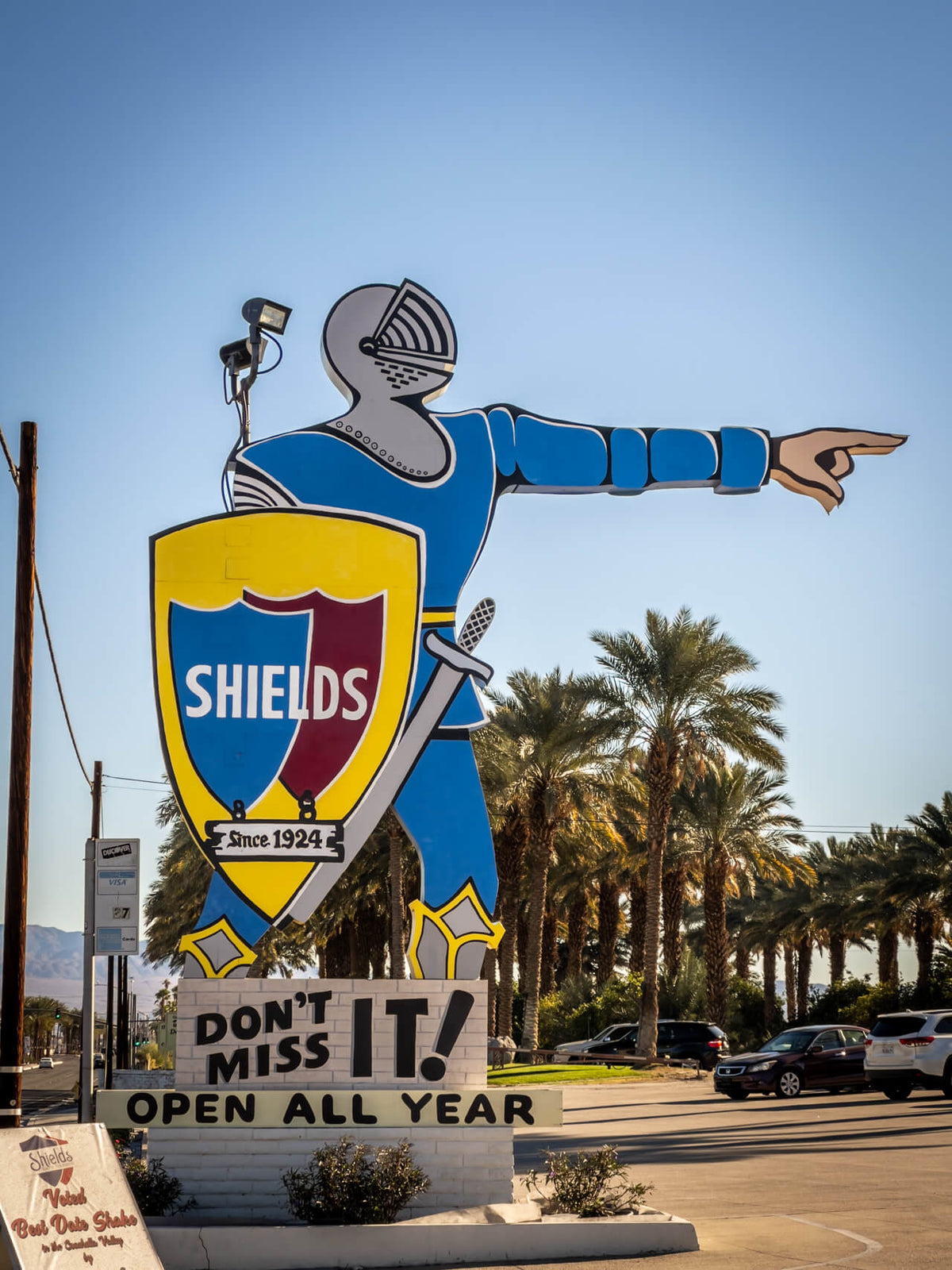
Floyd and Bess Shields opened Shields Date Garden in Indio in 1924. Floyd’s talks about palm reproduction developed into a recorded presentation, and the Romance Theatre opened in 1951. Its famously provocative title, The Romance and Sex Life of the Date, was clever roadside advertising—but the subject was real horticulture: separate male and female palms, hand pollination and the patient work of producing fruit.

The date shake becomes the valley’s drink
Shields is inseparable from modern date-shake culture, but it is not generally credited with inventing the drink. Most accounts trace the first date milkshake to Russell Nicoll’s Valerie Jean Date Shop south of Thermal around 1930. The idea was simple and perfectly suited to roadside travel: blend the valley’s intensely sweet crop into a cold, familiar American milkshake.
Shields helped popularize its own version through date crystals, a shelf-stable date product Floyd developed in the 1930s that could be turned into a smooth base for shakes. The drink did something boxes of fruit could not. It made the valley’s agricultural identity immediate, portable and memorable. A visitor did not have to understand pollination or irrigation to remember the taste.
How Indio became the City of Festivals
A local harvest celebration began in 1921 and evolved into the annual Riverside County Fair and National Date Festival by 1947. The event gave growers a showcase and helped shape Indio’s identity as the City of Festivals. Exhibits, food, rides, performances and pageantry turned a farm product into a shared regional symbol.
The festival’s long-running “Arabian Nights” architecture and entertainment reflected the same romanticized marketing once used by date stands. That imagery should be understood as an American promotional invention, distinct from the actual North African and Middle Eastern histories behind the imported palms. The crop’s real story is more interesting: plant exploration, global exchange, agricultural science, irrigation and the labor of local families and workers.

What remains of the date landscape
Urban growth has removed many of the groves that once lined valley roads, yet dates have not become a museum crop. Commercial orchards remain active, and places such as Clarke Ranch at Point Happy preserve pieces of the valley’s agricultural landscape. Smaller farms protect uncommon varieties. Researchers maintain genetic collections and study irrigation, disease and climate. Shields still combines a working grove, retail counter, garden and theater. The National Date Festival still gathers the region around a harvest identity more than a century old.
The best place to understand that history may be between destinations: a row of palms behind a wall, a white bag tied around a heavy bunch, a roadside sign promising a shake. Each is evidence of the system that built the industry—imported plants, local water, patient propagation, skilled labor and imaginative selling.
From the groves to the wider economy: Explore where the Coachella Valley’s money comes from and how today’s agriculture fits alongside tourism, healthcare, construction and seasonal residents.
Frequently asked questions
Are date palms native to the Coachella Valley?
No. The cultivated date palm, Phoenix dactylifera, was imported from the Middle East and North Africa. The California fan palm, Washingtonia filifera, is native to Southern California desert oases and is a different species.
Why do dates grow so well in the Coachella Valley?
The fruit needs a long, hot growing season, low humidity and dependable irrigation. The valley provides the heat and dry air; wells and later the Coachella Canal supplied water to the root zone.
Who invented the date shake?
Most historical accounts credit Russell Nicoll of the former Valerie Jean Date Shop south of Thermal, around 1930. Shields Date Garden later became one of the best-known places to drink one and developed date crystals for a smooth shake base.
Do date palms have to be pollinated by hand?
For dependable commercial production, yes. Male and female flowers grow on separate palms, and workers apply collected pollen to the female flowers rather than relying only on wind.
What is the difference between Medjool and Deglet Noor dates?
Medjools are generally larger, softer and darker. Deglet Noors are usually smaller, amber-colored and semisoft. Both are major commercial varieties, but the date-palm family includes many less common cultivars with distinct textures and flavors.
Sources and further reading
- USDA Agricultural Research Service: Dates to Remember — crop origins, early California plantings and genetic conservation.
- USDA ARS Image Gallery: Coachella Valley date planting — featured-image caption and credit.
- Glenn C. Wright: The Commercial Date Industry in the United States and Mexico — importations, varieties and industry development.
- Coachella Valley Water District: Groundwater and imported water — early wells and district history.
- Coachella Valley Water District: Water sources — Coachella Canal construction and deliveries.
- UC Agriculture and Natural Resources: Date-palm irrigation research — modern orchard water studies.
- Agricultural Marketing Resource Center: Dates — cultivation, pollination, harvesting and markets.
- UC Davis: Harvesting and postharvest handling of dates — ripening stages, bunch protection and cultivar differences.
- Barn Raiser: Date-palm workers in the Coachella Valley — reporting and photography on palmeros and harvest labor.
- FoodPrint: Preserving heirloom date varieties — offshoot propagation, living collections and small farms.
- Coachella Valley History Museum — date-industry and regional agricultural exhibits.
- Shields Date Garden: History and visitor experience and Romance Theatre — Shields’ institutional history.
- Coachella Valley Independent: A Century of Dates — reporting on Shields’ Blonde date, date crystals and palmeros.
- Imbibe: History of the date shake — Russell Nicoll, Shields and roadside drink culture.
- Greater Coachella Valley Chamber: National Date Festival history — the 1921 celebration and annual fair tradition.
- National Park Service: Desert oases — the native California fan palm.
Research checked September 7, 2026. Historical synthesis based on the linked sources; no original interviews are implied.