American Kestrel
Falco sparverius
Translation missing: en.doi_bird.notes.american_kestrel
- Bird group
- Raptors & owls
- Where to look
- Translation missing: en.doi_bird.places.american_kestrel
- Explore the region
- Coachella Valley bird guide
What to notice
- Small falcon with two dark vertical facial stripes.
- Female: reddish-brown wings, streaked breast and a finely barred tail.
- Male: slate-blue wings contrasting with a rusty back.
Where to look
Open fields, desert edges and roadside perches around Thermal.
When to look
Recorded here in October. Seasonal movements vary; a single sighting does not establish year-round presence at this field.
Next time you are outside
Scan exposed wires and posts; watch from a safe distance for a change of perch or a drop toward the ground.
Record a sightingHabitat guidance is not a guaranteed sighting. Photographs may have been taken outside the valley.
Through the lens.
Select any photograph for a closer look. Move through the gallery with the arrows or a swipe.
This is a regional bird guide; photographs may also come from places beyond the valley. Locations are noted when available.
Know what to notice.
A small falcon on a roadside wire can be easy to overlook until it turns its head. The hooked bill, dark facial stripes and intent gaze reveal a hunter. The American Kestrel (Falco sparverius) brings that combination of delicate size and predatory focus to the Coachella Valley’s open country.
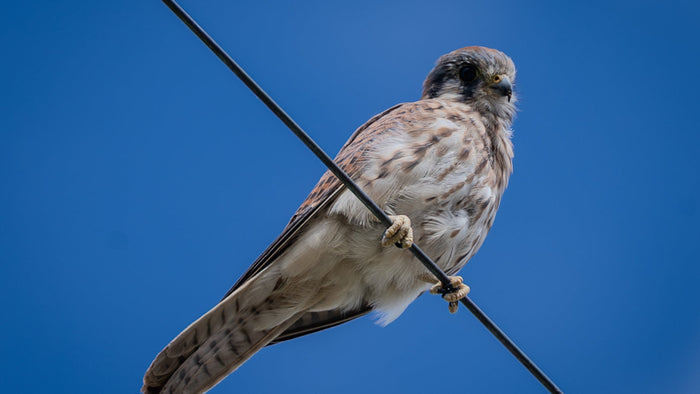
Photographed by Mark Miller in the agricultural fields of Thermal on October 23, 2026. The bird shown here is a female: warm brown wings, streaked underparts and a tail crossed by narrow dark bands distinguish her from the blue-winged male.
How to recognize an American Kestrel
North America’s smallest falcon is roughly the size of a Mourning Dove, with a relatively large head, narrow pointed wings and a long tail. Two dark vertical marks on each side of the face are particularly useful when the bird is perched.
- Female: reddish-brown wings and back, a barred tail and streaked breast.
- Male: slate-blue wings contrasting with a rusty back; the reddish tail has a broad dark band near its tip.
- In flight: look for pointed wings and a slender outline. A bird holding nearly stationary over a field on beating wings is worth a closer look.
Reading the bird in this photograph
The wire gives this female a clear perch above the field. Her yellow toes grip it while her head faces outward; the pale underside makes the brown streaking easy to see. The blue sky isolates her outline, showing how long the tail is relative to the body. These visible details support identification without relying on size alone.
Where to look around the valley
Open ground matters more than remoteness. Kestrels use farmland, desert edges, grasslands and other places with low vegetation and elevated perches. In the Thermal landscape, scan wires and posts beside fields before looking farther away. This October photograph documents one local encounter; it does not establish how many kestrels use a particular field or whether this individual stays all year.
Different populations have different seasonal movements. Northern birds migrate, while some farther south remain resident. Repeated observations are more useful than a single sighting for learning the pattern at a particular location.
A patient hunter above the fields
A kestrel can watch from a perch, then drop toward prey and grasp it with its feet. Where a suitable perch is absent, it may hover into the wind while searching below. Large insects are important food, along with small mammals, birds and other small animals. The photograph captures a perched bird; it does not show a hunt or identify what she was eating.
Nesting and conservation
Kestrels use existing cavities rather than excavating their own. Natural hollows, old woodpecker holes and suitable nest boxes can provide nesting sites. Open feeding habitat alone is therefore only part of what a breeding pair needs. Loss of cavities and prey, along with pesticide exposure, are conservation concerns even for this widespread falcon.
Kestrel, shrike or larger hawk?
A Loggerhead Shrike can also watch from a wire, but has a broad black eye mask and a gray, black and white pattern. A Red-tailed Hawk is much bulkier, with broad wings. The kestrel’s paired face stripes, rusty plumage and compact falcon shape are the better clues here.
Watching and photographing respectfully
Observe from a safe, permitted location and let the bird choose its perch. Keep roads, farm entrances and equipment routes clear. If approaching changes the bird’s behavior, give it more space. A quiet, distant view often reveals more than repeatedly following a bird from post to post.
Explore the next step in our illustrated story, The Tiny Falcon Above the Fields: How American Kestrels Hunt, with original photographs and an interactive comparison of perch hunting and hovering.
Sources
Cornell Lab: identification · Cornell Lab: life history · Audubon: range and behavior. Local photograph and observation: Mark Miller, October 23, 2026.
Another bird to discover.
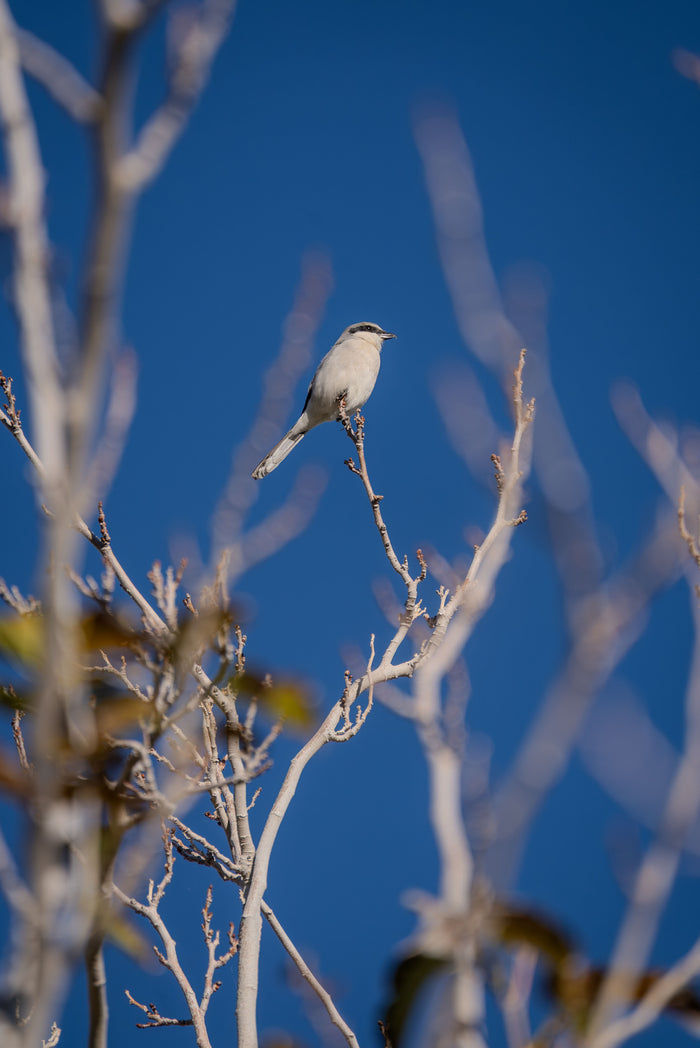
Loggerhead Shrike
A gray songbird with a bold black face mask, scanning for prey from exposed perches.
Meet this bird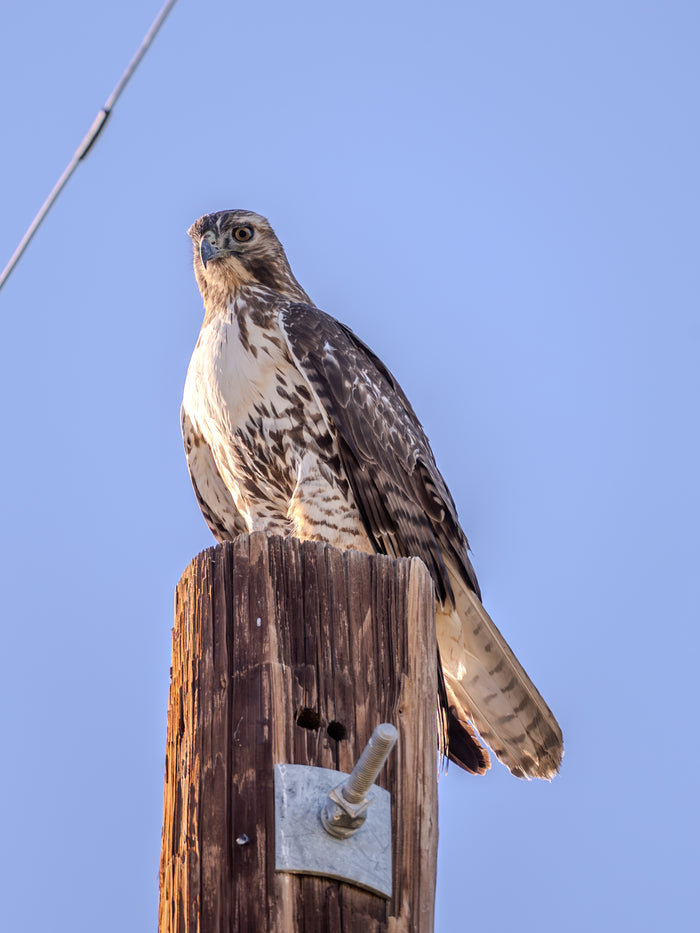
Red-tailed Hawk
Broad wings and, in adults, a reddish upper tail; often watches from a high perch.
Meet this bird