The History of Seven Lakes: Palm Springs Modernism, Golf and Presidents
How a 1960s condominium community united modern homes, golf, lakes and presidential history in one complete Palm Springs environment.

On February 6, 1968, Dwight D. Eisenhower stepped onto the 13th tee at Seven Lakes in Palm Springs and struck the only reported hole-in-one of his life. The shot became the community’s most famous moment, but the history surrounding it is even larger.
Seven Lakes was an early experiment in Palm Springs fairway living—a complete environment in which modern homes, an executive golf course, lakes, pools, greenbelts, a William F. Cody clubhouse and mountain views were designed to function together. More than six decades later, that complete idea remains visible across the approximately 120-acre community.
- A 1960s beginning: Development started in 1964, and the 18-hole executive golf course opened in January 1965.
- A coordinated design team: Richard A. Harrison designed the residences, William F. Cody the clubhouse, Hugh Kaptur the 1975 gatehouse, Ted Robinson the course and David Hamilton the landscape.
- An early housing model: Palm Springs staff identifies Seven Lakes as the first local residential condominium development planned around a golf fairway.
- Presidential history: Eisenhower made his only reported ace here; 12 days later, he played Seven Lakes with President Lyndon B. Johnson.
- Preservation update: The September 1, 2026 board recommendation is confirmed. This October 17 review has not verified subsequent City Council approval.
Where Is Seven Lakes, and Can You Visit?
Seven Lakes sits in the Melody Ranch area of south Palm Springs, west of South Gene Autry Trail. Its entrance is on East Seven Lakes Drive, and the club lists its address as 1 Desert Lakes Drive. The fairways, lakes and low buildings form a residential setting rather than a public park.
The club’s guest policy asks visitors to arrange access with their resident or member host and check in at the gate. A visit to a home, a clubhouse invitation and golf privileges are different arrangements. Confirm the details with your host or the club before arriving; do not assume the course or clubhouse is open for walk-in sightseeing.
For the surrounding area, explore the DOI regional map or read the history of Palm Springs. The map helps connect nearby places; it does not grant access to Seven Lakes.
A Community Built Around the Fairway
By the 1950s and early 1960s, the Coachella Valley was becoming nationally known for winter golf, resort life and modern architecture. The country club was changing with it. A golf course could be more than a place beside the homes; it could become the open landscape around which the homes were organized.
Golf developer Johnny Dawson helped advance this model across the desert. His influence reached Thunderbird, Eldorado, La Quinta, Seven Lakes and Marrakesh. The wider story continued through later developers such as Sunrise Company, whose role in expanding the Valley’s shared-amenity lifestyle is explored in How Sunrise Company Defined the Coachella Valley Lifestyle.
Seven Lakes stands near the beginning of that evolution. City preservation staff describes it as the first golf-course condominium development in the Palm Springs area and the first local residential condominium project planned around a fairway. The distinction matters. Golf communities already existed, but Seven Lakes assembled condominium ownership, distributed resort amenities, low-rise modern homes and a course-centered landscape into an unusually early and cohesive form.
How Tribal Lease Law Opened South Palm Springs
Seven Lakes began on allotted Agua Caliente tribal lease land. That history is essential to understanding why large developments spread across south Palm Springs when they did.
Earlier lease limits had discouraged projects that required decades to finance and build. The Indian Long-Term Leasing Act of 1955 expanded allowable terms, and federal legislation signed in 1959 permitted certain tribes—including the Agua Caliente Band of Cahuilla Indians—to enter leases lasting up to 99 years. Palm Springs staff concluded that the new framework helped make projects such as Seven Lakes practical.
A land lease conveyed the right to use and occupy land; it did not erase tribal ownership, sovereignty or the federal rules governing trust land. That broader history should also be read within the much longer story of the Cahuilla people and their homeland, without treating the history of one Palm Springs parcel as the history of every tribal landholding.
Seven Lakes Opens in the 1960s
Development began in 1964. Ted Robinson’s 18-hole executive course opened in January 1965, and the first residences were offered later that year. Construction continued in phases into the early 1970s. Hugh Kaptur’s gatehouse arrived in 1975, completing another defining part of the entrance experience.
The 341 units are spread among 147 residential structures: 139 duplex buildings and eight two-story buildings. That distinction helps explain the low density. Much of the interior experience belongs to fairways, paths, lakes and greenbelts rather than roads and parking.
- 1964Development begins during a pivotal period for Palm Springs condominiums and fairway-oriented housing.
- January 1965The executive golf course opens; initial residential sales follow several months later.
- 1964–1972The primary residential community is built in phases.
- 1975Hugh Kaptur designs the modern gatehouse, closing the proposed period of historical significance.
Five Designers, One Complete Environment
Seven Lakes is sometimes reduced to a single famous architect. Its real strength is collaboration. Five professionals shaped different parts of the community, and their work gains meaning from the way those parts connect.
Richard A. Harrison
Residences
Harrison designed the one-story garden homes and later two-story buildings. Flat roofs, clerestory windows, atriums, patterned shadow block and walls of glass kept the architecture low while opening it toward the course.
William F. Cody
Clubhouse
Cody designed the clubhouse as the social and architectural hinge of the community. Its horizontal wings, double-height center, post-and-beam structure, slump stone and course-facing glass connected indoor club life with the landscape.
Hugh Kaptur
Gatehouse · 1975
Kaptur’s 1975 gatehouse extended the modern identity to the community threshold through low massing, broad eaves, recessed lighting, glazing and a polished-concrete desk element.
Ted Robinson
Executive golf course
Robinson designed the executive course, identified by city staff as his first desert course. Recessed fairways, irregular bunkers, contoured greens, curving paths and seven water hazards made golf part of the scenery.
David Hamilton
Landscape
Hamilton is credited with the integrated landscape: palms, olive and citrus trees, greenbelts, curving paths and irregular lakes positioned to reflect the mountains. His work created the transitions that allow Seven Lakes to read as an oasis rather than a collection of buildings.
Architectural credits follow the city’s historic-resources report and the club’s official history. Further references appear in the source notes below.
Why the Homes Look Different
Seven Lakes is commonly called Midcentury Modern. A more precise description is International Style–influenced residential architecture within Palm Springs’ broader Desert Modernist tradition.

The one-story homes use long rooflines, minimal decoration, courtyard or atrium entries, clerestories and large panes of glass. Shadow-block walls filter sun and create privacy while casting changing patterns across paths and patios. Some floor plans integrate carports, and deep overhangs help control direct desert light.
The later two-story buildings remain horizontal rather than tower-like. Open balconies, breezeways, exposed stairs, integrated planters and rounded-square wall openings repeat the geometric vocabulary at a larger scale.
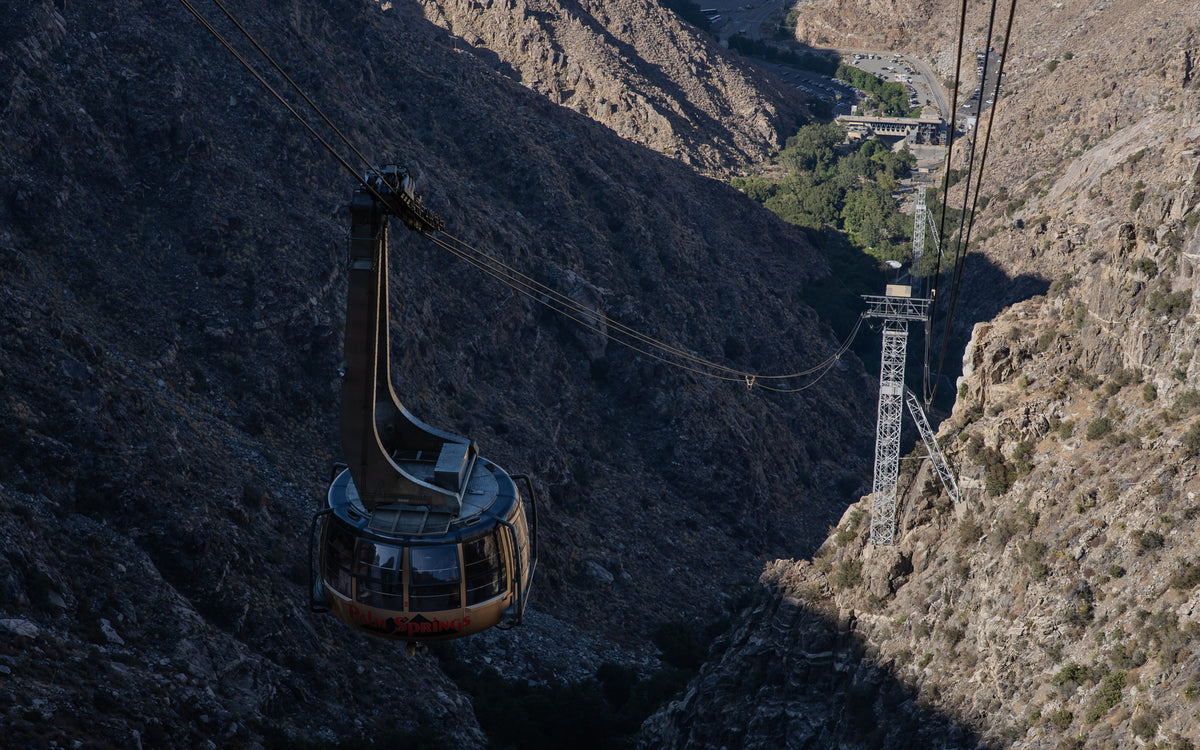
Most important, the homes rarely compete with the horizon. Their low profiles preserve the mountain line, while glass and clerestories draw green space and sky into the interiors. It is the same regional conversation between engineering, architecture and landscape seen in landmarks such as the Palm Springs Aerial Tramway, expressed here at residential scale.
The Lakes, Pools and Greenbelts Were Part of the Architecture
At Seven Lakes, the spaces between buildings are not leftover land. They are part of the design.
More than 30 percent of the site was dedicated to green space. Fairways were lowered by approximately three to four feet in places, preserving views from the homes. Seven biomorphic lakes created water hazards while reflecting the surrounding mountains. Curving pedestrian and cart paths linked the architecture to a landscape of palms, citrus, olive trees and broad greenbelts.
The community also distributed recreation close to the residences. The historic study documents 15 pool-and-ramada resources, including long, low shade structures, changing areas, showers and, in some locations, outdoor kitchens, shuffleboard or saunas. Rather than forcing every resident to gather at one central pool, the plan allowed the entire property to function like a resort campus.
Eisenhower’s Lucky 13
Seven Lakes’ best-known moment arrived on February 6, 1968. Former President Dwight D. Eisenhower, then 77, played the 104-yard 13th hole with a 9-iron and recorded the only reported hole-in-one of his life.

The event became part of the physical memory of the club. A commemorative plaque marks the hole, Eisenhower memorabilia has been displayed in the clubhouse, and the story has appeared in architectural tours and anniversary events. The shot is more than a celebrity anecdote because the place continues to preserve and interpret it.
The Day Two Presidents Played Seven Lakes
Twelve days after Eisenhower’s ace, presidential history returned to the course. On February 18, 1968, President Lyndon B. Johnson and Lady Bird Johnson visited Dwight and Mamie Eisenhower at their Palm Desert home. Johnson and Eisenhower discussed the Vietnam War, then the two presidents played Seven Lakes. Johnson later held a press conference near the 18th green for the White House press corps.
A recorded telephone conversation from February 19 confirms that the round occurred the previous day. Eisenhower recounted his recent ace, while Johnson joked about losing most of their holes.
The surviving record does not support turning the outing into a secret summit or claiming a specific war decision was made on the course. Its importance is subtler: a private leisure landscape in Palm Springs briefly became a setting where a sitting president and a former president discussed one of the defining issues of the era.
From Tribal Lease Land to Fee Ownership
Seven Lakes’ land story changed again decades after its opening. Major acquisitions completed in 2009 and 2014 converted the community from tribal lease land to fee-simple ownership.
That transition should be described as a change in ownership structure, not as the correction of a defective arrangement. Long-term Agua Caliente leases were a lawful and historically significant foundation for development across Palm Springs. The later purchases are another chapter in the same property history.
The Historic-District Proposal: What Is Confirmed
The Seven Lakes Homeowners Association filed its application for local historic-district designation on November 24, 2025. The proposed period of significance runs from 1964 through 1975, covering the original development, primary residential build-out and Kaptur gatehouse.
On September 1, 2026, the Palm Springs Historic Site Preservation Board recommended designation. That is the latest decision verified for this article as of October 17, 2026. The board’s recommendation and a final City Council designation are separate actions; this review has not verified a later council resolution.
The application received support from 246 of 341 units, or 72 percent. The historic study identifies 205 residential units and 29 of 34 nonresidential resources as contributing. A contributing resource retains enough historic character to help communicate the district’s period and design; the term does not mean a home is untouched, nor does “noncontributing” mean a property lacks value.
Palm Springs staff concluded that the proposed district qualifies because of its associations with Eisenhower and Johnson, its connection to postwar resort development and condominium living, the work of master designers, and its identity as a distinguishable whole.
If the City Council ultimately designates Seven Lakes, certain exterior alterations, demolition and new construction would receive added preservation review. Ordinary maintenance, many interior projects and appropriate like-for-like replacement are generally exempt, subject to city and HOA requirements. Designation would not freeze every interior, individually landmark every unit, automatically place the property on the National Register or guarantee a change in property values.
Another Window Into the Past: Seven Lakes on Film
Architecture is easier to understand when you can see the surrounding landscape as it once was. Deserted Films reports acquiring a 1970 home movie showing Seven Lakes from Southridge Road in the Rimcrest neighborhood. Its events archive includes an animated excerpt and describes a January 2026 presentation to the Seven Lakes community.
See the archival excerpt on Deserted Films in the “Past Events in 2026” section. Look for the January 18 Seven Lakes entry. The distant view offers a different perspective from today’s architectural illustrations.
Why Seven Lakes Still Matters
Seven Lakes helped turn fairway living into a recognizable Palm Springs lifestyle. It joined a comparatively new form of condominium ownership with resort recreation, modern architecture and a golf course that doubled as shared scenery.
The community was designed to make its architecture recede while mountains, water and fairways took center stage. That relationship still survives. Seven Lakes’ strongest claim to history is not one house, one clubhouse, one golf shot or even one presidential visit. It is the continued presence of the complete idea. For the wider context, continue with how the Coachella Valley became a golf capital.
Frequently Asked Questions
When was Seven Lakes Golf & Country Club built?
Development began in 1964. The executive golf course opened in January 1965, residential sales followed later that year, and primary construction continued into the early 1970s. Hugh Kaptur designed the gatehouse in 1975.
Who designed Seven Lakes in Palm Springs?
Richard A. Harrison designed the residences, William F. Cody designed the clubhouse and Hugh Kaptur designed the gatehouse. Ted Robinson designed the executive golf course, and David Hamilton is credited with the landscape.
Did Dwight Eisenhower make a hole-in-one at Seven Lakes?
Yes. On February 6, 1968, Eisenhower made his only reported hole-in-one on the 104-yard 13th hole using a 9-iron.
Is Seven Lakes an official Palm Springs historic district?
The latest decision verified for this article is the September 1, 2026 Historic Site Preservation Board recommendation. Final local designation requires separate Palm Springs City Council action. As of this October 17, 2026 review, a later council approval has not been verified; the board recommendation alone is not final designation.
Is Seven Lakes on fee land or lease land?
Seven Lakes was originally developed on Agua Caliente tribal lease land. Land acquisitions completed in 2009 and 2014 converted the community to fee-simple ownership, according to the Palm Springs staff report.
Sources and Further Reading
Reviewed October 17, 2026. The preservation discussion distinguishes the verified September 1 board recommendation from final City Council action. Architectural credits follow city records and the club’s official history. Dates below identify the cited record or event, not the date every source page was published.
- City of Palm Springs: Seven Lakes HSPB staff report and draft resolution — September 1, 2026
- City of Palm Springs: Seven Lakes historic-resources application
- City of Palm Springs: Historic Site Preservation Board records
- Seven Lakes Golf & Country Club: Official history, location and guest policy — accessed October 17, 2026
- Palm Springs Life: Lucky 13
- Bureau of Indian Affairs: Palm Springs Agency
- National Museum of the American Indian: Agua Caliente leasing history
- Presidential Recordings Digital Edition: Johnson and Eisenhower, February 19, 1968
- Palm Springs Municipal Code: Historic district review
- USModernist: William F. Cody archive
- American Society of Golf Course Architects: Ted Robinson
- Modernism Week: official October 15–18, 2026 program — accessed October 17, 2026
- Deserted Films: Past Events in 2026, January 18 Seven Lakes entry and 1970 home-movie excerpt — accessed October 17, 2026