

























Daft Punk’s Coachella Pyramid: Why One Set Still Matters
Inside the music, stage design and lasting influence of the duo’s 2006 performance in Indio.

Two robots. One illuminated pyramid. A set that people are still discussing twenty years later.
Daft Punk’s 2006 Coachella performance is often remembered as a spectacular reveal. What makes it worth returning to is how completely the music, stage design and performers belonged together.
The pyramid was the image people carried away. The deeper story is about building a live experience with a clear identity—and the Indio festival that became its first stage.
- The debut: Daft Punk introduced the pyramid show in Coachella’s Sahara tent on April 29, 2006.
- The idea: Music, visual design and robot personas formed one coordinated performance.
- The distinction: The later Alive 2007 album was recorded in Paris, not at Coachella.
One night in Indio
On April 29, 2006, Daft Punk brought a new stage show to Coachella's Sahara tent. Thomas Bangalter and Guy-Manuel de Homem-Christo appeared above the audience inside an illuminated pyramid, their robot helmets making them recognizable even at a distance. The performance became one of the festival's defining memories. [1]
The appeal of the story is easy to understand: a surprising stage appears, a crowd responds, and a concert acquires a life far beyond the people who attended. But remembering only the shape misses much of what made the show work.
The pyramid gave the performance a center. The music gave it movement. The robots made the whole thing feel like a world with its own rules.
For the wider story of the festival that hosted it, start with our history of Coachella. This is a closer look at one of its most influential nights.
Daft Punk already had a visual world
The pyramid did not arrive without a history behind it. Daft Punk had spent years making music, films, videos and costumes part of the same creative identity.
A contemporary FADER feature, republished in 2013, traced that approach through the robot personas, the animated film Interstella 5555 and the live-action Electroma. In the interview, Bangalter described a broader creative universe around the music. The stage show belonged to that same project. [2]
This matters because a costume alone is a surface. A recognizable visual language can do more: it can carry from an album to a video to a stage without needing a new explanation each time.
The robots brought that continuity to Coachella. Their faces were concealed, yet the characters were unmistakable. The audience did not need a close-up of an expression to recognize who was performing.
Who created the pyramid show?
In a 2007 Pitchfork interview, Bangalter credited the overall concept to the duo working with Cédric Hervet and Daft Arts' Paul Hahn, with Martin Phillips joining as lighting designer. He said production began in early 2006 for Coachella and was upgraded in 2007. [3]
That is a useful corrective to the idea of a single object appearing fully formed. The memorable result depended on a team connecting sound, light, stage structure and performance.
Phillips later told Water & Music that the breakthrough was how existing equipment was assembled and used. LED panels, light tubes and pixel curtains became components of a larger design. The pyramid's surfaces could carry mapped imagery, while the surrounding light structure extended the composition across the stage. [1]
A new combination can be more consequential than a new individual part. Here, familiar production tools supported a form simple enough to remember after one glance.
Why the shape worked
My reading of the design starts with its clarity. A pyramid has a strong outline. It gives your eye somewhere to land before the lights start changing.
That fixed geometry also gives movement something to push against. A pattern can travel across the surface, disappear or return, while the underlying form stays legible. The object holds the picture together as its appearance changes.
For a large audience, that is powerful. A subtle expression may be lost from the back of a tent. An illuminated triangular form can communicate at a much greater distance.
The placement of the performers matters as well. The two figures become part of the structure rather than standing in front of it as a separate element. The stage reads as a single scene: performers, architecture and light.
It is a principle that reaches beyond concert production. In a photograph, a strong arrangement often does more than a collection of individually interesting things. The relationship among the parts is what makes the image hold.
The music was rebuilt for the room
The visual centerpiece would have meant much less without a musical structure strong enough to support it.
Bangalter described a precise show with room to manipulate musical patterns and loops within fixed cues. It combined planning with performance rather than treating those as opposites. [3]
The later Alive 2007 album makes the approach especially easy to hear. Its official track list pairs material such as “Robot Rock / Oh Yeah,” “Around the World / Harder, Better, Faster, Stronger” and “One More Time / Aerodynamic.” These are not presented as a conventional sequence of untouched studio recordings. [4]
The pleasure is partly recognition and partly transformation. A familiar element enters a different context; one musical idea begins to share space with another. The listener can anticipate a phrase and still be surprised by what surrounds it.
Those combinations also help explain why the show is remembered as a whole. Individual songs remain recognizable, but they serve a larger progression. The audience has a reason to follow the next transition as well as the next favorite track.
Coachella 2006 and Alive 2007 are different records
This is an easy point to blur when clips, photographs and live audio circulate together.
Coachella in 2006 was the debut of the pyramid show. The production continued and developed afterward. Alive 2007 is a later live album: Daft Punk's official archive identifies its recording as June 14, 2007, at Bercy in Paris, and its release as November 19, 2007. [4]
The album is a valuable way into the music of that touring period. It should not be labeled a recording of the Coachella performance.
The distinction strengthens the story. One night in Indio introduced the idea; the subsequent tour gave it more opportunities to develop and reach audiences elsewhere. The best-known surviving audio document belongs to that later chapter.
Watch the story from inside Coachella
Coachella's documentary Busy P Says “Oui” follows Pedro Winter, Daft Punk's former manager, and his relationship with the festival. Directed by Joey Garfield and released in December 2024, it includes previously unseen footage and material from the 2006 performance alongside the wider Ed Banger story. [5]
Watch the documentary on Coachella's official YouTube channel.
It is a useful companion because the history belongs to people as well as equipment: artists, managers, designers, promoters and the audience whose memories keep bringing the night back into conversation.
What changed—and what did not
The pyramid did not invent electronic music, the use of lights at concerts or the idea of turning a performance into a spectacle. Its importance lies in how convincingly those things came together in this particular show.
In its retrospective, Water & Music connected the set to rising expectations for concert technology, while also interviewing industry figures about the costs and creative limitations of an escalating visual spectacle. Phillips emphasized clever use of design over simply entering a competition to make the biggest show. [1]
That is the more interesting legacy. A bigger screen is not automatically a better idea. More lights do not automatically give a performance a clearer identity.
What a design needs is a reason to exist inside the music. The pyramid had a recognizable form, a relationship to the performers and surfaces that could change with the show. The technology helped communicate an idea.
Why one set still matters
A memorable performance gives people more than a list of things that happened. It gives them a coherent experience they can describe afterward.
For Daft Punk at Coachella, the description remains remarkably compact: two robots, an illuminated pyramid and music rebuilt into something that felt larger than its separate pieces.
The stage became a symbol because it belonged to the performance so completely. The lesson is not to copy its shape. It is to make choices that support one another strongly enough that the audience remembers the whole.
And the place where that version of the idea first reached a festival crowd was an Indio polo field. For what happens to the same landscape after the music stops, continue with the story of Coachella's grounds between events.
Frequently asked questions
When did Daft Punk debut the Coachella pyramid?
April 29, 2006, in the Sahara tent at Coachella in Indio, California.
Was Alive 2007 recorded at Coachella?
No. Daft Punk’s official archive identifies the album as a recording from June 14, 2007, at Bercy in Paris. It was released on November 19, 2007.
Why is the pyramid performance still discussed?
Its lasting appeal comes from the way the stage, robot personas and reworked music formed a coherent live experience. Its influence is better understood as a memorable creative example than as the invention of electronic music.
Where can I watch official footage about the show?
Coachella’s official documentary Busy P Says Oui includes archive material from the 2006 performance. It is embedded above and available on Coachella’s YouTube channel.
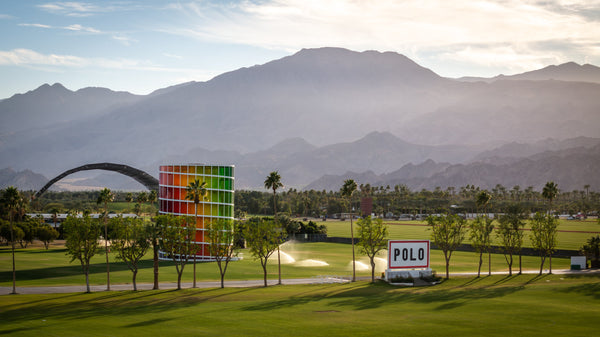
Does the featured photograph show the 2006 performance?
No. Mark Miller made it at Coachella in 2022. It shows a later festival setting, not Daft Punk’s pyramid or the 2006 crowd.
Sources and photograph notes
Researched October 27, 2026. Design interpretation is the author’s analysis; historical and production details draw on the sources below. This article does not claim firsthand attendance at the 2006 show.
- Water & Music — Kristin Robinson: The Coachella set and live-production technology. April 29, 2021; retrospective with lighting designer Martin Phillips and industry interviews.
- The FADER — Eric Ducker: Daft Punk: The Creators. June 28, 2013 republication of its 2007 feature and interview.
- Pitchfork — Mark Pytlik: Thomas Bangalter interview. October 1, 2007; firsthand account of creative collaborators, production and performance structure.
- Daft Punk: Alive 2007 — official album archive. Recording and release dates, track list and official live video.
- Coachella: Busy P Says Oui — official documentary. December 18, 2024; directed by Joey Garfield, with archive material from the 2006 performance.
Photograph note
The featured image is Mark Miller’s photograph of the Sahara stage at Coachella in 2022, used as a later view of the festival setting. It does not show Daft Punk or the 2006 pyramid. The embedded official documentary supplies archival context. No AI reconstruction is used.