




Elvis in Palm Springs: The Homes Behind the Headlines
A rented modernist landmark, a later desert retreat and the recordings that connect Elvis to Palm Springs.

Say “Elvis’s Palm Springs house” and two different places can slip into the same story.
One is the striking modernist residence where Elvis and Priscilla stayed after their Las Vegas wedding. The other is the desert home he bought several years later. They belonged to different chapters of his life—and only one was his property.
Following those two addresses opens a story that goes beyond celebrity sightseeing: the ambitions of a Palm Springs building family, a honeymoon that became part of pop culture, and a later home where Elvis made music.
- Two homes, different histories. Elvis leased the Ladera Circle honeymoon house and bought the Chino Canyon home in 1970.
- The architecture came first. William Krisel designed the House of Tomorrow for the Alexander family before its Presley connection.
- There is music in the later chapter. Official credits document recordings at Elvis’s Palm Springs home in September 1973.
Two addresses, two chapters
Two properties anchor this story, and keeping them separate makes everything that follows easier to understand:
- 1350 Ladera Circle: the Alexander Residence, also known as the House of Tomorrow and the Elvis Honeymoon Hideaway. Elvis leased it before his 1967 wedding.
- 845 West Chino Canyon Road: the home Elvis purchased in 1970, associated with his later years in Palm Springs.
Graceland’s official chronology dates the Ladera lease to September 21, 1966. Palm Springs tourism’s account identifies the separate Chino Canyon purchase in 1970.[1][3] One is the honeymoon house; the other is the house he owned. A photograph of one should never be used as if it showed the other.
Before Elvis, the House of Tomorrow
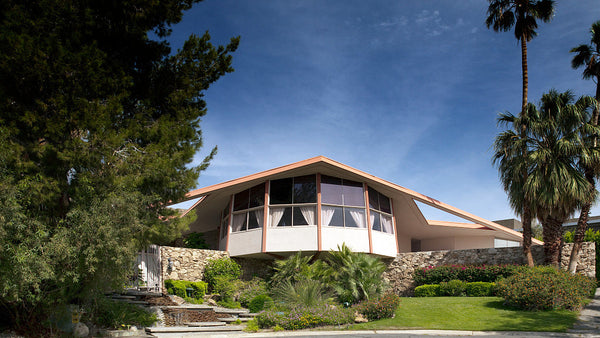
The Ladera Circle house already had a remarkable story before the Presleys arrived. William Krisel designed the 1960 residence for developer Robert Alexander, his wife Helene and their daughter Jill. The family’s house and lifestyle appeared in Look magazine in 1962.[2]
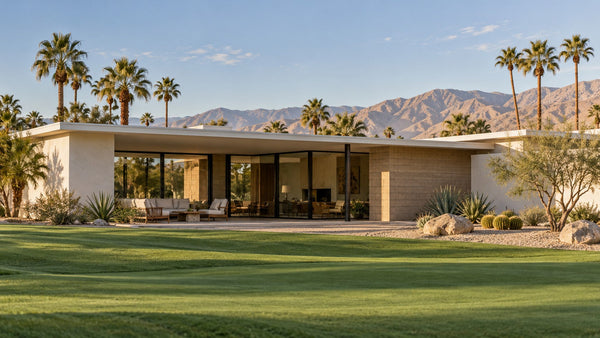
Look at the building before thinking about its famous tenant. The roof rises to a point above the glazed front, while stonework ties the lower portion to the slope. It has the confidence of a home designed to be noticed, even when nobody recognizable is standing at the door.
That is an especially useful distinction in Palm Springs. A celebrity connection can make a building famous to people who might never read an architect’s name. But the design often explains why the place was worth noticing in the first place.
The larger Alexander story runs through the city’s neighborhoods, not just this unusual family residence. Our article on how the Alexander homes changed Palm Springs follows that broader housing and design history.
The city designated the Alexander Residence a Class 1 Historic Site in September 2021. Chattel, the preservation firm that prepared the nomination report, makes a revealing distinction: the architectural and Alexander-family history supported the designation, while the brief Presley occupancy was not its basis.[2]
The wedding was in Las Vegas
The phrase “Elvis honeymoon house” can easily turn into “Elvis wedding house” as a story passes from one person to the next. The ceremony took place elsewhere.
Elvis and Priscilla married at the Aladdin Hotel in Las Vegas on May 1, 1967. Graceland’s chronology records a Palm Springs honeymoon lasting a few days before they returned to Memphis.[1]
Accounts of the journey add the elements that make the episode so memorable: publicity, an attempt to leave quietly and the use of Frank Sinatra’s Learjet. The Palm Springs Air Museum recounts Sinatra’s role in transporting the couple between Palm Springs and Las Vegas.[4] The basic sequence remains straightforward: a leased Palm Springs house, a Las Vegas wedding and a return to the desert.
There is no need to turn every room into a scene from a screenplay. The documented connection is already compelling. A place built around one family’s vision of modern living became attached to one of popular music’s most recognizable marriages.
The home Elvis owned
The Chino Canyon address belongs to a later chapter. Elvis purchased the estate in 1970, and it remained associated with him through the final years of his life. Palm Springs tourism describes repeated stays and a substantial expansion in 1974.[3]
This is where the idea of Palm Springs as a recurring retreat becomes more important than the single honeymoon episode. Buying a house establishes a different relationship with a city from leasing one for a season. The address becomes somewhere to return to.
The two properties also produce different kinds of curiosity. At Ladera Circle, architecture and the wedding story compete for attention. At Chino Canyon, the central question is what it meant for an intensely public performer to have another place to withdraw from view.
That later home also has a connection you can hear. Palm Springs appears in the recording history, not just in the captions beneath photographs.
The Palm Springs recordings
Sony Music’s official Elvis catalog identifies “I Miss You” and “Are You Sincere” as recordings made at Elvis’s Palm Springs home on September 23, 1973.[7][8] Its entry for “Sweet Angeline” makes a more specific distinction: the backing recording was made in Memphis, with Elvis’s vocal recorded at his Palm Springs home on September 22.[9]
All three appear on Raised on Rock / For Ol’ Times Sake. Those credits give the later residence a place in the musical story as well as the personal one. A retreat could become a working space, with musicians and recording equipment bringing the outside world back inside.
For a different way into this history, follow the official catalog links and listen to those songs. The Ladera story has the famous wedding photograph in the imagination; the later Palm Springs chapter has recordings that still play.
The house in the photograph
The featured photograph shows the Ladera Circle house as Carol M. Highsmith photographed it on May 2, 2009. It comes from the Library of Congress, whose catalog lists no known restrictions on publication.[5]
That date matters. This is an actual photograph of the honeymoon house, but it is not a photograph taken during the honeymoon. Trees grow, landscaping changes and buildings are repaired. An archival image has its own moment in time.
Seeing the story in Palm Springs
Start with the history, then plan around confirmed access. A famous address is not an invitation to enter a property, and an old tour page does not establish that interior visits are available today. Modernism Week’s official architecture-tour pages are a useful place to check current programs and what each ticket includes.[6]
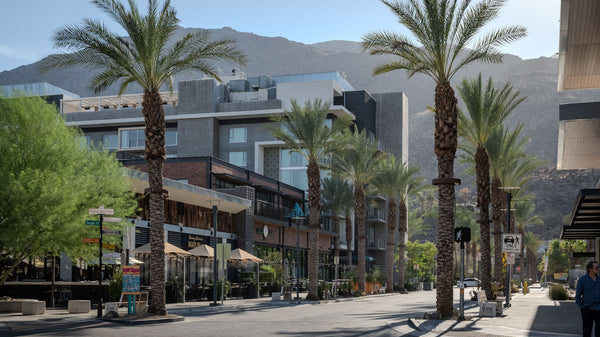
For a broader architecture outing, the Palm Springs Visitor Center offers a public-facing starting point. Pair that with downtown Palm Springs, the El Mirador Tower or the Plaza Theatre to explore more of the city’s built history. These are separate stops, not additional Elvis residences.

Elvis provides an engaging way into Palm Springs history because his name travels far beyond the desert. Once you follow the addresses, though, the city gets more interesting: an architect, a developer’s family, a rented home, a marriage, and a later retreat all come into focus.
The headlines bring you to the houses. Keeping their stories distinct gives you a reason to look longer.
Frequently asked questions
Where is the Elvis Honeymoon Hideaway?
The house is at 1350 Ladera Circle in Palm Springs. It is also called the Alexander Residence and the House of Tomorrow. It is separate from the home Elvis later owned on West Chino Canyon Road.
Did Elvis own the House of Tomorrow?
No. Graceland’s official chronology records that Elvis signed a lease on the Ladera Circle house on September 21, 1966. The Palm Springs home he purchased in 1970 was at 845 West Chino Canyon Road.
Did Elvis and Priscilla get married in Palm Springs?
They married at the Aladdin Hotel in Las Vegas on May 1, 1967, then honeymooned in Palm Springs. The nickname Honeymoon Hideaway does not mean the wedding ceremony took place at the house.
Did Elvis record music at his Palm Springs home?
Yes. Sony Music’s official catalog places I Miss You and Are You Sincere at his Palm Springs home on September 23, 1973. His vocal for Sweet Angeline was recorded there on September 22, over a recording made in Memphis.
Can you tour Elvis’s Palm Springs homes?
Do not assume either property allows walk-in visits. Confirm any interior access through a current, authorized tour listing. Modernism Week offers architecture programs, but the stops and whether a tour includes interiors depend on the specific ticket.
Sources and photography
Researched October 27, 2026. This article brings together published history, preservation documentation and official recording credits. It does not claim new interviews or firsthand access to either home.
- Graceland: Elvis history, 1966–1969. September 21, 1966 lease at 1350 Ladera Circle; May 1, 1967 Las Vegas marriage and subsequent Palm Springs honeymoon. Exact ceremony times are omitted because published accounts differ.
- Robert Chattel / Chattel, October 29, 2021: The House of Tomorrow. Report by the preservation firm that prepared the city’s nomination: 1960 construction, William Krisel, the Alexander family, 1962 Look feature and September 30, 2021 Class 1 designation.
- Randy Garner / Visit Palm Springs, June 11, 2024: Elvis in Palm Springs. 1970 purchase at 845 West Chino Canyon Road, later stays and 1974 expansion. Wedding ages and detailed anecdotes are not relied on here.
- Palm Springs Air Museum, 2022: Elvis and the Learjet — Part One. Sinatra’s aircraft and the Palm Springs–Las Vegas wedding journey.
- Carol M. Highsmith / Library of Congress, May 2, 2009: Elvis Presley honeymoon house, Palm Springs, California. Featured photograph, LC-DIG-highsm-04396. Rights advisory: no known restrictions on publication. The catalog’s building-date note differs from the preservation consultant’s report; this article uses the latter for the 1960 construction date.
- Modernism Week: Architecture tours. Current program information consulted October 27, 2026. No specific interior access or daily house-tour schedule is promised here.
- Sony Music / Elvis Presley official catalog: I Miss You. Palm Springs recording location, September 23, 1973, and album credit.
- Sony Music / Elvis Presley official catalog: Are You Sincere. Palm Springs recording location, September 23, 1973, and album credit.
- Sony Music / Elvis Presley official catalog: Sweet Angeline. Distinguishes the Memphis backing recording from the Palm Springs vocal recorded September 22, 1973.
Photography
Featured photograph: Carol M. Highsmith’s America, Library of Congress, Prints and Photographs Division, LC-DIG-highsm-04396; May 2, 2009. The image is cropped for the featured position. Palm Springs Visitor Center photograph: Mark Miller, 2024. Neither image is a photograph from Elvis’s honeymoon. No AI-generated images are used.


