







Frank Sinatra’s Desert: Beyond the Palm Springs Legend
The homes, friendships, music and charitable work that made the Coachella Valley part of his life.

Frank Sinatra is so closely associated with Palm Springs that his name can feel like part of the landscape. It appears in stories about houses, restaurants, famous guests and evenings that nobody wanted to end.
But the familiar image—a drink, a pool and the Rat Pack—captures only part of the connection. His desert life also reaches into Rancho Mirage, a circle of local relationships, a celebrated wedding and an institution built to help children.
Follow those threads and the map becomes more interesting. Sinatra’s desert was a place to live, entertain, make friends and leave something behind.
- Follow more than one city. Twin Palms is in Palm Springs; the later Compound and Sunnylands chapter are in Rancho Mirage.
- Look beyond the party stories. Architecture, friendships and the Barbara Sinatra Children’s Center all belong in the history.
- Keep the music part of the visit. Hear local singer Paul David through our interview and performance video.
Twin Palms and a new kind of desert home
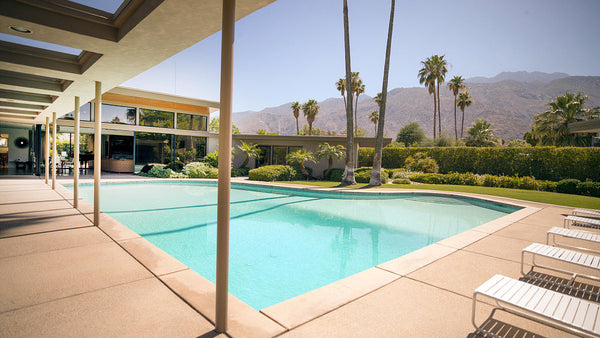
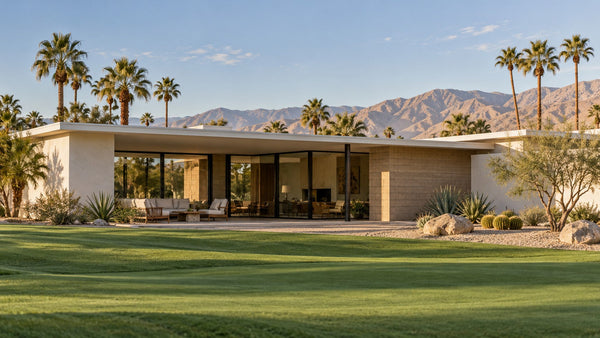
Start with the house that still supplies one of the clearest images of Sinatra’s desert years: Twin Palms, designed in 1947 by E. Stewart Williams.
The Palm Springs Preservation Foundation describes a residence shaped by glass, timber, stone and a swimming pool sheltered by the house and its outdoor structures. The two palms gave the estate its name. In 2011, it became a Palm Springs Class 1 Historic Site.[1]
The familiar story of Sinatra arriving with an ice cream cone and demanding a house by Christmas appears in the preservation nomination as a legend. The design decision is more revealing: Williams presented a modern alternative to the Georgian-style house Sinatra initially wanted.[2]
That choice gave the singer a home suited to its setting. Big panes of glass bring the landscape into the composition. Covered outdoor areas turn the space beside the pool into part of the living experience. The view matters as much as the front door.
For people who know Sinatra through a microphone, a tuxedo or a record sleeve, the house offers another way to picture him. It places the performer within a domestic scale: rooms, shade, a swimming pool and the mountains beyond.
Palm Springs was only part of the map
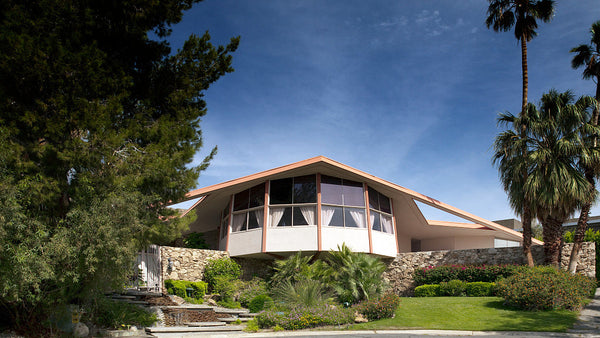
The phrase “Sinatra in Palm Springs” often reaches beyond the city limits. His later home, widely known as the Compound, was in Rancho Mirage near Tamarisk Country Club.
In a 2018 interview, documentary filmmaker Leo Zahn described how a William Cody-designed house became the nucleus of a much larger property. Guest accommodation and entertaining were central to its evolution. Zahn’s film, Sinatra in Palm Springs, draws on interviews with people who knew the local world around him.[3]
Twin Palms and the Compound belong to different chapters. One is a landmark of early desert modernism; the other speaks to the larger social life Sinatra built here. Keeping Palm Springs and Rancho Mirage distinct makes that progression easier to follow.
It also changes the scale of the story. This was more than a star spending an occasional weekend at a famous address. The desert became a network of homes, friends and familiar places.
The table mattered as much as the stage
A home can tell you where someone stayed. A restaurant can tell you something about the company they kept.
Melvyn’s, at the Ingleside property in Palm Springs, is one of the clearest examples. In recollections published by Visit Palm Springs, owner Mel Haber described waiting anxiously for Sinatra’s first visit after opening in 1975. Sinatra subsequently became a regular. Haber remembered an exacting diner who arrived with familiar companions and took the details of an evening seriously.[4]
The same account recalls planning a pre-wedding dinner for Sinatra and Barbara Marx in 1976. Those memories are valuable as Haber’s account of his own restaurant, rather than an invitation to turn every later retelling into established fact.
What comes through is the importance of repetition: the people who knew a preference, the table people hoped he would occupy, the evening that became a story afterward. Celebrity history often survives at that smaller scale.
The Sunnylands wedding
On July 11, 1976, Frank Sinatra and Barbara Marx married at Sunnylands, the Rancho Mirage estate of Walter and Leonore Annenberg. Sunnylands’ own historical account describes the Annenbergs arranging the celebration and guests arriving under the impression that they were attending an engagement party.[5]
After the ceremony, the reception moved to the Sinatras’ nearby compound. It is a useful distinction: the wedding at Sunnylands, the reception at home, and the pre-wedding dinner remembered at Melvyn’s were different events at different places.
For a moment, several strands of the desert story come together. The famous singer is also a friend, a neighbor, a dinner guest and a bridegroom. The region is not simply scenery around him; it is where the relationships unfold.

A legacy beyond the parties
It is easy for the parties to take over. They are colorful, repeatable stories, and they fit the popular image of Sinatra’s desert life. The charitable work deserves a place alongside them.
Barbara and Frank Sinatra founded the Barbara Sinatra Children’s Center in 1986 on the Eisenhower medical campus in Rancho Mirage. The center provides therapy and programs addressing child abuse and neglect.[6]
That is a different kind of local legacy from a famous dining table or a preserved house. It is an institution created to meet a need, with work that continues beyond the lives of its founders.
The center also keeps Barbara in the story as more than a supporting figure in Frank’s biography. The organization bears her name, and its account identifies both of them as founders. A fuller picture of the desert years makes room for that shared work.
The music belongs in the story
Before visiting an address, listen. The phrasing, the timing and the ability to make a familiar lyric feel conversational are the reasons the name still means something to people who never saw Sinatra perform.
The local connection also extends to a stage. The Plaza Theatre was among the Palm Springs venues where Sinatra hosted and performed, according to the National Trust Community Investment Corporation’s history of the building.[7]
Today, hearing that repertoire in a room with other people offers a different experience from standing outside an old residence. A singer shapes the pace of the evening; a familiar melody brings a response from the audience. That living exchange helps explain why the music remains part of the desert’s identity.
Following the story today
Choose the part that interests you most. For architecture, begin with Twin Palms and check the estate’s official private-tour information. Visits require arrangements; a historic association does not make a residence an open museum.[8]
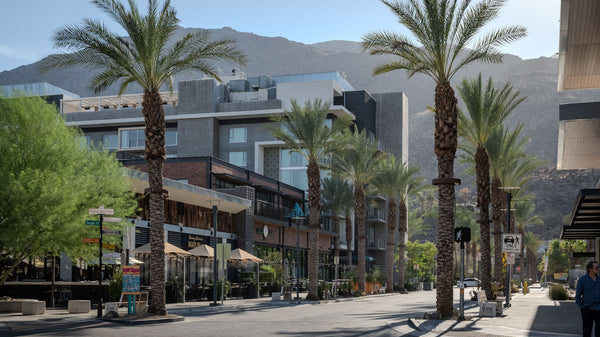
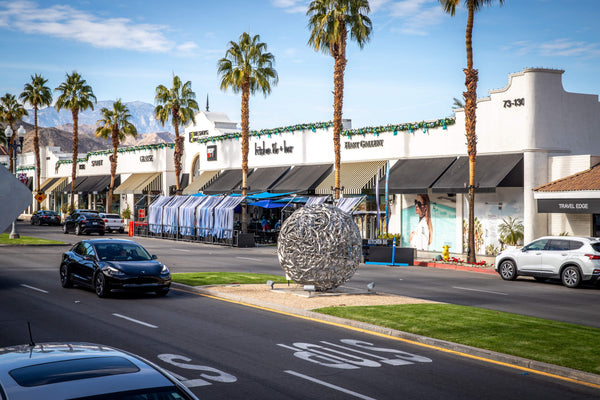
For the wider setting, explore downtown Palm Springs or the Sunnylands guide. For a social evening of your own, Paul David’s profile above provides a way to hear a local performer before discussing an event.
The most interesting Sinatra map contains more than glamorous homes. It includes a theatre, a restaurant, a wedding, a charitable institution and music that people continue to sing. Together, those places and relationships make the desert connection feel less like a distant legend and more like a life lived here.
Frequently asked questions
Where did Frank Sinatra live in the Coachella Valley?
His best-known desert homes include Twin Palms in Palm Springs, designed by E. Stewart Williams in 1947, and the later Compound near Tamarisk Country Club in Rancho Mirage. They are separate properties.
Who designed Frank Sinatra’s Twin Palms house?
E. Stewart Williams designed Twin Palms in 1947. Its glass, natural materials and relationship to the pool and outdoor spaces make it a notable example of Palm Springs modernism.
Did Frank Sinatra marry Barbara Marx at Sunnylands?
Yes. They married at Sunnylands in Rancho Mirage on July 11, 1976. Sunnylands’ account places the reception afterward at the Sinatras’ nearby compound.
What was Frank Sinatra’s connection to the Barbara Sinatra Children’s Center?
Barbara and Frank Sinatra founded the center in 1986. Located on the Eisenhower medical campus in Rancho Mirage, it provides therapy and programs addressing child abuse and neglect.
Where can I find a local singer who performs Frank Sinatra music?
Coachella Valley singer Paul David performs Sinatra favorites for private gatherings and celebrations. DOI’s Local Services profile includes a performance video, an interview and contact information to discuss availability and pricing.
Sources and photography
Researched October 27, 2026. This is an original synthesis of preservation records, institutional histories and attributed interviews. It does not claim firsthand attendance at historical events.
- Palm Springs Preservation Foundation: Sinatra Twin Palms Estate. 1947 design, architect E. Stewart Williams, architectural features and 2011 Class 1 designation.
- Patrick McGrew / Palm Springs Preservation Foundation: Frank Sinatra Residence: historic-site nomination. House-history section, printed page 8: design choices, materials and the later move toward Tamarisk. The ice-cream-cone story is identified as legend. Exact dates for the transition to the later property differ across published histories, so this article does not select one.
- Stephanie Sporn / Sotheby’s, November 30, 2018: Interview with filmmaker Leo Zahn. Zahn discusses the Rancho Mirage Compound, its origins in a Cody-designed house and Sinatra’s relationships in the desert.
- Visit Palm Springs, November 3, 2023: Meet Frank Sinatra through Mel Haber. Haber’s recollections of Sinatra as a regular diner and the pre-wedding dinner at Melvyn’s. These personal stories are attributed to Haber.
- Sunnylands, July 11, 2014: The Sinatra wedding at Sunnylands. July 11, 1976 marriage to Barbara Marx and reception at the Sinatras’ compound.
- Barbara Sinatra Children’s Center: Who We Are. 1986 founding by Barbara and Frank Sinatra, location and institutional mission.
- National Trust Community Investment Corporation: Plaza Theatre. Sinatra’s connection with hosting and performing at the historic theatre.
- Sinatra House: Private tours. Current arranged-tour information, checked October 27, 2026. Confirm requirements and availability directly.
- Carol M. Highsmith / Library of Congress, June 2013: Frank Sinatra’s Twin Palms Estate. Featured photograph, LC-DIG-highsm-25617. The catalog’s MARC rights field states: no known restrictions on publication. View catalog and rights record.
Photography
Featured photograph: Carol M. Highsmith, June 2013. Credit: The Jon B. Lovelace Collection of California Photographs in Carol M. Highsmith’s America Project, Library of Congress, Prints and Photographs Division. Cropped for the featured position. It is a later photograph of Twin Palms, not an image from Sinatra’s residency.
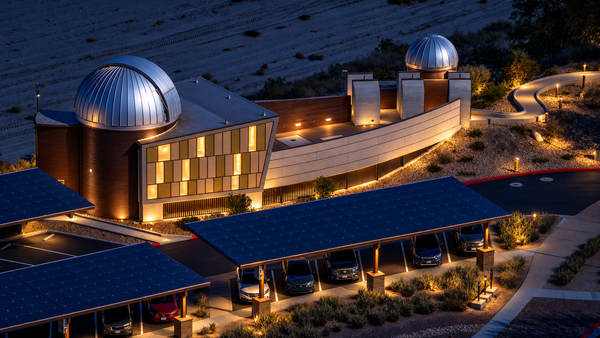
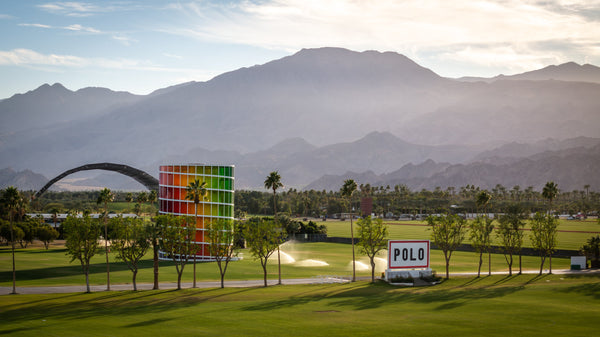
Paul David portrait: Mark Miller, October 26, 2026. Sunnylands Center photograph: Mark Miller, October 14, 2026. The Center is separate from the historic house where the 1976 ceremony took place. No AI-generated images are used.


