














How Palm Springs Became a Midcentury Modern Capital
The architects, desert design ideas and preservation efforts behind a citywide architectural identity.

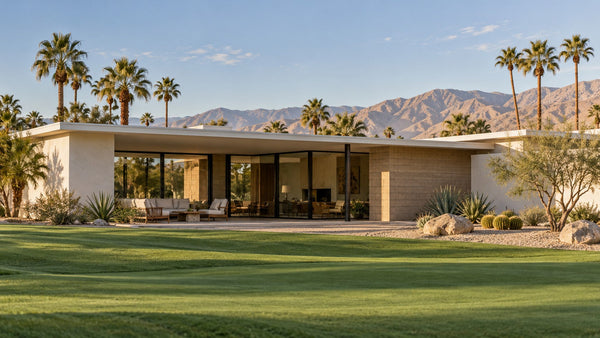
Look past the pool, the palm trees and the colorful front door. The most interesting part of Palm Springs modernism is the negotiation between a building and its setting: a roof reaching out for shade, glass opening toward a mountain, a screen softening the boundary between public and private space.
Palm Springs became a midcentury modern capital because inventive architects, willing clients, neighborhood builders and growing civic institutions produced a remarkable concentration of buildings—and because later generations learned to value and preserve them. This guide explains that larger story and gives you a few practical ways to see it for yourself.
- Palm Springs modernism grew from private commissions, neighborhood building and civic ambition.
- Desert design is easier to understand when you look for shade, orientation and the transition between indoors and outdoors.
- Famous houses tell only part of the story; City Hall, the Visitor Center and the museum broaden it.
- Photography, preservation and reuse helped turn a building legacy into a lasting identity.
Why modernism found a home in Palm Springs
A city does not become an architectural capital because one famous house goes up. It needs clients, designers, builders, opportunities to experiment—and enough surviving buildings for later generations to recognize a larger story.
Palm Springs brought those ingredients together. Its resort economy offered commissions for vacation houses and hotels. Postwar growth created demand for neighborhoods, offices and public buildings. The mountains supplied an extraordinary setting, while the desert imposed practical questions: Where will people find shade? How can a room enjoy the view without receiving the full force of the sun? What happens between the front door and the street?
Modern architecture gave designers ways to answer those questions with open plans, clearly expressed structure and fewer historical ornaments. Yet the result was never one uniform look. A delicate steel-and-glass pavilion, a sculptural roadside canopy and a heavy concrete museum could all belong to the city's modern architectural story.
This was not an empty landscape waiting to be discovered. Palm Springs is part of the Agua Caliente Band of Cahuilla Indians' homeland, and its development involved a much longer history of land, water, tourism and community. Our history of why Palm Springs exists provides that wider context. Here, the focus is the built environment: how modernism became a visible language across the city.
The modern story began before the postwar boom
“Midcentury” can make the story sound as though it began suddenly in the 1950s. Albert Frey was already working in Palm Springs in 1934. The Swiss-born architect brought experience with European modernism, then developed an approach suited to a very different landscape.
Frey's work is useful because it challenges the idea that desert architecture must disappear into a beige background. Industrial materials and precise geometry could sit beside rough rock and mountain slopes. His buildings explored the relationship between those things rather than pretending they were the same. Frey House II, completed in 1964, became an especially clear expression of that relationship.
Later, E. Stewart Williams helped broaden the city's modern vocabulary. He arrived in 1946 to join the architectural practice of his father and brother; Frank Sinatra's house became an early major residential commission. Williams also designed buildings for everyday institutional and commercial life. Modernism was becoming more than a private retreat for a celebrated client.
It is tempting to assign every recognizable building to a single star architect. Palm Springs rewards a more careful reading. Partnerships and collaborating offices mattered. City Hall, for example, belongs to the work of Clark, Frey & Chambers with Williams, Williams & Williams—not to a story in which one person designed an entire city alone.
Read the building: six desert design clues
The most useful way to recognize desert modernism is to ask what a feature does. A roof may make a dramatic silhouette and shelter a walkway. A screen may create a pattern and filter sunlight. Open each clue below, then look for the same relationship in a building or photograph.
01 · The overhang
Look for: a roof that continues beyond the exterior wall. That extension creates an intermediate zone between enclosed space and open desert.
Read it carefully: shade changes with orientation, season and time of day. A horizontal overhang can block high sun, but low afternoon sun may reach beneath it. The drawing is a concept, not a sun study for a specific building.
02 · Glass with a partner
Look for: glass paired with an overhang, a screen, a recessed opening or a shaded terrace. The pair matters more than the size of the window alone.
Read it carefully: glass connects a room visually to the landscape, but it can also admit unwanted heat. A beautiful mountain view is not proof of a cool interior or an efficient building.
03 · The filtering screen
Look for: perforated metal, open masonry or another layer standing in front of a window or outdoor space. It can offer partial privacy while allowing light and views through.
Try it: compare the screen's pattern with the shadow it casts. At the Architecture and Design Center, movable aluminum screens are part of the building's documented design.
04 · A roof with a job
Look for: the relationship between the roof, its supports and the activity below. A canopy over cars communicates something different from a low roof over a private living room.
Read it carefully: a butterfly roof is one recognizable form, not a requirement for modernism. A roof shape alone does not establish an architect, construction date or energy performance.
05 · The outdoor room
Look for: a patio, courtyard or terrace that feels deliberately connected to interior space. Doors, paving, walls and overhead shelter can make the transition feel continuous.
Try it: ask where you would sit, where the shade would be and how private the space feels. “Indoor–outdoor living” becomes more meaningful when you can describe the actual connection.
06 · Materials against the mountain
Look for: contrasts between smooth and rough surfaces, slender framing and heavy walls, reflected sky and exposed aggregate.
Try it: compare the Palm Springs Art Museum with the former gas station now used as the Visitor Center. Their materials and silhouettes create very different relationships with the same desert setting. Modernism is broader than a white house with a colorful front door.
These clues are a way to observe architecture, not a claim that every midcentury building solved the climate perfectly. Window specifications, insulation, maintenance and mechanical cooling matter too. For the technological side of that story, read how air conditioning changed life in the Coachella Valley.
From exceptional houses to whole neighborhoods
Individual commissions gave architects room to develop distinctive ideas. Richard Neutra's Kaufmann House, built in 1946–47, is one of the city's best-known examples. Its significance is not simply that it has glass walls. The composition makes enclosed rooms, terraces and the surrounding setting read as parts of a larger living environment.
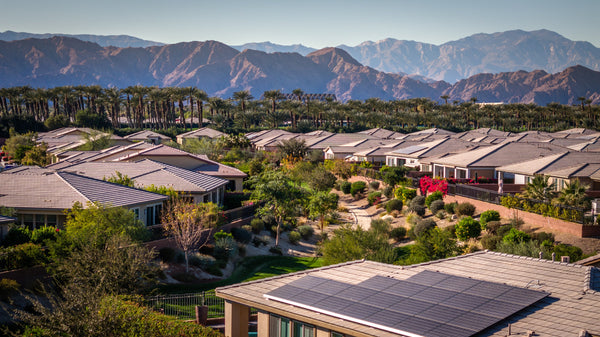
But a collection of exceptional private homes would not have produced the same citywide identity. Developers and builders helped modern design reach a much broader scale. The Alexander Construction Company, working with architects including William Krisel, made modern houses into neighborhoods rather than isolated landmarks.
That story deserves its own detail, and DOI already covers it in How the Alexander Homes Changed Palm Springs. The important connection here is scale: repeated plans, varied rooflines and coordinated streetscapes made modernism part of the everyday view from the road. The house was one unit; the neighborhood became another architectural experience.
Three buildings that take the story beyond the house
Public and commercial commissions are essential to understanding Palm Springs. They show how the same broad movement could accommodate government, roadside service and cultural life. Use these examples as a reading guide rather than a timed itinerary; check each destination's current access information before visiting.
Palm Springs City Hall: civic life under a canopy
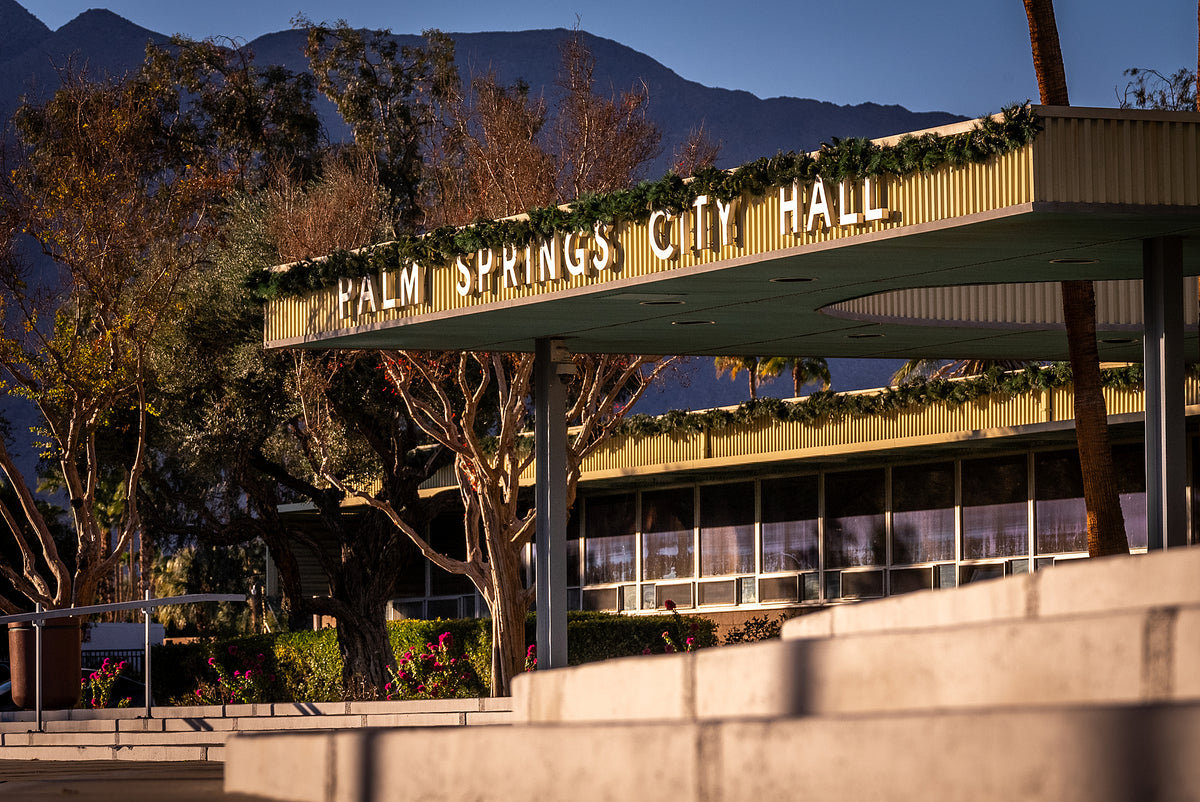
The City Hall complex developed in the 1950s shows modern architecture being used for the business of a growing city. Its circular canopy opening and palms give the entrance an immediately recognizable identity. The architectural team also used shading elements that make the boundary between building and desert more complex than a flat wall.
What to notice: how the entrance roof frames the sky, how people approach the building and where the design provides shelter. Follow the City Hall place guide for a closer look.
Palm Springs Visitor Center: architecture for the passing motorist

Today's Visitor Center began as the Tramway Gas Station in 1965, designed by Albert Frey with Robson Chambers. Its dramatic canopy originally belonged to the ordinary task of serving automobiles. That combination of useful shelter and memorable shape helps explain why a commercial building can become a city landmark.
What to notice: the long roofline, the relatively small enclosed portion and the mountain backdrop. Picture the building's original function before reading it only as a sculpture. See the Visitor Center guide.
Palm Springs Art Museum: a different kind of modern presence
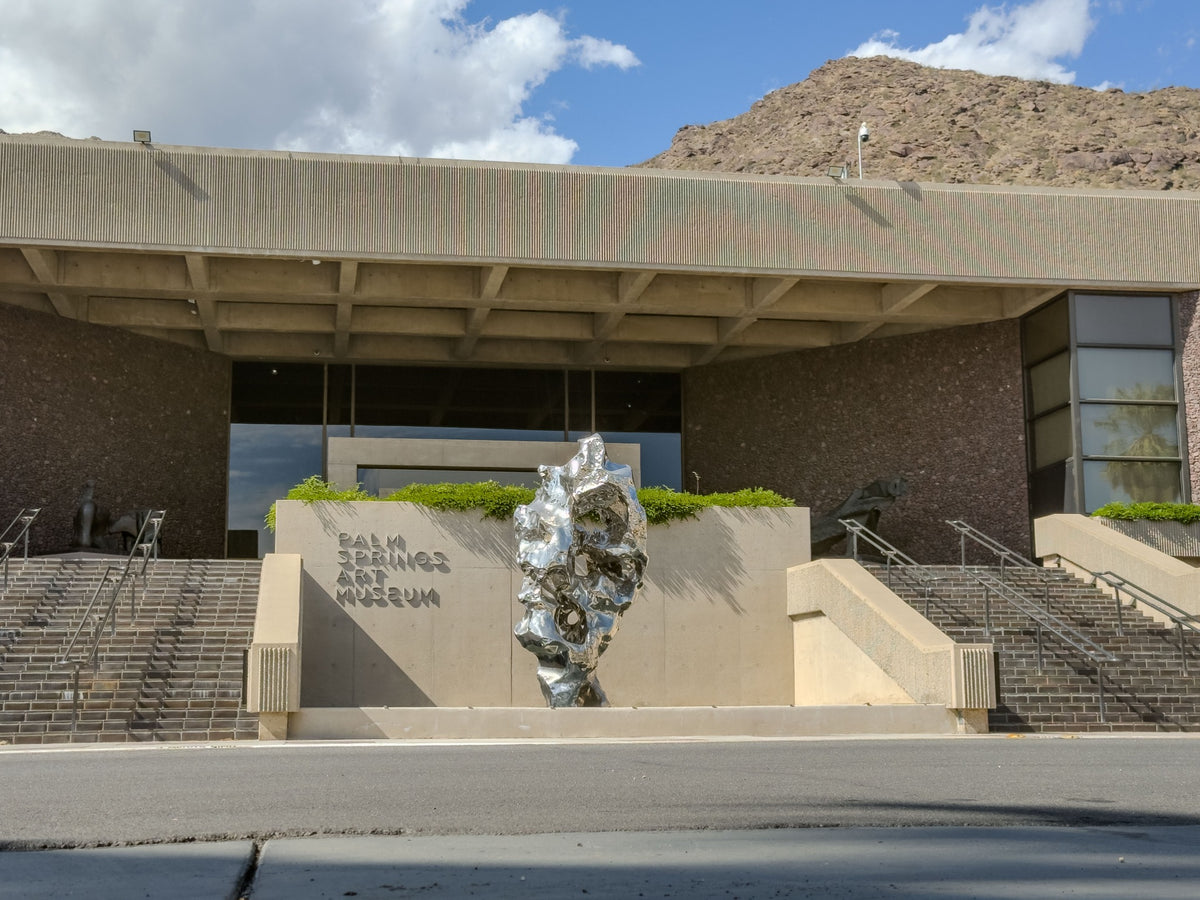
E. Stewart Williams's museum opened in 1976, extending the story beyond the familiar 1950s image. Its substantial forms and textured concrete offer a counterpoint to the lighter pavilions often associated with the city. The building's relationship with the mountain is central to the experience of approaching it.
What to notice: the broad approach, deep shadows and the way the building's surfaces sit against the slope. The Palm Springs Art Museum guide includes photographs for comparison.
How photographs and preservation made the reputation last
Buildings helped create the reputation; photographs helped carry it elsewhere. Julius Shulman's 1947 photographs of the Kaufmann House are a documented example of architecture becoming an image people could encounter far from Palm Springs. A photograph can make the relationship between room, terrace, light and mountain instantly legible.
It can also simplify the story. The camera selects an angle and a moment. An unbroken view, an empty terrace or a carefully lit interior may tell us less about heat, maintenance, neighboring development or everyday use. Looking at the actual building adds those questions back.
Preservation made continued looking possible. The Palm Springs Preservation Foundation dates to 1997, while Modernism Week's organization began in 2005 and its first event took place in February 2006. Research, advocacy, tours and public interest helped make the surviving architecture a subject of study rather than merely yesterday's real estate.
Reuse offers a particularly useful example. The former Santa Fe Federal Savings and Loan building, designed by E. Stewart Williams, became the Palm Springs Art Museum's Architecture and Design Center in 2014. Its restoration by Marmol Radziner drew on original drawings and Shulman photographs. The glass-and-steel building and its movable sun screens are now part of the architectural lesson, not just a container for exhibitions.
A better way to look at Palm Springs
On your next architecture outing, choose fewer buildings and spend more time looking. Start with the roof and its supports. Find the shaded edge. Notice which windows look outward and which walls protect privacy. Then step back far enough to see how the building meets its street, neighboring structures and mountain backdrop.
Respect the difference between public-facing landmarks and private residences. A famous house is not automatically open to visitors; use an authorized tour when one is offered, and observe private homes from lawful public areas without approaching doors or entering grounds.
For another comparison, explore Aluminaire House through DOI's place guide, or follow the Seven Lakes history to see how modern design enters a different residential setting.
Palm Springs became a modernist capital through the accumulation of these different experiments: private and public, modest and ambitious, lightweight and monumental. Its strongest architectural identity is not one roofline. It is the opportunity to see so many answers to the same enduring question—how to live and build in this desert.
Palm Springs modernism: common questions
Why is Palm Springs famous for midcentury modern architecture?
The city combines distinctive private commissions, modern residential neighborhoods and civic and commercial landmarks. Architects responded to the resort setting and desert conditions, while builders spread modern design across neighborhoods. Photography, preservation and architectural tourism helped sustain the reputation.
What is desert modernism?
Desert modernism is an approach that adapts modern architectural ideas to a desert setting. Common features include strong indoor–outdoor connections, shading, open plans and a deliberate relationship with the landscape. It is not one roof shape, and the label alone does not guarantee energy efficiency.
Which architects helped shape modern Palm Springs?
Albert Frey, E. Stewart Williams, Richard Neutra and William Krisel are among the figures discussed here. The city’s architectural history also includes William F. Cody, Donald Wexler, Hugh Kaptur, Robson Chambers and collaborating offices. Check the documented attribution for each building rather than assuming one architect designed everything with a similar appearance.
Is every midcentury modern house in Palm Springs an Alexander home?
No. Alexander refers to the construction company associated with particular developments, not to every modern house in the city. Houses by different architects and builders may share features. DOI’s Alexander Homes history explains that specific neighborhood-building story.
Can visitors go inside the famous houses?
Some properties offer authorized tours or special-event access, while others remain private residences. A place’s architectural fame does not create public access. Check the owner or official tour provider before visiting; use lawful public areas for exterior viewing and respect residents’ privacy.
Sources and photography
Research checked October 31, 2026. Historical facts draw on the institutional and preservation sources below. The visual reading exercises are editorial interpretation; diagrams are simplified schematics, not measured building drawings or performance simulations.
- Palm Springs Art Museum: Albert Frey: Inventive Modernist. Frey’s background, materials and architectural approach.
- Palm Springs Art Museum: Architecture & Design. Architectural holdings and Julius Shulman’s 1947 Kaufmann House photograph.
- Palm Springs Art Museum: E. Stewart Williams. Williams’s 1946 arrival, practice and museum opening in January 1976.
- Getty, Stacy Suaya, September 25, 2025: An Albert Frey Tour of Palm Springs. Frey’s desert work, City Hall and the former Tramway Gas Station.
- Palm Springs Modern Committee: Robson C. Chambers. Partnerships and collaboration on City Hall and the 1965 gas station.
- Visit Palm Springs: Palm Springs Visitor Center History. Original use and architectural attribution.
- Society of Architectural Historians: Kaufmann Desert House. Richard Neutra, 1946–47 construction and the house’s relationship to its setting.
- Palm Springs Art Museum: Architecture and Design Center. Former bank, movable screens and restoration using historical drawings and photographs.
- Palm Springs Art Museum: Our Story. Architecture and Design Center opening in 2014.
- Palm Springs Preservation Foundation: About. Organization’s 1997 origins and preservation mission.
- Modernism Week: About Us. Organization established in 2005; first event in February 2006.
- Pacific Northwest National Laboratory / Building America Solution Center: Shading and Solar Control for Windows and Skylights. Orientation, sun angle and the limits of horizontal shading.
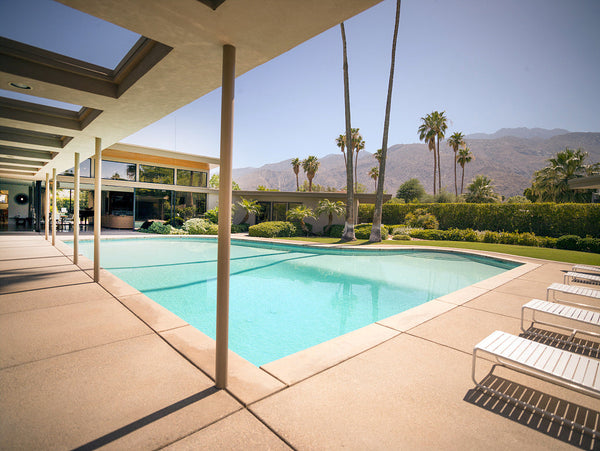
- Library of Congress: Carol M. Highsmith photograph, LC-DIG-highsm-25617. Featured image: Twin Palms in June 2013, Jon B. Lovelace Collection. Existing DOI image credit and registered photographic classification retained.


