




























Coyotes of the Coachella Valley: Living Between Wild Land and Our Neighborhoods
Food, family, voices and the everyday movements of a native neighbor—from Thermal’s fields to the mountain edge.

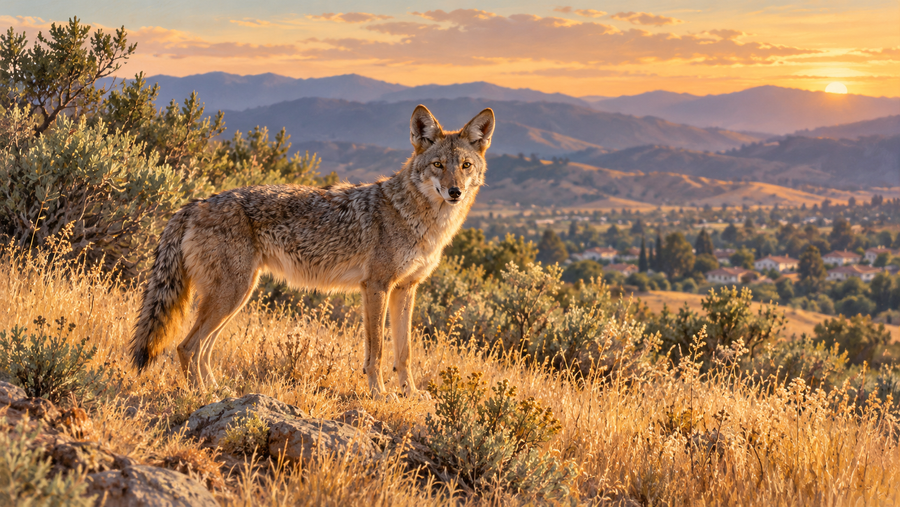
The coyote resting on a rock in the opening photograph was photographed at The Living Desert. Farther down, my Thermal photograph shows a wild coyote with cattle, buildings and mountains behind it. That wider frame places wildlife and working land in the same view.
The coyote is not confined to the empty spaces on our maps. It moves through a landscape of desert scrub, agricultural edges, washes, foothills and neighborhoods. Understanding that movement begins with ordinary needs—food, water, cover and room to raise a family. [2]
- Coyotes hunt, scavenge and eat plant foods; their opportunities change across the landscape.
- A lone coyote can belong to a family, and a chorus cannot give you a reliable head count.
- Secure food sources and supervise pets while leaving room for wild animals to move.
A familiar face, with its own way of living
The coyote (Canis latrans) belongs to the dog family. Its narrow muzzle, upright ears, lean body and bushy tail make a useful combination of field marks. The coat can blend into dry grasses and desert ground so well that movement is often what catches your eye first. [1]
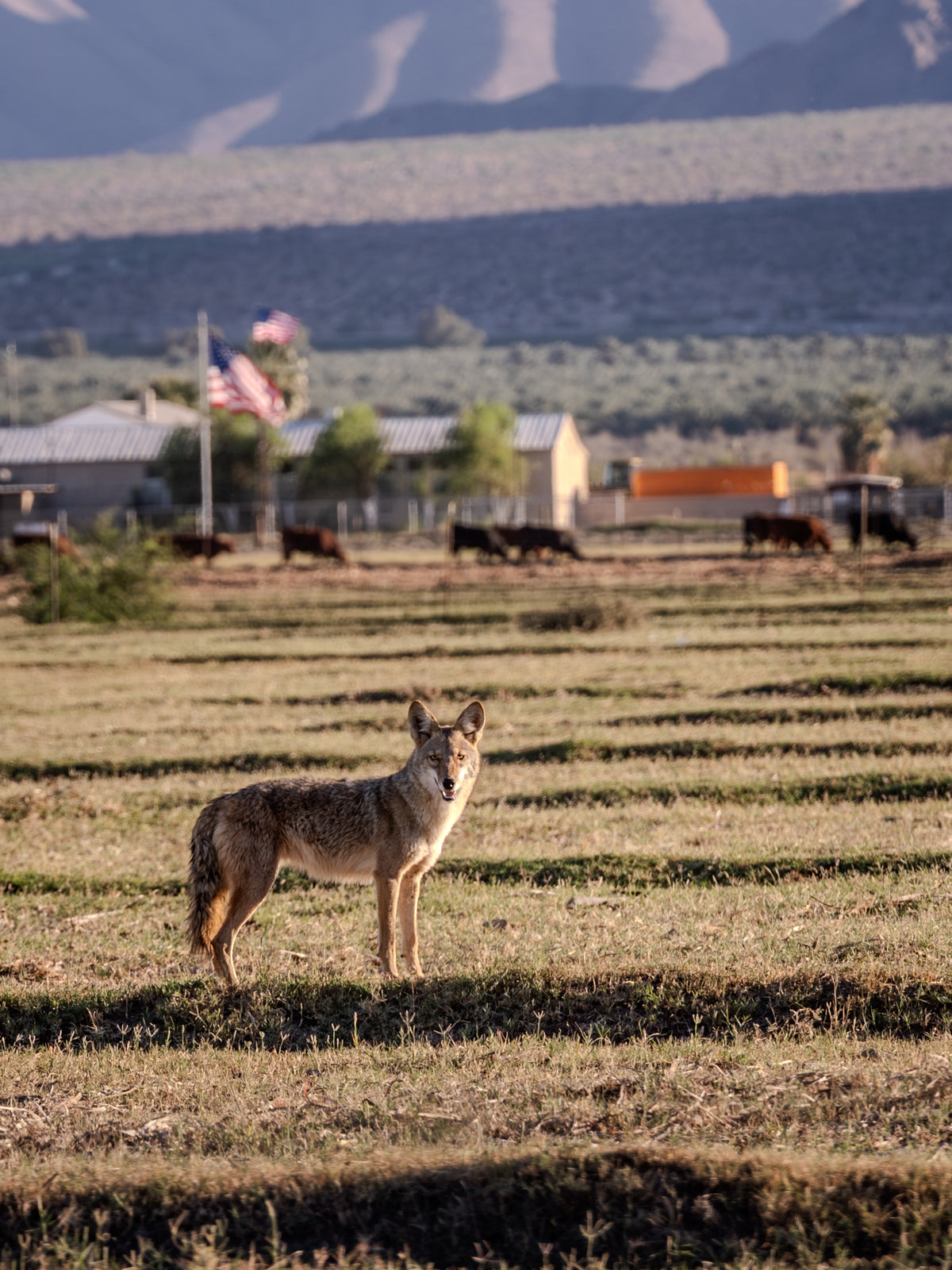
Compare that wider view with the resting animal in the opening portrait, photographed at The Living Desert. The zoo photograph lets us examine the animal closely; the Thermal image places a wild coyote back inside a larger setting. Neither photograph tells us everything that happened before or after the shutter opened.
Food is a changing opportunity
Coyotes hunt and scavenge. Rodents and rabbits are important foods, alongside insects, reptiles, fruit and carrion. A coyote may search, stalk, pounce or dig for prey. Its next meal depends on what the habitat and season make available, rather than a single fixed menu. [2]
That flexibility is why the line between “wild land” and “our land” is a poor guide to where a coyote belongs. A rabbit on a lawn is still prey. Fruit fallen beneath a landscape tree can be food. An open bin or a bowl of pet food adds a different opportunity: a reward supplied by people. [7]
The animal is also part of the food web we have been following through these articles. Unlike the turkey vulture, it can catch live prey as well as consume remains. Unlike the rabbit or ground squirrel, it is searching for other animals along with plant foods. Each species experiences the same landscape differently. [1]
Explore the coyote’s surroundings
What makes a place useful to a coyote?
Choose a need, then compare the yard setups. The drawing illustrates habitat relationships; it is not a mapped territory, den location or predicted route.
Swipe across the landscape to explore. Selecting a need brings that area into view.
1. Meals come from the landscape
Open ground can offer hunting opportunities, while fruit and carrion add other foods. Water is another resource. The presence of a food source does not tell us that a coyote will visit at a particular time. [2]
2. Shelter is more than a den
Brush and natural cavities provide cover. A den is especially important for raising young; it is not a permanent house in which every adult spends every day. Leave suspected den sites undisturbed. [3]
3. Small patches can be connected
A coyote may move between several patches of habitat, including through developed areas. This dashed line illustrates that idea. It does not identify a trail used by a real animal or imply that a road crossing is safe. [4]
4. A yard can offer unintended rewards
Accessible pet food, fallen fruit and trash can attract coyotes. Removing those rewards changes what a yard offers, even when nearby natural habitat still supports wildlife. [7]
Compare the yard
The open bin, outdoor food bowl and fallen fruit show food people can unintentionally supply.
Illustration only; not to scale. Securing food removes these attractants, but does not eliminate natural prey, guarantee that coyotes stay away or make a yard coyote-proof.
A family behind the lone silhouette
Seeing one coyote does not mean it has no family. Coyotes may live in family groups, while individuals also travel or forage alone. Young from an earlier breeding season sometimes remain with the family. A solitary sighting is only a brief view of that social life. [4]
In California, breeding generally takes place in winter, with pups appearing in spring. Adults may excavate a den, enlarge an existing burrow or use another sheltered cavity. Pups depend on adults for food during their early months; as they grow, some eventually disperse to find space of their own. [3]
That seasonal rhythm changes what a place means. A quiet patch of cover may also be a nursery. Give den areas plenty of space and keep dogs close; a coyote defending young should not be treated as an invitation to investigate.
What are the howls telling us?
A chorus can sound like a neighborhood full of coyotes. It is safer to describe what you heard than to turn that impression into a head count. In a study using recordings of one to four coyotes, listeners consistently overestimated the number calling. The result concerns human perception, not a census of our valley. [8]
Nor does a howl prove that an animal has just been killed. The Urban Coyote Research Project cautions against that interpretation. Calls have several functions in coyote communication; without more context, we cannot translate a chorus into a single event. [9]
For a field note, record the time, duration and whether the sound came from one direction or several. Keep the description separate from the story you imagine. Listening can be rewarding without following the calls into the dark or playing recordings to provoke a response.
One regional landscape, many settings
The California wildlife account describes coyotes in open scrub, brush, croplands and forest settings, including mountains. That makes the Coachella Valley and its surrounding uplands a range of usable environments, rather than a desert population neatly separated from a mountain one. This is habitat context, not proof that a particular animal moves between all these places. [2]
On the valley floor, think of Thermal and Coachella’s agricultural edges, the open ground around Indio, and the foothills behind La Quinta and Palm Desert. Toward Idyllwild, Big Bear and Lake Arrowhead, ask the same questions about cover, food and development—but do not assume the same density, daily schedule or territory size everywhere.
Joshua Tree provides a clear regional reference: the National Park Service lists coyotes among the park’s commonly seen mammals. That establishes their presence in the park, not a guaranteed encounter at any pullout or campground. [10]
A coyote walking beside homes may be using a connection between habitat patches. Daylight alone is not evidence that it is sick or dangerous: the National Park Service notes that coyotes can be active during the day as well as at night. Behavior and context matter. [4]
Sharing space starts with what we leave available
Research in the Santa Monica Mountains and Simi Hills found both natural prey and human-related food in urban coyotes’ diets; fruit from neighborhood trees was an important example. Those results are not a Coachella Valley diet survey, but they help explain why “I don’t feed coyotes” can still leave an unfinished job around the house. [7]
Secure trash and pet food, keep small pets supervised, leash dogs and use secure enclosures for poultry. Clean up spilled birdseed that can attract small animals. These steps address specific opportunities without pretending that every coyote passing nearby can—or should—be made to disappear. [5]
At Joshua Tree, rangers specifically warn that feeding can lead coyotes to linger near people and roadways. Keep food secured and watch from a distance. A coyote approaching for a handout is not a better wildlife encounter. [6]
If a coyote approaches, keep children and pets close, make yourself look large, make loud noise and back away slowly while allowing it room to leave. If physical contact occurs, fight back and contact Animal Control or 911. These are the California Department of Fish and Wildlife’s encounter instructions. [5]
Photograph the animal and the setting
A close portrait reveals the eyes, muzzle and coat. A wider frame can reveal the more complicated story: the field edge, scrub, buildings or road that shares the scene. The Thermal photograph works because the coyote is part of the landscape, not isolated from it.
Use distance and your lens rather than food to shape the photograph. Avoid calling an animal closer, approaching a den or blocking its path. If your presence changes its behavior, give it more room. Observing without supplying a reward helps keep a wild coyote wild. [6]
The goal is not to turn familiarity into fearlessness. It is to notice a capable native animal, understand a little more about what it is doing, and leave it able to continue.
Coyotes: common questions
Does seeing a coyote during the day mean something is wrong?
Not by itself. Coyotes can be active by day or night. An animal approaching people, acting aggressively or appearing injured needs a different response from one simply passing through. [4]
Does a lot of howling mean there are many coyotes nearby?
Not necessarily. A playback study found that listeners tended to overestimate how many coyotes were calling. A chorus is not a reliable head count. [8]
Does howling mean coyotes just killed something?
No. Coyotes vocalize for several reasons; hearing a howl is not evidence of a recent kill. [9]
What can I change around my home?
Secure trash and pet food, supervise small pets, leash dogs and protect poultry. These steps reduce accessible rewards and exposure; they do not make a yard coyote-proof. [5]
Should I feed a coyote to get a better photograph?
No. Feeding can draw coyotes toward people and roads. Keep your distance and photograph their ordinary activity instead. [6]
Sources & photography notes
- National Park Service, Santa Monica Mountains. Coexisting with Coyotes. Updated December 19, 2016. Identification, diet and adaptable habitat use.
- California Department of Fish and Wildlife; G. Ahlborn. California Wildlife Habitat Relationships: Coyote. Updated May 2000. Broad habitat, food and movement context; not current local abundance.
- University of California Statewide IPM Program. Coyote. Updated March 2007. Family development and den use; current encounter advice follows CDFW.
- National Park Service, Santa Monica Mountains. Coyote Behavior. Updated July 12, 2016. Family groups, daytime activity and movement between habitat patches.
- California Department of Fish and Wildlife. Human–Wildlife Conflicts: Coyotes. Current coexistence and encounter guidance, reviewed October 21, 2026.
- National Park Service, Joshua Tree. Keep Wildlife Wild. Updated February 13, 2024. Feeding, distance and wildlife photography.
- National Park Service, Santa Monica Mountains. Coyote Research. Updated July 7, 2015. Southern California research outside the Coachella Valley; findings are not local estimates.
- Kyle R. Brewster and colleagues. Do You Hear What I Hear? Human Perception of Coyote Group Size. Human–Wildlife Interactions, Fall 2017, 11(2). Playback study of perceived group size.
- Urban Coyote Research Project. I hear coyotes howling. Does that mean they have just killed something?. Research-program explanation of the howling misconception.
- National Park Service, Joshua Tree. Animals. Updated February 12, 2024. Coyotes in the park’s mammal community.
Sources reviewed October 21, 2026. Photographs by Mark Miller: the field image is labeled Thermal in the archive; the resting portrait is labeled The Living Desert. The landscape explorer is illustrative, not a territory map, actual den location or prediction of animal behavior.