
























Why Is That Tarantula Walking Across the Desert?
A seasonal search brings a hidden life into view.

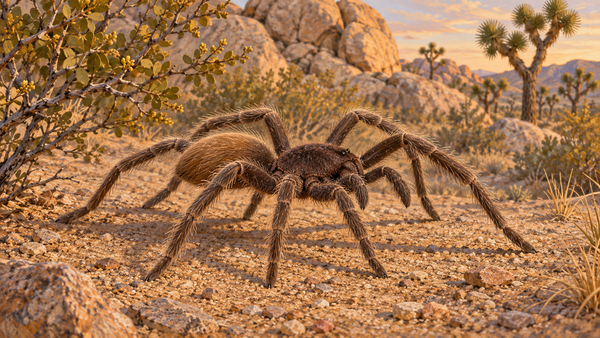
Something dark is moving across the pale ground. It is too deliberate to be a windblown leaf. Then the shape resolves into a tarantula, each leg finding its next place on the gravel.
In the desert, that short crossing can be a glimpse of a much longer story. A mature male may be searching for a mate—and much of the life he is leaving behind has happened out of sight.
- A tarantula in the open during fall may be a mature male searching for a mate.
- Burrows hide much of the spider’s life; courtship brings a different set of behaviors into view.
- Explore the hidden home, surface search and vibrational signals without disturbing a real spider.
A search, not a swarm
In Joshua Tree, a tarantula walking in the open during fall is likely to be a male looking for a female. It is a seasonal change in behavior that makes an otherwise inconspicuous animal easier to notice. It does not mean a coordinated group is traveling to one destination. [1]
Timing varies. The Natural History Museum of Los Angeles County describes a broad mating-season window that depends on weather and species. “Fall” is a useful clue for a local observer, not a promise that every tarantula follows the same calendar. [2]
A crossing alone cannot establish a spider’s sex, species or purpose with certainty. But the courtship explanation changes how you look at it: this may be a search, rather than an animal wandering without direction.
The life you usually do not see
Many southwestern tarantulas spend years associated with a burrow. They enlarge it as they grow and hunt around the entrance, usually remaining hidden during daylight. That leaves most of their lives outside the view of someone walking past. [3]
A burrow is more than an empty hole. Joshua Tree’s account describes a female’s burrow in sandy soil lined with silk. Silk can be part of the spider’s home even though there is no familiar circular web stretched between branches. [1]
The mature male’s search shifts attention from that sheltered home to the surface between burrows. The journey and the destination belong to the same story.
Follow the courtship journey
Move between the hidden home, the surface search and the entrance to a female’s burrow. The sequence is simplified: it shows the change in behavior, not a mapped route or a guaranteed successful encounter.
FROM UNDERGROUND TO OPEN GROUND
What brings him to the surface?
A burrow shelters a spider through much of its life. Here, the male and female occupy separate illustrative burrows.
Original schematic cutaway. Spider sizes, burrow shapes, spacing and depth are exaggerated for clarity. Rings show the idea of vibration; they are not measured signals. No mating or female response is guaranteed. [1–4]
Courtship is a conversation in vibrations
Finding another spider is only part of the task. Chemical cues help guide the search, while tapping and drumming communicate at close range. The Natural History Museum describes males tapping with their legs and pedipalps—the smaller appendages near the mouth. A receptive female may answer with tapping of her own. [2]
For us, the conspicuous feature is a large spider. For another tarantula, small movements through the ground can carry important information. The rings in the illustration make that otherwise invisible idea visible; they do not show a recording of a particular species’ signal.
Courtship is not automatically successful. The female may not be receptive, and approaching another large spider carries risks. The male’s behavior is therefore more complicated than simply arriving at a doorway. [2, 3]
The cost of leaving shelter
The surface search exposes a male to hazards that a sheltered spider can often avoid. National Park Service accounts describe males being killed on roads or taken by predators before finding a mate. That makes an ordinary-looking patch of open ground a consequential part of the journey. [4]
Males also generally have a shorter life after maturity than females, which can live for many years. It is tempting to turn this into a dramatic rule that every mating ends with the male being eaten. That is not the right conclusion: risk is real, but a particular outcome cannot be assumed. [2, 3]
Watch the crossing. Let it continue.
If a tarantula crosses your path, give it room. Watch without handling, chasing, feeding or blocking it. A photograph taken from a respectful distance can preserve the moment without changing the animal’s direction. [1]
There is no need to find or open its burrow to complete the story. The brief view above ground is valuable precisely because it shows an animal usually hidden from us. The next time that dark shape resolves into eight legs, you may be seeing a seasonal search unfold one step at a time.
Frequently asked questions
Why are tarantulas easier to see in fall?
Mature males may leave the area around their burrows to search for females. Joshua Tree describes fall sightings as likely males on this search. Timing differs by species and weather.
Is a wandering tarantula definitely male?
No. A brief sighting cannot establish sex or purpose with certainty. A male searching for a mate is a strong seasonal explanation, not an identification based solely on walking.
Do tarantulas live underground?
Many southwestern tarantulas spend much of their lives in or around burrows. They can use silk inside the burrow and hunt near its entrance.
Why does a male tarantula tap the ground?
Tapping and drumming are part of courtship communication. A receptive female may respond. The diagram represents that idea rather than a measured signal.
Should I pick up a tarantula to look at it?
No. Observe from a respectful distance and let it continue. Do not handle, chase or feed it, block its route, or disturb its burrow.
Sources and visual notes
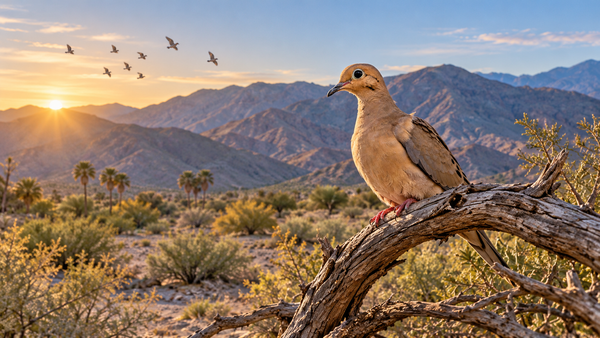
Sources checked November 8, 2026. The featured image is AI-generated and illustrative, not a wildlife photograph or documented sighting. The interactive uses original schematic vectors. Shapes, distances, burrow depths and signals are not measured, and the sequence does not identify a particular species.
- National Park Service — Tarantula, Joshua Tree. Local fall courtship, silk-lined burrows and low-disturbance observation. No species identification is inferred from the generated image.
- Natural History Museum of Los Angeles County — Creepy, Crawly, Courtship. Mating-season variation, chemical cues and vibrational communication.
- University of Arizona Cooperative Extension — Tarantulas. Burrow-centered life, nighttime hunting and male courtship. Arizona examples provide regional biological context.
- National Park Service — Tarantulas and Tarantula Hawks, Bandelier. Surface-search hazards and signaling near burrows; a New Mexico account, not a Joshua Tree sighting report.


