

















The Lizard That Inflates Itself Between the Rocks
Meet the chuckwalla—and explore how a narrow rock crevice becomes a refuge.

A heavy-bodied lizard slips between two rocks and disappears. The gap looks barely large enough to admit it. Then the animal does something that makes the hiding place work even better: it takes in air and presses its expanded body against the rock.
Meet the common chuckwalla. Its defense turns a narrow crack into a refuge—and gives us a reason to look at a rocky hillside as more than scenery.
- Chuckwallas retreat into rock crevices, then inflate their lungs to wedge themselves more tightly inside.
- They are mainly plant eaters; nearby food and rocky shelter both shape their habitat.
- Use the interactive cutaway to understand the defense, then observe wild lizards without disturbing them.
Meet the desert’s rock specialist
The common chuckwalla, Sauromalus ater, is a bulky lizard with a broad body, loose folds of skin and a substantial tail. It belongs to the iguana family, although it looks very different from the green iguanas many people picture. Its home includes the deserts of southeastern California. [1, 2]
Color is variable. Adults may combine dark heads and limbs with gray, brown, reddish or yellowish areas; females and younger animals can be banded. Shape, habitat and the whole animal are better clues than one color patch. [1]
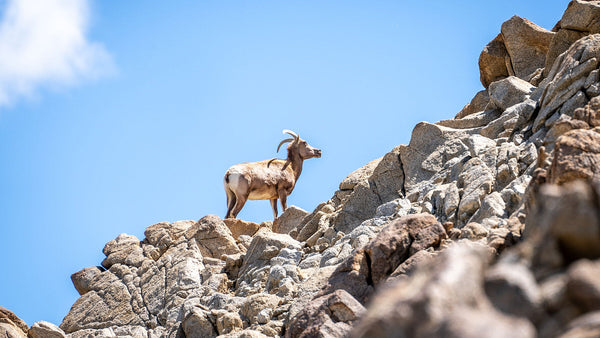
The important setting is rock: outcrops, boulder piles and the protected spaces between them. The chuckwalla needs plants for food, but a patch of vegetation without suitable rocky shelter is only part of the picture. [2]
Inside the crevice: a three-part defense
The sequence matters. First the chuckwalla retreats into a gap. Then it inflates its lungs, expanding its body and wedging itself more tightly against the surrounding rock. When the threat passes, it can deflate and emerge. It does not make the rock move, and it does not need to become a round balloon. [3, 4]
LOOK INSIDE THE ROCK
A small change makes a tight fit
Step through the defense. The rock stays still while the lizard’s position and body outline change.
The rock has a narrow opening. A nearby refuge gives the lizard somewhere to retreat if danger approaches.
An explanatory model, not a measured animal or a view through real rock. Expansion and movement are schematic; the illustration does not calculate lung volume, pressure or grip strength. Explore the sequence here, not by approaching or frightening a wild lizard.
Why the gap matters as much as the lizard
A hiding place works through its shape. A suitable narrow crevice surrounds the body closely enough that expansion can make extraction difficult. The animal and its shelter work together. That is why a pile of boulders can mean something different to a chuckwalla than an open stretch of ground. [2, 3]
The animation simplifies the animal into an outline so you can follow that relationship. It is not a diagram of a particular chuckwalla’s lungs, and the size change is not a scientific measurement. What matters here is the order: retreat, expand, remain sheltered, and later emerge.
A plant eater on the rocks
Despite its imposing build, a chuckwalla feeds mainly on plants. Leaves, flowers and fruits supply food, and moisture in its diet helps it live in a dry environment. It is not simply a bigger version of every insect-catching lizard you see beside a trail. [1, 2, 4]
Joshua Tree National Park describes a useful broad contrast: chuckwallas are large plant-eating lizards of rocky areas, while desert iguanas fill a similar role on the flats. This is a way to read habitat, not an identification rule with no exceptions. [5]
Food nearby
Plants supply leaves, flowers and other food. A rocky refuge alone does not provide everything the lizard needs.
Shelter nearby
Boulder cracks offer protected spaces. A food-rich patch without suitable shelter leaves out the other half of the story.
Sun, shade and shelter
Chuckwallas bask on exposed rock and shift their activity with conditions. California’s wildlife account describes much of their activity in spring and early summer, with warm-area activity possible at other times. Weather and location matter more than a guaranteed calendar date. [2]
A rock crevice is therefore more than an emergency escape route. It is part of the animal’s daily choice of exposed and sheltered places. Compare this with how a desert iguana uses sun, shade and shelter: desert adaptation still requires behavior, not just an ability to tolerate heat.
Look at the spaces between the rocks

On your next permitted trail walk, notice where large rocks meet. Look at the shaded seams, the nearby plants and the exposed surfaces above them. You can practice seeing the habitat even when no animal is visible.
If you do see a lizard, stay back and use a long lens or binoculars. Do not try to demonstrate the defense by chasing it into a crack, lifting rocks or reaching into a refuge. A chuckwalla that remains calmly on its perch is a better encounter than one forced to hide. Joshua Tree’s wildlife guidance specifically asks visitors not to disturb these wary lizards. [5]
Explore the Chuckwalla Trail guide for the landscape used as the illustration’s reference. The trail’s name does not guarantee a sighting. For another way to read rocky country, continue with why Joshua Tree’s rocks look like that.
CHECK THE SEQUENCE
What makes the refuge harder to leave—for a predator?
Frequently asked questions
Why does a chuckwalla inflate its body?
After retreating into a rock crevice, it can inflate its lungs and expand its body against the rock. This makes it harder for a predator to extract it.
Does it get stuck permanently?
The defense is reversible. When danger has passed, the lizard can deflate and emerge from a suitable refuge.
Is a chuckwalla an iguana?
It belongs to the iguana family, Iguanidae. The common chuckwalla is a different species from the green iguana and from the desert iguana.
What does a chuckwalla eat?
It is primarily herbivorous, eating plant material such as leaves, flowers and fruits. It may occasionally consume insects.
Where should I look for one?
Rocky outcrops and boulder piles within its desert range provide habitat. Observe from permitted trails and a distance; never disturb a refuge to find or flush an animal. A suitable-looking place is not a guaranteed sighting.
Sources and visual notes
Sources checked November 8, 2026. The featured image is an AI-generated natural-history illustration, not a photograph or a documented sighting. The rock cutaway is an original schematic illustration; its proportions are educational rather than measured. The close rock-refuge image is an AI-assisted reconstruction based on Mark Miller’s original Rancho Mirage landscape photograph. It illustrates possible shelter, not a surveyed rock formation or documented chuckwalla refuge.
- Arizona-Sonora Desert Museum — Common Chuckwalla. Appearance, range, rocky habitat and life history.
- California Department of Fish and Wildlife — Common Chuckwalla species account. CWHR account, updated March 2000. California habitat requirements, food and activity patterns.
- National Park Service — Common Chuckwalla, Grand Canyon-Parashant. Retreat, lung inflation and emergence; background on the animal.
- Nevada Department of Wildlife — Chuckwalla. Body shape, plant-based diet, dietary moisture and crevice defense. Nevada-specific range statements are not used as California location evidence.
- National Park Service — Lizard Lifestyles, Joshua Tree. Rock-dwelling chuckwallas, desert iguanas on flats, basking and guidance not to disturb lizards.


