














The Racquet Club: Hollywood’s Desert Playground
How tennis, familiar faces and a private social world helped shape Palm Springs.

What makes a town feel like a destination? Sometimes it is a grand hotel or a remarkable landscape. Sometimes it is a place where the right people keep finding reasons to return.
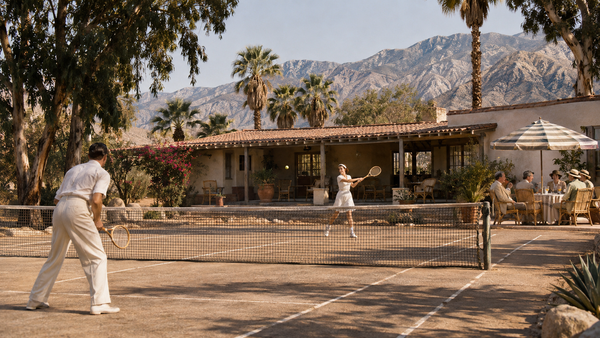
For Hollywood’s desert crowd, the Racquet Club was that kind of place. Actors Charles Farrell and Ralph Bellamy began with tennis courts north of Palm Springs’ center. During the 1930s, their venture grew into a social world of swimming, meals, guest cottages and familiar faces. Playing tennis was one reason to come. Knowing who might be there was another.
The club helped make a particular image of Palm Springs persuasive: a place where famous people could exchange the demands of Hollywood for a more informal life. Its later decline raises a different question—how do you preserve a place whose significance came as much from what happened there as from what was built?
- Tennis was the beginning. Farrell and Bellamy’s club became a recurring meeting place for Hollywood’s desert visitors.
- The social setting mattered. Courts, dining, a pool and cottages helped turn an afternoon visit into a longer stay.
- Two preservation stories need separating. The original club and the neighboring Garden Villas have distinct historic designations.
- Designation does not mean restoration. The surviving features tell only part of the story.
How the club grew—and what was lost
Select an era to follow the changing place, not just the famous names.
Selected milestones. The adjacent Garden Villas have a separate preservation history, explained below.
Two actors looking for a court
Farrell and Bellamy’s starting point was practical. Local histories describe their frustration at relying on hotel tennis courts, where paying guests had priority. They wanted somewhere they and their friends could play on their own terms.
The Palm Springs Preservation Foundation dates the Racquet Club’s establishment to 1934 and describes its modest beginnings: two courts and a snack bar. Historical accounts also describe preliminary court-building and play in 1933. The distinction matters more than an argument over a single opening-day anecdote. An informal sporting arrangement was becoming an institution.
The familiar story about being displaced by a particular movie star is best treated as a story told about the club, not as the necessary explanation for its existence. A need for reliable courts, a circle of Hollywood friends and room to expand are enough to explain the opportunity.
Nor was Palm Springs waiting to be discovered. Cahuilla people had made this their homeland long before resort development, and hotels already attracted visitors. The Racquet Club entered an existing place and helped change its reputation.
The attraction was the company
The club’s influence grew from repeated encounters. A guest could watch a match, meet friends for lunch, linger at the pool and see the same people again that evening. Sport supplied the structure; hospitality made staying worthwhile.
Writer and longtime club insider Gloria Greer captured that atmosphere in a 2012 recollection for Palm Springs Life. Remembering a childhood visit with Ed and Sylvia Sullivan, she described moving past tennis courts into a dining room and then out toward the pool. The people being pointed out included performers she would later know as major stars.
Her account is valuable because it describes a lived social setting, not just a guest list. The rooms, court and pool belonged to one continuous experience. A visit could move between activity and conversation without leaving the club.
That helps explain the appeal of exclusivity. Privacy did not necessarily mean solitude. It could mean being around people who understood the same professional world, without performing for a general audience. The club offered a version of informality that depended on knowing who belonged.
A private retreat with a public image
Humphrey Bogart, Errol Flynn and Lana Turner appear among the early visitors identified by the Preservation Foundation. Other accounts connect the club with a much longer roster of performers. But piling up names can obscure the more interesting relationship between Hollywood and the desert.
A star at leisure made Palm Springs look different from a filming location or a conventional vacation stop. Tennis clothes, poolside afternoons and casual meals suggested that this was where public figures became private people. That impression helped sell the destination, even when the actual club experience was limited to members and their guests.
There was a tension within the retreat. The club offered privacy, yet it also became a setting for publicity photography. Greg Niemann’s history in the Coachella Valley Independent describes studio photo sessions and the mingling of established performers with newcomers. Hollywood was never entirely left behind.
Marilyn Monroe’s association with the pool belongs to that story. It is more careful to discuss photographs and encounters connected with her early career than to compress a complicated professional rise into a claim that one afternoon “discovered” her.
Legend or documented history?
The stories are part of the club’s appeal. Their details do not all have the same evidentiary footing.
Did the club open in 1933 or 1934?
Different milestones are being described. Greg Niemann’s historical account places early court play at Christmas 1933 and the grand opening in December 1934. The Preservation Foundation uses 1934 for establishment, while Gloria Greer’s recollection gives a different opening-day account.
What we can say: the project took shape in the early 1930s and became an established club in 1934. The sources used here do not support treating one precise ceremonial opening date as uncontested.
Did Marlene Dietrich get the founders kicked off a court?
A memorable detail in a broader origin story. Accounts describe Farrell and Bellamy depending on the El Mirador’s courts, with hotel guests receiving priority. Some retellings name Dietrich as a complainant; others explain the general difficulty of getting court time without making that detail central.
What we can say: wanting reliable access to tennis is the consistent explanation. The named-star confrontation is a reported anecdote, not a necessary fact on which the club’s history depends.
Was Marilyn Monroe “discovered” at the pool?
The association is stronger than the slogan. Greer recalls Monroe posing for publicity photographs at the club. Niemann recounts the poolside story involving photographer Bruno Bernard and agent Johnny Hyde.
What we can say: the club belongs in accounts of Monroe’s early publicity and Hollywood contacts. “Discovered here” compresses those encounters into a single breakthrough and should not be read as proof that her career began at the pool.
Compare the accounts by Gloria Greer and Greg Niemann with the Preservation Foundation’s chronology in the sources.
A club that grew around its guests
The physical place expanded with its popularity. The Preservation Foundation records a swimming pool in 1935, dining-room enlargements in 1937 and 1951, and 35 cottages added along Netcher’s Creek in 1946. Further cottages followed in 1956.
Those additions changed what a tennis club could be. Overnight accommodation let the social world continue beyond an afternoon match. Dining and gathering spaces gave nonplayers their own reasons to visit. The property became a small resort organized around a shared center.
It was also a place shaped by successive additions rather than a single architectural statement. Later modernist work joined an establishment whose earliest appeal had been straightforward recreation and companionship. That layered character is part of its history.
Farrell’s relationship with Palm Springs extended beyond hosting guests. The city’s historic assessment records his ownership through 1959 and his service as mayor from 1947 to 1955. The same person could welcome Hollywood friends, run a local business and help represent the city. The club’s social influence and Palm Springs’ civic ambitions were closely connected.
The club and the Garden Villas are different places
The Racquet Club’s name spread beyond the original grounds. For readers exploring architectural history, one distinction is essential: Racquet Club Cottages West, now known as Racquet Club Garden Villas, is an adjacent development with its own design and preservation history.
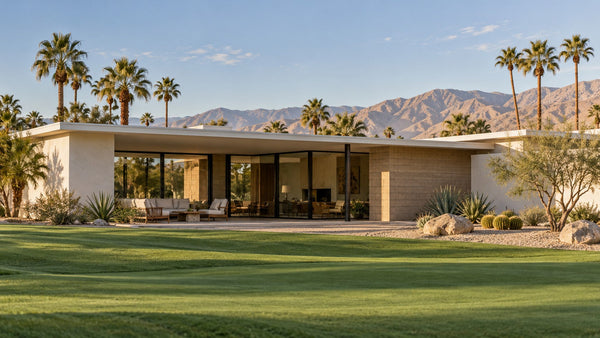
The Foundation identifies that complex as 37 modernist condominiums, designed by William F. Cody and developed by Paul Trousdale in 1959–1960, with landscape architecture by Phil Shipley and Associates. Its relationship to the club is part of its significance, but it should not be treated as interchangeable with the earlier clubhouse and courts.
Original Racquet Club
2743 North Indian Canyon Drive. The sporting and social institution founded by Farrell and Bellamy. Palm Springs designated the property a Class 2 historic site on January 28, 2021.
Racquet Club Garden Villas
360 West Cabrillo Road. The neighboring Cody-designed development, originally Racquet Club Cottages West. It became the city’s third historic district on November 20, 2013.
This is why a photograph, listing or tour description using the words “Racquet Club” needs context. It may refer to the original institution, the Garden Villas or a surrounding neighborhood.
When a gathering place loses its gathering
A social club’s buildings cannot keep its culture alive by themselves. Ownership changes, changing leisure habits and the loss of regular guests can weaken the reason for returning long before the last structure disappears.
The Racquet Club’s later history should not be reduced to one dramatic night. By October 2013, the Preservation Foundation had already warned that the property faced deterioration and the danger of fire or demolition through neglect. A major fire followed on July 23, 2014.
The city’s subsequent historic assessment documents extensive alterations and losses across the property, including removed tennis courts and landscaping. It also records the destruction of a two-story building in the 2014 fire. The surviving site therefore cannot stand in for the entire experience remembered by former guests.
That difference is central to preservation. A familiar name may endure after the spaces and routines that gave it meaning have been fragmented. Protecting what remains requires understanding both the losses and the surviving evidence.
What is being remembered—and what can be protected
The January 2021 designation identified contributing features including a tennis court, the main pool, the Schiff Residence, a Frey-designed bungalow and portions of the clubhouse. Those elements preserve different parts of the story: recreation, hospitality, domestic life and architecture.
A historic designation is not the same as a completed restoration, a reopened club or public access. The Foundation continues to document the Racquet Club among its buildings to watch. This article follows its history and documented designation; it does not present the property as an operating attraction.
The larger legacy is easier to recognize across Palm Springs. The city’s appeal has often depended on the relationship between architecture, leisure and the people associated with a place. The Racquet Club brought those ingredients together early and made them socially powerful.
Its story adds another layer to our coverage of Frank Sinatra’s desert life, Elvis’ Palm Springs homes and the city’s modern architecture. Those are connected histories of a destination—not claims that every celebrity belonged to this particular club.
The Racquet Club mattered because it made Palm Springs a place people wanted to return to together. Remembering it well means looking beyond the famous faces to the spaces, hosts and repeated rituals that made that possible.
The Racquet Club today
The original property is at 2743 North Indian Canyon Drive in Palm Springs. Its present-day story is the relationship between surviving fabric, missing spaces and a famous name. It should not be mistaken for the neighboring Garden Villas or presented as a restored club welcoming visitors.
In a February 17, 2026 report, Greater Palm Springs Business Insider described the property as a redevelopment offering after years of vacancy, failed proposals and damage. That is a dated account of its condition and marketing—not confirmation of today’s ownership, sale status or a future opening.
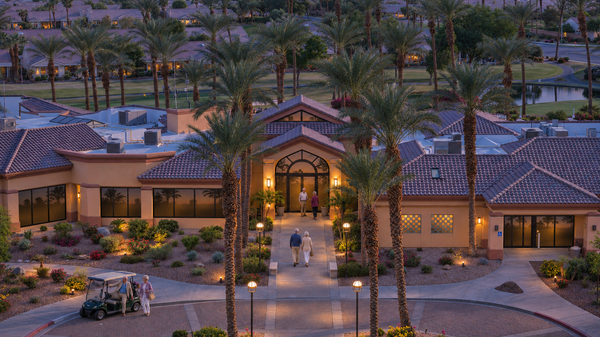
Reading the site: the features named in the 2021 designation are a historical record, not a guaranteed inventory of what remains visible today. Current photographs can document an entrance, building or landscape as it actually appears, while the earlier records explain its significance.
Racquet Club history questions
Who founded the Palm Springs Racquet Club?
Actors Charles Farrell and Ralph Bellamy founded it. The Preservation Foundation dates its establishment to 1934; historical accounts also describe preliminary tennis activity in 1933.
Why was the Racquet Club important to Palm Springs?
It became a recurring social destination for Hollywood visitors, combining tennis, dining, swimming and lodging. That association helped strengthen Palm Springs’ identity as a desert retreat.
Are the Racquet Club and Racquet Club Garden Villas the same property?
No. The original club is at 2743 North Indian Canyon Drive. The adjacent Garden Villas, originally Cottages West, are at 360 West Cabrillo Road and have a separate architectural and historic-district history.
What happened in the 2014 Racquet Club fire?
A major fire on July 23, 2014 damaged the historic complex. The city’s assessment records the loss of a two-story building, alongside other alterations and removals that changed the property over time.
Does historic designation mean the Racquet Club is open to visitors?
No. Historic designation recognizes significance; it is not evidence of restoration, operation or public access. This is a history article, not a visitor-access guide.
Sources and historical notes
Researched November 2, 2026. Sources differ on early court activity and exact opening dates; this article distinguishes the early-1930s beginnings from the commonly cited 1934 establishment. Recollections are identified as such. Historical designations do not establish present operating or access conditions.
- Palm Springs Preservation Foundation — The Racquet Club. Founding, expansion, fire, and January 2021 designation.
- City of Palm Springs / Historic Resources Group — Historic Resources Assessment: Palm Springs Racquet Club. Physical changes, surviving resources and historical significance.
- Gloria Greer, Palm Springs Life, December 18, 2012 — Creating a Racquet (Club). First-person recollection and club history.
- Greg Niemann, Coachella Valley Independent, February 11, 2023 — How Windswept Vacant Land Became the Palm Springs Racquet Club. Historical account of the club’s beginnings and social life.
- Palm Springs Preservation Foundation — Racquet Club Cottages West. Cody, Trousdale, landscape design and the separate 2013 historic district.
- City of Palm Springs — City Council action summary, November 20, 2013. Official record of the Cottages West historic-district action.
- Bob Marra, Greater Palm Springs Business Insider, February 17, 2026 — The Racquet Club: A Palm Springs Landmark at a Crossroads. Dated reporting on the site’s condition and redevelopment offering; not confirmation of present listing status.