













Why Do Some Desert Rocks Look Painted Black?
Look beneath desert varnish—and discover the thin coating that changes a rock’s appearance.

A pale desert hillside can be interrupted by a boulder so dark it looks painted. The contrast is especially striking where an old outer surface meets a lighter, naturally exposed face.
One explanation is desert varnish: a thin coating with a history different from the rock beneath it. Look closely, and a simple black patch opens a story about minerals, moisture, microbes and time.
- Some dark desert rocks wear a thin mineral coating called rock varnish; others are dark for different reasons.
- Clay, iron and manganese compounds help create the coating, with microbial activity contributing to its story.
- Explore the outside, a cross-section and a magnified model without disturbing a real surface.
A coating, not necessarily the whole rock
Rock varnish is a natural surface coating containing clay minerals and iron and manganese oxides. It can make the exterior look very different from the underlying rock. Manganese-rich coatings tend toward dark brown or black; other mixtures can look more reddish. [1, 2]
That does not make every black surface varnish. Some rocks contain dark minerals throughout. Some dark areas are shadows. Other surface coatings can resemble varnish, and geologists distinguish between them. The useful first question is not just “What color is it?” but “Where is that color?” [1, 5]
Look beneath the surface—without touching it
Imagine moving from the view on a trail to a cross-section, then to a much closer look. The illustrations below separate the host rock from its coating. They are teaching models, not a sample collected from the featured scene.
THREE SCALES OF ONE IDEA
The outside has its own story
A dark outside and a lighter naturally exposed face can suggest a coating. The color contrast is a clue, not a laboratory identification.
Original conceptual drawings. The rock, colors, grains and layer thickness are not measured. Switching views changes the illustration; it does not depict scraping or peeling a real rock. Leave natural surfaces intact.
What makes it black?
The dark material is not a layer of household varnish and it is not simply dirt baked into paint. Rock varnish is a mineral mixture. Clay makes up much of it, with iron and manganese compounds contributing strongly to its appearance. Early chemical studies of southern California varnishes found those metals enriched relative to the underlying rock. [1, 2, 3]
A little material can make a large visual difference when it lies at the surface. You are looking at the part that meets the light, not seeing straight through to everything below. The exaggerated cross-section makes that distinction visible.
The coating also need not be uniformly black. Patches, warmer browns and variations across one face are part of what makes a varnished boulder worth a closer look. A dark surface is not automatically a different rock type. [1, 6]
Dust, moisture—and microscopic life
Varnish formation brings together material arriving at a surface and changes happening there. Windblown dust can supply fine particles. Thin films of water can move dissolved substances even where a rock looks dry much of the time. Researchers have investigated both chemical and biological contributions to the accumulation of manganese. [2, 3]
There is life in this seemingly bare setting. A study of varnish in the Whipple Mountains identified diverse microbial communities associated with the coating. That finding shows that varnish can be a habitat; on its own, it does not explain every step of its formation. [4]
In 2021, researchers studying western U.S. varnishes found abundant photosynthetic cyanobacteria and evidence that their uptake and use of manganese could help explain its enrichment. This supports a biological mechanism within a system also shaped by sunlight, water and mineral chemistry. It is more precise than saying bacteria simply “paint rocks black.” [2]
A slow history, not a simple clock
A dark coating can suggest a surface has remained exposed and stable long enough for material to accumulate. But darkness is not a ready-made age scale. Growth and loss depend on local conditions, the surface and the processes acting on it. [3, 6]
In their 1958 southern California study, Engel and Sharp described widely varying formation rates. Some coatings represented very long intervals, while a much faster example occurred at one Mojave locality. One timetable cannot be applied to every boulder. [3]
It is also useful to separate two histories: when the rock itself formed, and what has happened to its exposed surface. A coating is part of the latter. The old rock beneath it and the younger surface record do not have to share an age.
Read a real landscape carefully

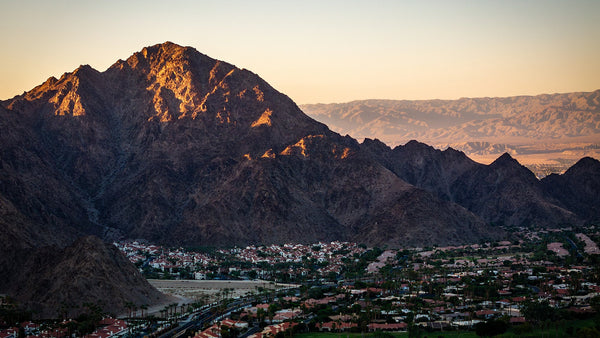
In my photograph, some rock faces catch warm light while others sit in shade. Begin by noticing that lighting difference. Then look for a color boundary that follows the rock’s surface rather than the edge of a shadow.
A naturally exposed face can offer a comparison without anyone breaking the rock. Texture, location and existing color boundaries help frame better questions. They do not replace the close examination and analysis needed to identify a coating with confidence.
The larger shapes have a different story, explored in why Joshua Tree’s rocks look like that. Weathering can shape an entire boulder while a coating changes what its surface looks like. [5]
Leave the surface record intact
Look, photograph and compare. Leave scraping, chipping and cleaning out of the exercise. In places with rock art, people made use of the contrast between a dark surface and lighter rock below; those cultural records deserve particular care. [1]
The next dark boulder you pass does not need to yield a perfect identification to become more interesting. You can notice whether color follows the surface, where moisture might travel, and how one face differs from another—all while leaving the record in place.
ONE QUICK CHECK
A black boulder—is it definitely varnish?
Frequently asked questions
What is the black coating on some desert rocks?
One possibility is rock varnish, a thin natural coating containing clay minerals and iron and manganese oxides. Black appearance alone cannot identify it; dark minerals, shadows and other coatings can look similar.
Is desert varnish the same as the rock underneath?
No. A varnish coating can differ in composition and color from its host rock. A light naturally exposed face beside a dark exterior can reveal that contrast.
Do bacteria make desert varnish?
Microbes live in varnish, and research supports a biological role in manganese enrichment. Varnish also involves water, light and mineral chemistry; it is too simple to describe every coating as bacteria painting the rock.
Can I tell the age of a rock by how black it is?
No. Coating formation and loss vary with local conditions, and a surface coating has a different history from the rock itself. Darkness does not provide an exact age.
Should I scratch a rock to see whether it has varnish?
No. Observe existing natural exposures and photograph the surface. Leave coatings and any rock art intact; the illustrations let you explore a cross-section without damaging a real rock.
Sources and visual notes
Sources checked November 8, 2026. The featured image is an AI-generated illustrative scene, not a sampled or laboratory-identified rock. The three-scale diagrams are original schematic vectors with exaggerated layers and illustrative colors, not microscopy. The Hall of Horrors image is original photography by Mark Miller.
- National Park Service — Desert Varnish. Coating terminology, composition, color variation and rock-art context.
- Lingappa and colleagues (2021) — An ecophysiological explanation for manganese enrichment in rock varnish. PNAS 118, e2025188118. Primary research on physical, chemical and microbial aspects of varnish, including cyanobacterial manganese uptake.
- Engel and Sharp (1958) — Chemical data on desert varnish. Geological Society of America Bulletin 69:487–518. Southern California analyses and variation in formation rates. Historical findings are distinguished from more recent biological research.
- Kuhlman and colleagues (2006) — Diversity of Microorganisms within Rock Varnish in the Whipple Mountains, California. Applied and Environmental Microbiology 72:1708–1715. Microbial communities associated with varnish.
- USGS — Geology of Joshua Tree National Park. Regional rock types and weathering; context for separating rock formation and shape from surface appearance.
- Arizona-Sonora Desert Museum — Desert Soils. Joseph R. McAuliffe. Desert surface development, varnished stones and the relationship between rock weathering and coating persistence.


