








Where Does a Desert Tortoise Go All Day?
Follow its hidden life below ground—and see how weather changes the day.

On a hot afternoon, you can look across a desert hillside and never see the tortoise that lives there. It may be close by, behind an entrance that blends into the ground, spending the difficult part of the day in shelter.
For the Mojave desert tortoise, also called Agassiz’s desert tortoise, going underground is a major part of living above ground. Its day is shaped by temperature, moisture and opportunities to feed—not by a fixed timetable.
- Much of a desert tortoise’s life happens in shelter, beyond what a visitor can see.
- Burrows buffer heat, cold and drying conditions; activity changes with weather and season.
- Explore four scenarios, then learn why an empty-looking landscape may still be occupied.
Most of the story is hidden
The animal in this story is Gopherus agassizii, the native desert tortoise found in southeastern California and neighboring parts of the Southwest. “Desert tortoise” is also used for related species elsewhere, so not every observation from Arizona or Mexico should be treated as a description of the same animal. [1, 5]
Its sturdy legs and claws help it excavate shelter. A burrow buffers the conditions outside, offering protection from temperature extremes and the drying air of the surface. The shell is part of its protection; choosing where to spend its time is another part. [1, 2]
National Park Service accounts often summarize this hidden life as about 95 percent of the time underground. Think of that as a broad description of how shelter-dependent the animal is, not a stopwatch reading for every individual or every day. [1, 3]
Change the conditions, change the day
A mild morning and a hot afternoon can offer very different opportunities. Rain may make water and fresh plants available, while winter cold can mean a long period of reduced activity. Explore the scenarios below without treating them as guaranteed sightings. [2, 3, 5]
ABOVE GROUND / BELOW GROUND
Where would shelter matter most?
Choose a set of conditions. Follow the illustrated tortoise between the surface and its burrow.
When temperatures and other conditions are suitable, a tortoise may emerge to feed, move or seek a mate. Being a desert animal does not mean spending the hottest hours in the sun.
Conceptual cutaway. The tunnel, animal, sun and plants are not to scale. These are separate scenarios, not a daily schedule, live forecast or temperature model. Rain alone does not guarantee activity; temperature, season and the individual also matter.
What the burrow changes
At the surface
Sun, wind and temperature can change exposure quickly. Finding food may require leaving cover.
In shelter
The surrounding ground reduces the extremes. Shelter can be cooler in hot weather, warmer in cold weather and less drying than exposed air.
The burrow does not manufacture cold air. It changes the tortoise’s exposure to the world outside. A shaded, buffered space can make a major difference to an animal whose body temperature depends on external conditions. [1, 2]
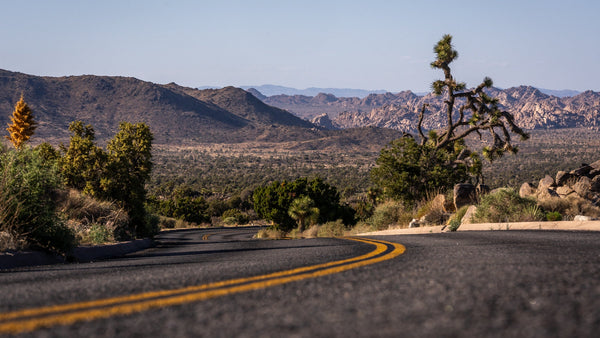
Do not picture one standard tunnel that every tortoise copies. Shelter varies with terrain. USGS research in southern Joshua Tree has documented tortoises using steep boulder piles and small mountains, while populations elsewhere use flatter ground and soils suitable for digging. [4]
Water is part of the story, too
Grasses, wildflowers and other plant foods provide both nourishment and moisture. Tortoises also drink when water is available, and their urinary bladder is an important water reserve. A period of rain can therefore create opportunities beyond simply cooling the surface. [1, 3]
That reserve helps explain why a close encounter should stay calm. A frightened tortoise may empty its bladder and lose stored water. Use distance and a long lens, rather than handling the animal for a better view. [3]
Adaptation has limits. In long-term Joshua Tree studies, USGS researchers linked prolonged drought with declining tortoise populations. The ability to conserve water does not make a tortoise independent of rain, food or a functioning habitat. [4]
A landscape of refuges, not one front door
A tortoise can use multiple shelters over time. Their use varies with season and local conditions; the Forest Service’s review describes substantial variation in burrow use across studies. The cutaway follows one refuge to explain the idea, not a permanent address for every animal. [5]
Food patches, shelter and the routes between them belong to the same living landscape. A burrow that looks empty from outside may still matter. An animal can be farther back than you can see, or it may use that refuge at another time.
This is one reason to keep vehicles on established roads and avoid damaging burrows. There is more to protect than the animal visible in the moment. [3]
Read the day without chasing the animal
If you do not see a tortoise, that alone tells you very little about whether one lives nearby. Look at the habitat from permitted trails: the soil, available cover, low vegetation and the changing balance of sun and shade. Do not probe openings, block entrances or try to lure an animal out.
If you are lucky enough to encounter one, give it room to continue naturally. For any animal in immediate danger on a road, prioritize your own safety and seek guidance from park staff; a routine wildlife sighting is a reason to watch, not relocate.
The same habit of looking beneath the obvious connects with the chuckwalla’s rock-crevice defense and how plants survive between rainstorms. Much of desert life depends on what happens out of sight.
ONE QUICK CHECK
No tortoise in sight. What does that tell you?
Frequently asked questions
Where does a desert tortoise go during the hottest part of the day?
It may retreat into a burrow or other protected shelter. Underground conditions buffer the temperature and moisture extremes of the exposed surface.
Does a desert tortoise spend exactly 95 percent of every day underground?
No. National Park Service accounts use about 95 percent as a broad summary of shelter use. Individual activity varies with season, weather and local conditions; it is not a fixed daily timetable.
Are desert tortoises only active at night?
No. They can be active during daylight when conditions are suitable. Hot weather can limit exposed activity, while cooler seasons can allow daytime movement.
Does one tortoise always use the same burrow?
Not necessarily. Tortoises can use multiple shelters, and shelter choice changes with terrain, season and local conditions.
Should I pick up a tortoise to help it?
Leave a routine wildlife encounter undisturbed. Frightening or handling a tortoise can cause it to lose stored water. For an animal in immediate danger on a road, prioritize your safety and seek guidance from park staff.
Sources and visual notes
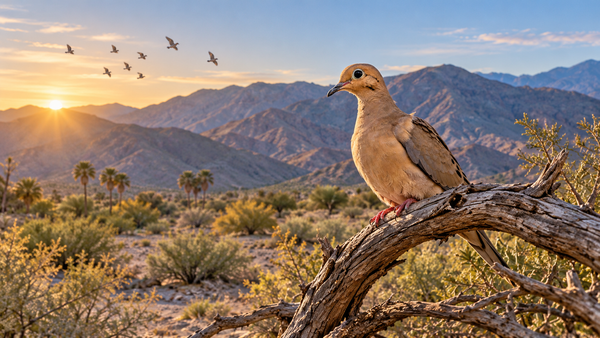
Sources checked November 8, 2026. The featured image is an AI-generated natural-history illustration, not a photograph or a documented sighting. The interactive cutaway uses original schematic drawings. Its geometry, colors and animal position explain scenarios; they do not reproduce a surveyed burrow, forecast or measured temperature record.
- National Park Service — Desert Tortoise, Joshua Tree. Species identity, burrowing, plant foods and water conservation.
- National Park Service — Desert Tortoise, Death Valley. Buffered burrow conditions and changing daily activity.
- National Park Service — Desert Tortoise, Mojave National Preserve. Shelter use, seasonal opportunities, stored water and low-disturbance observation.
- USGS — Desert Tortoise Ecology. Research in southern Joshua Tree, terrain differences and drought-related population change.
- USDA Forest Service — Desert tortoises species review. Species distinctions, seasonal activity and variation in use of shelter. The review covers several species; this article focuses on Gopherus agassizii.


