

























How Do Bighorn Sheep Stand on Rocks That Steep?
Split toes, firm edges and softer pads—working together.

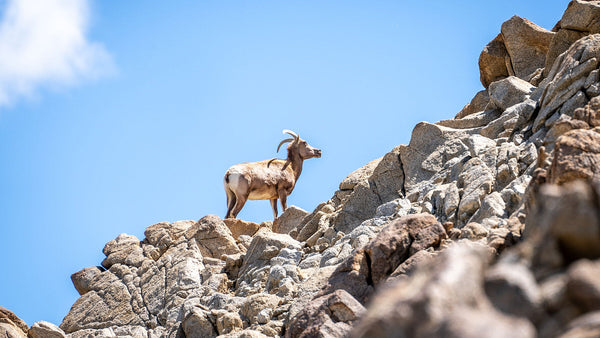
A bighorn stands among broken rocks, with its feet on surfaces that barely look large enough to hold it. From below, the hillside can seem like a wall. From the sheep’s position, it is a series of places to stand.
My photograph captures that contrast. To understand the foothold itself, we need to look much closer—at a foot built from two main toes, firm edges and softer contact surfaces.
- Two main toes, firm hoof edges and softer pads help a bighorn find a foothold.
- Feet work with flexible joints, vision and coordinated movement.
- Explore the contact in a schematic close-up, then connect it to the rocky habitat in Mark’s photograph.
Start with the foot, not the horns
The horns get our attention, but the feet explain much of the climbing. A bighorn has cloven hooves: each foot ends in two main weight-bearing toes rather than one continuous hoof. These can spread, helping the animal place its foot on uneven ground. [1, 2]
That split is one part of the arrangement. The outer hoof is firm, while the inner contact area is softer. A useful comparison is a shoe with different materials at its edge and sole—though the sheep’s foot is a living structure that moves with the animal. [2, 3]
Take a closer look at the foothold
Choose a feature below, then switch to the side-view example. The drawings explain relationships, not exact anatomy or a calculated limit on how steep a sheep can climb.
A FOOT MADE FOR BROKEN GROUND
What makes the contact work?
The two main toes can spread instead of acting as one rigid block. This helps the foot fit an uneven place to stand.
Original conceptual drawings, not veterinary anatomy or measured pressure maps. Toe separation and pad deformation are exaggerated. A highlighted feature contributes to grip; it does not guarantee traction on every surface. [1–3]
Firm edges and softer centers
A hard rim and a yielding pad do different jobs. Firm edges can engage small irregularities in the rock. Softer, elastic centers help the hoof make contact with the surface. Calling the entire hoof “rubbery” misses that combination of materials. [2, 3]
Nor does a soft pad work like a suction cup. Bighorns do not attach themselves to a cliff by sealing a vacuum. They maintain contact, place their feet and balance their weight. The drawing highlights a possible contact point; it does not mean every step uses the same part of the hoof.
The rest of the animal matters too
The foot works with flexible joints and coordinated movement. National Park Service interpreters describe ankle flexibility alongside split hooves and soft pads when explaining the climbing abilities of bighorns and mountain goats. A useful foothold still has to be found and used. [1]
Vision is part of that process. Bighorns have keen eyesight, and climbing involves judging the ground ahead, not simply pushing a special sole against whatever surface appears. [3, 4]
Watch a sheep pause and shift its weight, if you have the opportunity to observe without disturbing it. The whole sequence matters: where it looks, where it places a foot and how it moves onto the next support. One still photograph cannot show all of those decisions.
Why the rocks are worth climbing
Steep, open terrain is useful habitat, not just an obstacle. California wildlife biologists describe bighorns using rugged ground, vigilance and climbing to detect and escape predators. Their range also includes canyons, washes and alluvial fans; they do not spend every moment balanced on a cliff. [4]
Food and water connect these different parts of the landscape. The ability to move through rough terrain helps an animal use its surroundings, while access to water and suitable forage remains important. A remarkable hoof does not make habitat loss irrelevant. [4, 5]
A local animal, not a climbing demonstration
The bighorns along the San Jacinto and Santa Rosa mountains belong to the federally endangered Peninsular population. The broader story of their food, range and conservation is in my Bighorn Sheep of the Coachella Valley guide. This article concentrates on one smaller question: how a foot meets a rock. [4]
Use distance, binoculars or a long lens to watch. Do not approach to make an animal move or follow it onto steep ground. Respect closures and give wildlife room. [5]
The next bighorn on a rocky slope may still look impossibly balanced. Look below the horns. What first seemed like one small point of contact is a flexible arrangement of toes, edges and pads, working with the rest of the animal.
Frequently asked questions
What helps bighorn sheep grip steep rocks?
Split hooves, firm outer edges, softer inner pads and flexible feet contribute to traction and balance. The animal’s vision and coordinated movement matter too.
Are bighorn hooves like suction cups?
No. Their contact surfaces provide traction; they do not seal a vacuum against the rock. The toes, rims and pads work with foot placement and balance.
Why are the hooves split?
Each foot has two main weight-bearing toes that can spread, helping it fit uneven terrain instead of acting as one rigid block.
Can bighorn sheep climb any cliff?
No. Specialized feet do not guarantee grip on every surface. The drawings do not predict a maximum climbing angle or prove that any particular ledge is safe.
Are the Coachella Valley’s bighorns protected?
The Peninsular population is federally endangered. Watch from a distance, respect closures and avoid making sheep move for a closer view or photograph.
Sources and visual notes
Sources checked November 8, 2026. Featured photograph by Mark Miller; it documents the animal and rocky setting, not the underside of its hoof. Interactive images are original conceptual vectors, not veterinary anatomy, pressure measurements or a measured climbing simulation. The general hoof features are distinguished from local conservation information.
- National Park Service — Along the Way #15: Mountain Climbers. Split toes, soft pads and ankle flexibility; an interpretive comparison of bighorns and mountain goats.
- National Park Service — Desert Bighorn Sheep, Colorado National Monument. Flexible hooves, pads and rocky terrain.
- Los Angeles Zoo — Desert Bighorn Sheep. Harder hoof edges, soft elastic centers and visual abilities. Numeric climbing claims are not used.
- California Department of Fish and Wildlife — Peninsular Desert Bighorn Sheep. Local population, endangered status, habitat and predator avoidance.
- National Park Service — Desert Bighorn Sheep: Living Life on the Edge. Escape terrain, habitat connections, water and responsible observation. Population estimates on that page are not repeated here.


