















How Can a Kangaroo Rat Live Without Drinking Water?
A seed, a burrow and a body built to conserve moisture.

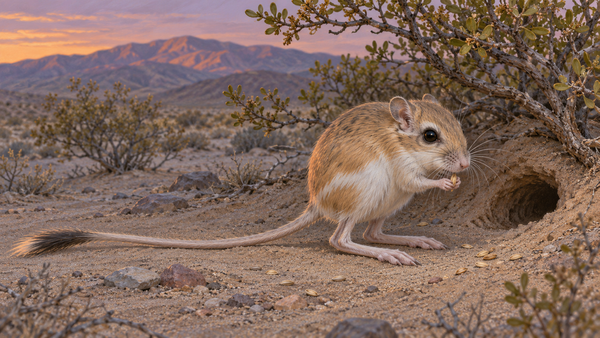
A small animal sits beside a burrow, holding a seed in its front paws. It has oversized back feet, a long tail and no water bowl in sight.
For a kangaroo rat, that seed can be part of the answer to a much bigger question: how do you keep a body supplied with water in a landscape where drinking water may be scarce?
The answer combines water gained from food with unusually effective ways of keeping water from leaving.
- Kangaroo rats still need water; food moisture and metabolism can supply it without drinking.
- Conserving water is just as important as obtaining it.
- A burrow, nighttime foraging and seasonal foods are parts of the same survival strategy.
Without drinking is not without water
Kangaroo rats are rodents, not miniature kangaroos. Several species live in western North America. Merriam’s kangaroo rat, Dipodomys merriami, occurs across much of California’s desert country, including desert scrub in Riverside County. Its water comes from moisture in food and from metabolism. [1]
“Without drinking” describes a remarkable ability, not a body that has stopped needing water. Cells still depend on it. The difference is how the animal obtains its supply—and how little it can afford to waste.
A field study of wild Merriam’s kangaroo rats in the Mojave Desert found that the animals did not drink even when rain briefly made water available. That observation is stronger than a slogan, but it belongs to the animals and conditions studied. It is not a claim that every kangaroo rat everywhere will never take a drink. [2]
Two ways food supplies water
First, food contains moisture. Even a seed that feels dry need not contain zero water. Green vegetation and insects can contribute more moisture, depending on what the animal eats. Merriam’s kangaroo rats are seed eaters whose diets can include both. [1, 2]
Second, the body makes metabolic water. As nutrients are broken down and used with oxygen, water is among the products. This is different from squeezing water already present out of a seed. The animal’s metabolism is producing it. [3]
These inputs matter together. The Mojave field study found that diet varied by season, with green vegetation and arthropods important in late winter and early spring. It also suggested that seeds stored underground took up moisture from humid burrow air before being eaten. A dry-looking surface can conceal a more complicated water supply. [2]
Follow the water through the animal
Select a part of the story below. The diagram separates water arriving from food and metabolism from water leaving the body. Its paths show connections, not measured quantities.
A WATER BUDGET WITHOUT A WATER BOWL
Gain water. Limit the losses.
Moisture already in a seed or other food enters with the meal. This is separate from metabolic water produced inside the body.
Conceptual diagram, not a measured daily budget. Line widths and box sizes do not represent volumes or percentages. Shelter affects the surroundings in which water is lost; it does not eliminate breathing or waste. [1–4]
Keeping water in is half the solution
A supply that looks small to us can matter when losses are small too. Kangaroo rats produce concentrated urine and dry droppings. Their nasal passages also recover some moisture from outgoing breath, reducing the amount lost to the air. None of these adaptations makes water loss disappear. Together they reduce it. [3, 4]
Think of the difference between adding to a container and slowing a leak. Food and metabolism supply water; conservation changes how quickly that supply is used up. Metabolic water alone is not the whole explanation for desert survival.
Nor should this become a recipe for a person or a pet. This is the ecology of wild animals with particular adaptations and diets, not a reason to withhold drinking water.
The burrow is part of the system
Kangaroo rats generally shelter below ground during the day and forage at night. A burrow offers a more stable environment than the exposed surface. Its conditions can help conserve moisture as well as provide shelter. [3, 4]
CHANGE THE TIME OF DAY
The surface is only part of its world
Below ground, the animal avoids the exposed daytime surface. Shelter and behavior work alongside its water-conserving body.
Illustrative burrow layout, animal size and seed cache; no depth or temperature is implied. The night view represents a foraging trip, not continuous activity all night.
Seeds are carried in external cheek pockets and stored for later. A surface trip can therefore supply meals eaten underground. Collecting food, returning to shelter and conserving moisture are connected parts of the animal’s daily life. [3]
A nighttime animal in a living desert
Merriam’s kangaroo rats use desert flats and slopes with suitable soils for burrowing. They are also prey for animals including owls, snakes and foxes. A seed eater that is easy to overlook in daylight still connects plants, soil and predators. [1]
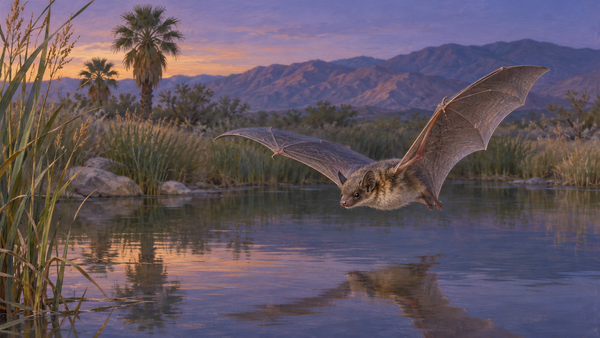
The underground refuge has a useful parallel in a desert tortoise’s daily routine, while bats over a pond show a different relationship with open water. There is no single desert survival strategy.
If you encounter a kangaroo rat, watch from a distance without blocking or opening its burrow. The most interesting part of the scene may be what you cannot see: a meal, a sheltered chamber and a body doing an extraordinary job of holding onto water.
Frequently asked questions
Do kangaroo rats really live without drinking water?
Some can meet their water needs without drinking under natural conditions. Food moisture and metabolic water supply them while adaptations reduce losses. This does not mean their bodies do not need water, or that every species and individual never drinks.
How can a dry seed provide water?
A seed may contain some moisture already. Separately, the animal produces metabolic water as it uses nutrients with oxygen. Both contribute to its supply.
Do kangaroo rats eat only seeds?
Seeds are important, but diets vary by species, season and conditions. Merriam’s kangaroo rats can also eat green vegetation and arthropods. A Mojave field study documented substantial seasonal changes.
How do kangaroo rats avoid losing water?
Concentrated urine, dry droppings and moisture recovery in the nasal passages reduce losses. Burrow shelter and nighttime activity also help. Water conservation works with the supply from food and metabolism.
Are kangaroo rats related to kangaroos?
No. They are rodents. Their enlarged hind feet and hopping movement explain the common name; the long tail and small front paws help give them their distinctive appearance.
Sources and visual notes
Sources checked November 8, 2026. The featured image is an AI-generated natural-history illustration, not an original wildlife photograph or documented sighting. The water paths and burrow cutaway are original schematic vectors, not measurements, anatomical drawings or a surveyed burrow. Interactive highlights explain relationships and do not calculate a real animal’s water balance.
- California Department of Fish and Wildlife — Merriam’s Kangaroo Rat life history. Regional distribution, habitat, diet, water sources and predators.
- Nagy and Gruchacz (1994) — Seasonal Water and Energy Metabolism of the Desert-Dwelling Kangaroo Rat. Physiological Zoology 67:1461–1478. Published abstract: wild Merriam’s kangaroo rats, seasonal diet, water balance and possible moisture uptake by cached seeds in the Mojave Desert.
- National Park Service — Kangaroo Rats, White Sands. Cheek pockets, burrows, food and metabolic water, and water-conserving adaptations. Regional examples are not treated as Coachella Valley observations.
- Arizona-Sonora Desert Museum — The Desert Adaptations of Birds & Mammals. Peter Siminski. Microclimates, metabolic water, respiratory moisture recovery and concentrated waste.
- San Diego Natural History Museum — Merriam’s Kangaroo Rat. Regional natural-history account and food-water relationship.


