



















Why Is the Dirt Green at Desert Construction Sites?
What colored soil treatments can do—and why a photograph cannot identify the material.

Among the unfinished homes and pale sand in my November 6 Cotino photographs, patches of ground have an unmistakable turquoise-green cast. It is the kind of detail that makes you look twice: why would a construction site have green dirt?
Green coloring can be part of a sprayed soil treatment. Some products bind loose particles to control dust or erosion; others are fiber mulches used with seeding. The color can help crews see coverage. The photographs do not identify which treatment was used at Cotino, and I have not verified a product or application record for these parcels.
- Some soil treatments contain dye so crews can see coverage.
- Dust binders and hydraulic mulch can both create colored ground.
- A green surface does not establish the product, seed content or safety.
- The treatment on the photographed Cotino parcels remains unconfirmed.
The green color can be a marker
A treatment does not have to be naturally green to leave a green surface. Manufacturers and contractors sometimes add color so an applicator can see where a spray has landed.
For example, Desert Mountain Corporation describes adding green dye to its Surface-Loc treatment so the treated area is visible and its condition can be monitored. That is a documented use of dye in a dust-control application—not evidence that Surface-Loc was used at Cotino.
The useful distinction is between the visible color and the material doing the work. The dye may mark coverage; the binder or mulch provides the soil-protection function. Seeing one does not tell you the composition of the other.
Dust control and erosion control solve related problems
Construction exposes and disturbs ground. Vehicles and equipment can loosen surface material, and wind can carry fine particles away. Water moving across bare ground can also transport soil.
Soil binders help hold particles together. Some form a surface crust; fiber mulches provide a protective layer, often with a binding agent. These approaches can overlap, but a dust suppressant, a hydraulic mulch and a seeding mixture are not interchangeable names for one product.
South Coast AQMD’s public guidance explains that Rule 403 addresses fugitive dust and that Rule 403.1 adds requirements specific to the Coachella Valley. This gives the local context for dust-control work. It does not tell us which treatment appears in a particular photograph or establish whether a site is complying with its plan.

Green does not necessarily mean grass is coming
Hydroseeding is another reason bare ground may look green. Seed can be applied in a water-based mixture with mulch and other ingredients. Profile Products, for example, describes green coloring in its EcoFibre hydraulic mulch as an aid to even application.
That can make the ground look green before any grass has grown. But a colored dust-control treatment need not contain seed at all. Green ground alone is not proof of a future lawn.
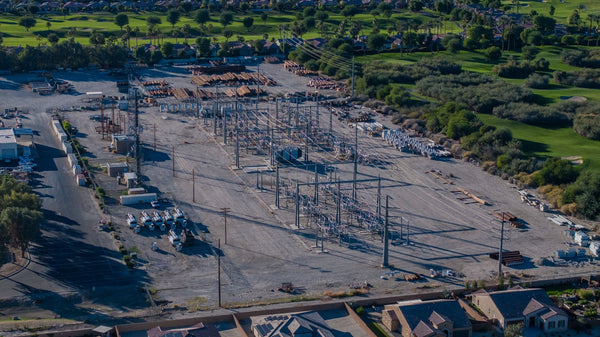
At Cotino, the photographs show colored soil beside both completed-looking exteriors and active construction. They do not establish the planting plan, whether seed was applied, or whether all colored patches received the same material.
What the Cotino photographs actually show
The strongest observation is the contrast: pale desert soil interrupted by blue-green patches and streaks, with tire marks, roads and buildings around them. That appearance is consistent with a surface application, but this remains an interpretation of a photograph.

To identify the treatment confidently, we would need confirmation from the developer or the contractor responsible for that application, ideally with its product name and work record. A project dust-control plan could help explain the intended measures, but a plan listing a possible treatment would not by itself prove what was applied on the photographed day.
Does the color tell us whether it is safe or effective?
No. A green tint does not establish toxicity, environmental suitability, application rate or performance. Those questions depend on the actual product, how and where it was applied, and the conditions afterward.
Likewise, a fading color is not a reliable test of whether a treatment has stopped working. The colorant and the soil-protection material can behave differently. Product documentation and inspection of the treated surface are more useful than the strength of the tint.
So the next time you spot bright green ground at a desert construction site, think of it as a visible clue about site work. It may be helping crews track a dust-control or erosion-control application, or it may be part of a seeding operation. For Cotino’s photographed parcels, the specific answer remains unconfirmed.
Questions about green construction-site soil
Is the green ground at Cotino definitely a dust suppressant?
No. The appearance is consistent with a surface application, but a photograph cannot distinguish a dyed dust treatment from hydraulic mulch or identify the exact product. The Cotino material has not been confirmed for this article.
Why add dye to a soil treatment?
It can make coverage visible, helping applicators see treated areas. Some suppliers also describe using the color to help monitor the treatment.
Does green dirt mean the area has been hydroseeded?
Not necessarily. Some hydraulic mulches are green, but dust-control products can also contain a green colorant. Color alone does not show whether seed was included.
Does the dye itself stop dust?
The color can serve as a marker. Binding or soil-covering ingredients provide the treatment’s protective function; the actual formulation determines how it works.
Can you tell whether the treatment is safe from the photograph?
No. Safety and suitability require the actual product information and application context. A color is not enough to establish either.
Sources and identification limits
Researched November 10, 2026. Cotino treatment identification remains unverified; no claim is made that any named example product was used there.
- Mark Miller’s original November 6 Cotino aerial photographs and field report.
- South Coast AQMD: Rule 403 dust-control information — regional context for Rules 403 and 403.1.
- Desert Mountain Corporation: documented green dye in a Surface-Loc application — an example from a different site, not a Cotino identification.
- Profile Products: EcoFibre — green coloring in hydraulic mulch to assist application.
- Soilworks product descriptions — soil-binding and surface-crust examples.


