































Northern Mockingbird
Mimus polyglottos
A gray, long-tailed singer with bright white wing patches visible in flight.
- Bird group
- Songbirds & flycatchers
- Where to look
- Gardens & desert edges
- Explore the region
- Coachella Valley bird guide
What to notice
- A gray, long-tailed singer with bright white wing patches visible in flight.
Where to look
Gardens & desert edges
When to look
Look for it through the year around neighborhoods, parks and open shrubs. Singing and nesting behavior change with the season.
Next time you are outside
Listen for a phrase repeated several times before the song changes. The recording in this profile gives you a starting point.
Record a sightingHabitat guidance is not a guaranteed sighting. Photographs may have been taken outside the valley.
Through the lens.
Select any photograph for a closer look. Move through the gallery with the arrows or a swipe.

This is a regional bird guide; photographs may also come from places beyond the valley. Locations are noted when available.
Know what to notice.
A familiar gray bird. An extraordinary way of making the world audible. The Northern Mockingbird rewards two kinds of attention: the quick glance that catches a white flash in flight, and the patient listening that turns a fence-top singer into an individual with a changing repertoire. Its appearance is restrained. Its presence is anything but.
In the Coachella Valley, you do not have to begin with a distant birding destination. Begin with the edge of a garden, a hedge beside open ground, or a fence along a field. This guide brings together identification, natural history and research on song so that the next bird you notice becomes more than a name.
Field guide by Mark Miller · Original Coachella Valley photographs · Reviewed October 23, 2026
Explore this field guide
Identify the bird before the performance
The Northern Mockingbird, Mimus polyglottos, belongs to Mimidae, the family that also includes thrashers and catbirds. Think slender body, small head, thin bill, long legs and an especially long tail. The tail is a better first clue than a fleeting impression of color. [1]
- Size: about 8.3–10.2 inches (21–26 cm) long, with a 12.2–13.8-inch (31–35 cm) wingspan; roughly robin-sized, but more slender.
- At rest: gray to gray-brown above, pale below, with two light wingbars. The larger white wing patch may be only partly visible.
- In flight: broad white patches in the wings and white outer tail feathers create a much more striking bird than the perched view suggests.
- In motion: watch for walking, running and hopping on the ground, followed by a return to an exposed perch. [1]
Males and females look alike enough that an ordinary photograph usually cannot establish sex. Juveniles have a spotted or streaked breast and darker eyes; the adult’s underparts are cleaner. A young bird’s shorter-looking tail can also change the overall impression. Use several features together, especially when judging a partly hidden bird. [2]
Similar birds on a desert fence
A fence is a meeting place for unrelated birds. The perch alone is not an identification. Start with the head and bill, then check the tail, underparts and wing pattern.
Northern Mockingbird or Loggerhead Shrike?
The Loggerhead Shrike has a conspicuous black face mask, a relatively large head and a stout bill with a hooked tip. The mockingbird has a smaller-looking head and a finer bill, without that bold mask. Both can show white in flight, so a white flash alone does not settle the question. [9]
Northern Mockingbird or Say’s Phoebe?
A Say’s Phoebe has a warm cinnamon belly, a gray breast and a relatively large-looking head. It often bobs its tail on a low perch. Look for the mockingbird’s longer-tailed silhouette and bold white flight markings rather than relying on a shared grayish back. [10]
Could the mimic be a European Starling?
Yes—mimicry is not unique to mockingbirds. The European Starling also imitates other birds, but has a compact body, short tail and pointed wings. Adults are dark and glossy or pale-spotted depending on season; juveniles are brown. Confirm the singer visually when possible. [11]
Many sounds, one performance
A mockingbird typically repeats a phrase two to six times, then moves on. Whistles can give way to rasps, trills or sharper notes. Both sexes sing; unmated males are especially persistent and may continue late into the night. The shorter, scratchier calls you hear during an encounter are a different part of its vocal behavior from the extended song. [3]
Press play, then let the whole sequence unfold. First listen for repetition. On a second pass, notice what changes: the height of a note, its texture, the pace, or the space around it. There is no need to identify every borrowed voice to enjoy how the performance holds together.
Recording: C. E. Price, 2007, “Mockingbird Song 3”, released into the public domain. Converted from video to MP3 with the original timing retained. This is a separate example recording, not sound from Mark’s photographs or a documented Coachella Valley location. [12]
The song contains both imitations and mockingbird-specific material. Research on birds in North Carolina found that copied sounds were selective: pitch and rhythm helped explain which other species were imitated. A repertoire can contain hundreds of distinct phrases, but a repertoire is not a fixed number of complete “songs,” nor is every phrase a different species. [4]
That makes the experience more interesting than a checklist of impersonations. You can hear echoes of other voices, yet the ordering, repetition and changing texture belong to the singer in front of you. The separate DOI story, One Bird, Many Voices, follows that experience of listening.
Why the transitions can feel musical
In a 2021 study, Tina C. Roeske, David Rothenberg and David E. Gammon examined relationships between successive phrases. They described morphing: changes that preserve some qualities of a sound while altering others. Their analysis of recordings from five birds found similarities across adjacent phrases more often than expected by chance. [5]
- Tone color: the texture changes while other features remain related.
- Pitch: a related sound moves higher or lower.
- Squeeze: a related pattern becomes shorter in time.
- Stretch: a related pattern becomes longer in time.
These are useful listening ideas, not four rules that every phrase must follow. The study does not establish that a mockingbird composes with human intentions, and the authors leave the biological function unresolved. Nor have these transitions been individually labeled in the recording above. [5]
Still, this offers a precise way to approach something beautiful: attend to the relationship between sounds. “Harmony” can describe the pleasure of the whole performance; here, the revealing detail is how one phrase leads into another. Let the bird supply the sequence.
A singer with a territory to defend
The same bird that seems absorbed in song may abruptly chase an intruder. Mockingbirds defend space against other mockingbirds and other animals, including around nests. Territorial behavior also occurs outside the breeding season; a fruit-bearing shrub can be worth defending in winter. [2] [6]
Watch the wing flash. A bird on the ground may pause and partly spread its wings, exposing the white patches. One hypothesis is that this startles prey into moving, but the explanation is not settled. Describe what you see—pause, spread, step, capture—before assigning a purpose. [13]
There is also experimental evidence for recognizing individual people. In a University of Florida study published in 2009, nesting mockingbirds reacted more strongly over repeated visits by the same human intruder, then responded less strongly when a different person approached. This demonstrates discrimination between people in that experimental setting; it does not mean every neighborhood bird has a personal relationship with every passerby. [7]
For an observer, the practical response is simple. A repeated alarm or a defensive flight is a reason to increase distance. You do not need to locate the nest to understand the message.
Where it fits in the Coachella Valley
California’s wildlife habitat account describes a largely resident bird of low elevations, including southern desert areas. It uses desert scrub and washes as well as cultivated landscapes. The recurring combination is cover, open foraging ground and elevated perches—a more useful search image than “anywhere in the desert.” [6]
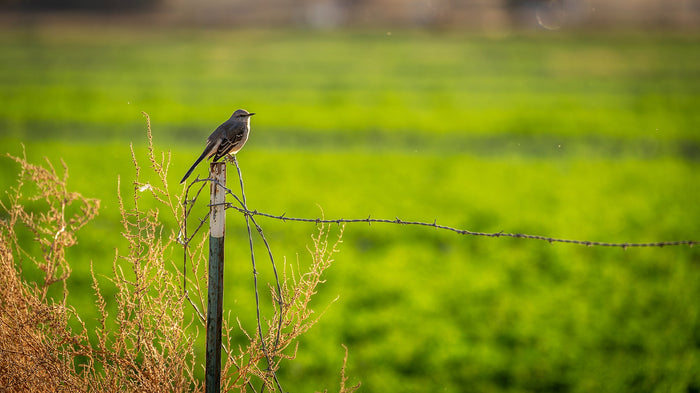
Applied locally, that suggests looking along the interfaces: shrubs beside a park lawn, a garden adjoining open ground, or the vegetated margin of a field. This is habitat-based guidance, not a promise that a particular bird is present. Mark’s two photographs on this page document Northern Mockingbirds in the Coachella Valley; they do not establish a nest, sex, singing behavior or year-round occupancy at those exact perches.
Look throughout the year: the broad resident pattern allows some individual movement. Quietness alone does not establish that a bird has left. [6]
A forager whose menu changes
Insects and other small invertebrates are especially important in the warmer breeding months; fruit becomes a larger part of the diet in fall and winter. Watch for a bird dropping from a perch, crossing the ground in short runs, stopping to take prey, or feeding among fruiting branches. It can also catch insects in the air. [6]
This helps explain why a bird might use several parts of a small landscape. The singing perch, the sheltering shrub and the feeding patch need not be the same place. When watching a familiar bird, ask which resource it is using right now. A fence-post portrait is one moment in a larger routine.
Examples of prey include beetles, grasshoppers and caterpillars. Berries are not an incidental treat: fruit can be a major seasonal resource. The balance varies with conditions, so a single feeding observation should not become a rule about the entire species. [2]
From a twig foundation to dependent young
Nests are open cups, usually in a shrub or tree. The male commonly builds the twig framework and the female adds much of the lining. A typical nesting attempt has two to six eggs; incubation and the nestling stage each last about 12–13 days. Two or three broods may be raised in a season. These are general species ranges, not a schedule for every Coachella Valley pair. [8]
Both parents feed the young. Leaving the nest does not mean a youngster is independent or immediately a strong flyer. That interval helps explain why adults can be especially watchful around low vegetation even when no nest is visible. [2]
A young mockingbird is on the ground. Does it need help?
A feathered youngster that can hop may be a fledgling still being cared for by its parents. Keep pets away, step back and watch from a distance. A sparsely feathered nestling is a different situation; a visibly injured bird needs advice from a licensed wildlife rehabilitator. Do not assume a parent has abandoned a youngster simply because you cannot see it nearby. [14]
Give a familiar bird unfamiliar attention
You can make a useful observation without an unusual sighting or a perfect photograph. Choose one subject for a few minutes: the pauses between phrases, the route between perches, or the moment a ground-feeding bird raises its head. A short, careful description is more informative than guessing at everything at once.
- For identification: try to record a side view showing the bill, wing and full tail. Leave room around the bird rather than cropping away the features you need.
- For behavior: note the action and its context. “Spread both wings on the ground before moving forward” preserves more evidence than “scared an insect.”
- For sound: record from where you are, without playback to draw the bird closer. Note time and place, and listen for nearby singers that might also enter the recording.
- For a better photograph: choose a background, wait and let the bird move into the composition. A routine perch can offer more opportunities than a chase.
This is the value of birdwatching close to home: repeated visits let you improve your questions. The photograph may be the result, but learning to notice is the practice.
In a garden, retain useful cover, favor locally appropriate plants, reduce pesticide use and keep cats indoors. Check vegetation for active nesting before pruning. Widespread does not mean unaffected by landscape change: the Cornell account reports an approximately 30% decline across the 1966–2019 survey period, a historical continental trend that should not be mistaken for a current Coachella Valley population estimate. [8]
Questions worth keeping open
Does every mockingbird learn new sounds throughout life?
That familiar claim is not as settled as it often sounds. Research discussed by the Cornell Lab in 2016 found no average increase in the mimetic repertoire of the adult males followed over time, and experimental sounds were not adopted. That challenges a universal lifelong-learning claim; it does not answer every question about when or how all mockingbirds learn. [4]
Why is it singing outside my window at night?
Night singing is natural in this species, particularly among persistent unmated males. It is not enough evidence to diagnose a confused bird or identify an individual’s exact circumstances. Listen for repeated phrases and, in daylight, confirm which species is using the area. [3]
Are the imitations in this recording identified?
No. The recording illustrates a real performance, but this guide does not assign copied species or research-defined transitions to particular timestamps. Similarity can suggest a possibility; identifying an imitation reliably takes comparison and care.
Is the Northern Mockingbird native here?
Yes. It is a native North American species, and California’s habitat account includes southern desert populations. Its ability to live around people should not be confused with being an introduced species. [6]
Sources, research and recording credit
Sources checked October 23, 2026. Identification and natural-history ranges describe the species broadly. The local search guidance is an application of habitat information, not a site-specific bird census. Photographs: Mark Miller. The studies below have their own geographic and sample limits.
- Cornell Lab: Northern Mockingbird identification. Structure, measurements, plumage and visible behavior.
- Audubon: Northern Mockingbird. Age, sex, food, breeding and territorial behavior.
- Cornell Lab: Northern Mockingbird sounds. Phrase repetition, calls and night singing.
- Mary-Russell Roberson, Living Bird, April 12, 2016. Reporting on David Gammon’s work on mimicry and adult learning.
- Roeske, Rothenberg & Gammon (2021): Mockingbird Morphing Music: Structured Transitions in a Complex Bird Song. Frontiers in Psychology 12:630115. DOI: 10.3389/fpsyg.2021.630115.
- California Department of Fish and Wildlife: Northern Mockingbird, CWHR B393. California Wildlife habitat account; historical baseline for distribution, seasonality and habitat.
- Levey et al. (2009): Urban mockingbirds quickly learn to identify individual humans. PNAS 106:8959–8962. DOI: 10.1073/pnas.0811422106.
- Cornell Lab: Northern Mockingbird life history. Nesting ranges and the dated 1966–2019 population trend.
- Cornell Lab: Loggerhead Shrike identification.
- Cornell Lab: Say’s Phoebe identification.
- Cornell Lab: European Starling identification.
- C. E. Price (2007): Mockingbird Song 3. Public-domain dedication recorded on Wikimedia Commons; audio converted to MP3, timing unchanged.
- Cornell Lab: Northern Mockingbird overview. Wing-flashing observation and the unresolved function.
- Cornell Lab: I found a baby bird. What do I do? Distinguishing fledglings from nestlings.
Another bird to discover.
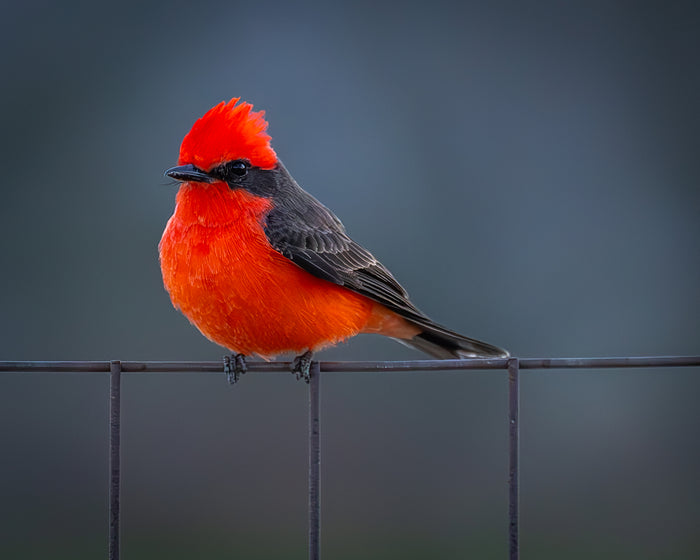
Vermilion Flycatcher
Adult males flash scarlet red; watch for short flights out from an exposed perch.
Meet this bird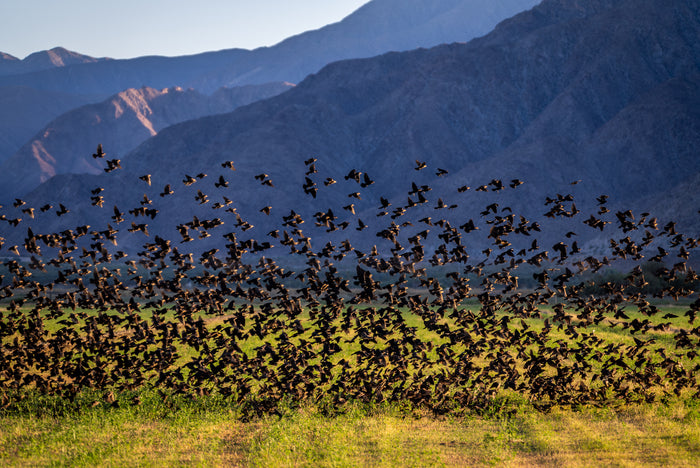
European Starling
Glossy dark plumage turns speckled in fresh feathers; look for flocks over farms and towns.
Meet this bird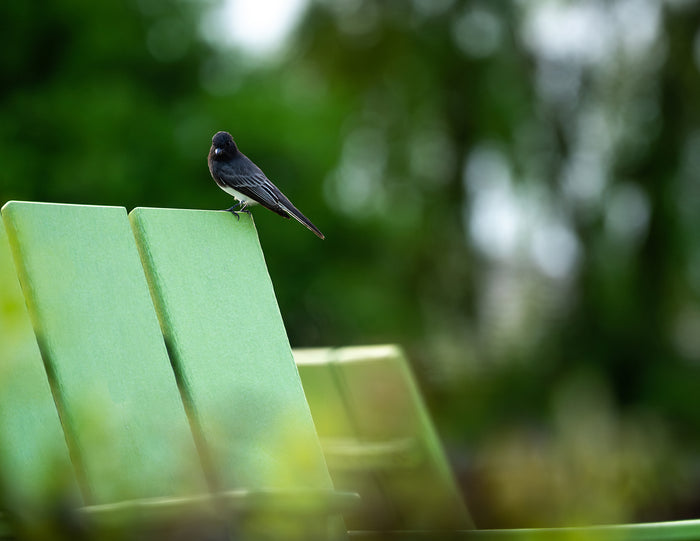
Black Phoebe
A black chest and white belly; often returns to the same low perch after catching insects.
Meet this bird