




Arnold Palmer at Bermuda Dunes: The Story of His Last Win
A friendship, a familiar desert stage and the 1973 victory now remembered by a statue beside the course.

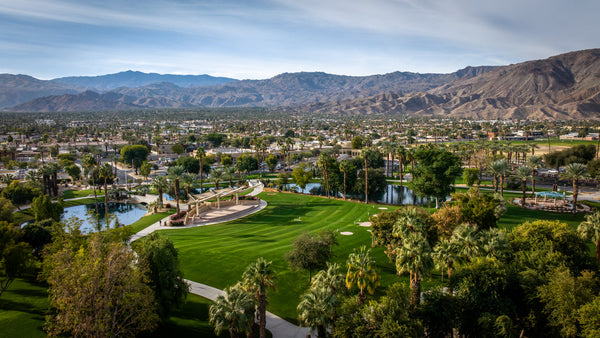
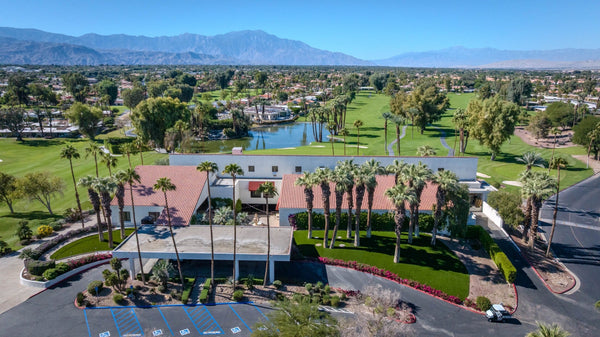
In my October 26 photographs of Bermuda Dunes Country Club, Arnold Palmer’s statue stands between the clubhouse and a landscape of palms, fairways and water. A small plaque supplies the reason to stop: this is where his last PGA Tour victory became part of the course’s history.
The inscription records the achievement. The larger story is about a golfer returning to a familiar stage, a friendship that made the club a personal place, and a Sunday when an uncertain future gave way to one more win.
- Palmer’s 1973 victory at Bermuda Dunes was his 62nd and final PGA Tour win.
- His connection to the club included membership and a friendship with co-developer Ernie Dunlevie.
- The statue and its plaque preserve the memory; the private grounds require authorized access.
A desert tournament that suited Palmer
The Palm Springs Golf Classic began in 1960 with an unusual format: professionals and amateurs competing across five days and four courses. Bermuda Dunes shared that original rotation with Thunderbird, Tamarisk and Indian Wells. Palmer won the first edition.2
It was a regional event, even when the Palm Springs name appeared in the headlines. Each participating course contributed a different setting. Bermuda Dunes helped give the tournament a home in the central valley, beyond the resort city most visitors already knew.
Bob Hope’s official involvement followed in 1965. Golf, entertainment and fundraising became closely intertwined; the tournament’s proceeds supported the hospital that became Eisenhower Medical Center.2 For the wider story, read how the Coachella Valley became a golf capital.
Bermuda Dunes was a personal connection
Palmer’s relationship with the club extended beyond tournament rounds. He was a member, and Ernie Dunlevie, its co-developer and a tournament organizer, was a close friend. Kingdom’s account of Palmer’s club memberships says Dunlevie set aside a condominium at Bermuda Dunes for him to use during visits.4
That detail gives the story a more human scale. A course on a tournament itinerary can be temporary: arrive, practice, compete, leave. A place with a friend and somewhere to stay becomes part of a repeated life. Bermuda Dunes belonged to that more personal geography.
The course itself was designed by Billy Bell Jr. Palmer’s association with Bermuda Dunes should not be confused with authorship of its layout.3

Returning with something to prove
By the 1973 Classic, Palmer was 43. His previous PGA Tour victory had come at the Westchester Classic in July 1971. He had gone through 1972 without a win, ending a run of 17 consecutive winning seasons.5
Palmer opened with 71, then recovered over the next three rounds to begin the final day just one stroke behind Nicklaus and Johnny Miller.5
For anyone who plays golf, the shape of that recovery is recognizable. A poor opening does not always determine the week. Palmer had gradually put himself close enough for the final day to matter.
One more Sunday, in the rain
Rain accompanied the final round. Palmer moved ahead, saved par at the 16th and finished with a birdie at the last. Nicklaus’s late eagle attempt did not fall. Palmer celebrated by throwing his visor toward the spectators.5
On February 11, 1973, he closed with 69 for a five-round total of 343, or 17 under par. Nicklaus and Miller finished two shots behind. It was Palmer’s fifth Classic title and his 62nd PGA Tour victory.1
The names behind him matter. This was a win over a field that included his great rival Nicklaus and a younger Miller, who would win that year’s U.S. Open. Palmer had produced another winning finish against formidable competition.1
A last win, rather than a farewell
Looking back, the result has the clarity of a closing chapter. On the day, it was a victory to celebrate. Jim McCabe’s PGA Tour retrospective records Palmer describing it as “The sweetest ever.”1
It became his final PGA Tour win. It did not end his playing career: Palmer continued competing and later won on the senior circuit.5 Calling Bermuda Dunes his “last win” without that qualification would leave out what came afterward.
What makes the moment compelling is the gap between a day as it is lived and a day as history remembers it. Palmer was trying to win a tournament. We can now see that he was also completing a remarkable sequence of 62 victories.
Reading the statue today
The plaque beneath the statue is headed “A Hell of a Day.” It recalls the closing birdie, the 17-under finish and the two-shot margin. My photographs show a present-day tribute, not an image from the tournament itself.
Open the Arnold Palmer statue gallery to study the inscription and see the figure from different angles. Knowing the result changes the photograph: the surrounding course becomes the setting of a specific sporting memory.

Bermuda Dunes Country Club is private. Arrange authorized access before visiting its grounds. The country club photo guide offers a closer look at the setting, and our Bermuda Dunes history explains how the club helped shape the surrounding community.
Arnold Palmer and Bermuda Dunes: common questions
When did Arnold Palmer win his last PGA Tour event?
February 11, 1973, at the Bob Hope Desert Classic, with the final round played at Bermuda Dunes Country Club.1
How many times did Palmer win the desert Classic?
Five: 1960, 1962, 1968, 1971 and 1973. Palm Springs Life records that sequence in its account of his desert career.6
Did Arnold Palmer design Bermuda Dunes Country Club?
Was 1973 the end of Palmer’s competitive career?
No. It was his final PGA Tour victory. He continued playing and later won on the senior circuit.5
Can the public visit the Arnold Palmer statue?
It stands within a private country club. Arrange permission or an authorized visit directly with the club; see the statue guide for details.
Sources and photography
Researched October 27, 2026. Numbered notes identify the sources for historical claims.
- PGA TOUR — Jim McCabe, “A hell of a day”
Final victory, date, scores, opponents and Palmer’s quoted reaction.
- SCGA / FORE — A Look Back: The Colorful History of a Desert Classic
January 1, 2015. Original format, course rotation and Bob Hope’s involvement.
- Bermuda Dunes Country Club — Our History
Course designer and the club’s connection to Palmer’s Classic victories.
- Kingdom — Matt Halnan, The King of Clubs
Membership, friendship with Ernie Dunlevie and the condominium made available to Palmer.
- Kingdom — Matt Halnan, Arnold Palmer in the Desert
The winless 1972 season, recovery through the tournament, final-round account and later senior career.
- Palm Springs Life — Bill Dwyre, The King Was Here
November 16, 2022. The sequence of Palmer’s five Classic titles.
Original photographs by Mark Miller, October 26, 2026. The statue and plaque document the present-day tribute. No photograph here is presented as archival coverage of the 1973 tournament. The sculptor and dedication date have not been verified.


