




























Red-breasted Sapsucker
Sphyrapicus ruber
A red head and breast draw attention to this woodpecker and its rows of sap wells.
- Bird group
- Woodpeckers
- Where to look
- Mountain woodland
- Explore the region
- Coachella Valley bird guide
What to notice
- A red head and breast draw attention to this woodpecker and its rows of sap wells.
Where to look
Mountain woodland
When to look
Local seasonal timing is not specified in these field notes. Use the habitat clues as a starting point and check current conditions.
Next time you are outside
A red head and breast draw attention to this woodpecker and its rows of sap wells.
Habitat guidance is not a guaranteed sighting. Photographs may have been taken outside the valley.
Through the lens.
Select any photograph for a closer look. Move through the gallery with the arrows or a swipe.
This is a regional bird guide; photographs may also come from places beyond the valley. Locations are noted when available.
Know what to notice.
The Red-breasted Sapsucker is a vibrant woodpecker most often associated with the coniferous forests of the Pacific coast and mountain ranges. In Idyllwild and the surrounding San Jacinto Mountains, this bird is a seasonal visitor and occasional breeder, favoring mid- to high-elevation forests of pine, oak, and cedar.
Appearance
Easily recognized by its bright crimson head and breast, this woodpecker has a black-and-white mottled back and a pale, often yellow-tinged belly. The intense red coloration is a key field mark distinguishing it from other local sapsuckers, such as the Red-naped Sapsucker.
Habitat and Behavior in Idyllwild
In Idyllwild’s mature forests, the Red-breasted Sapsucker drills neat rows of holes in tree bark—especially in willows, alders, and conifers—to harvest sap. These sap wells serve not only the bird but also attract hummingbirds and insects, making the sapsucker a keystone species in its ecological niche.
You’re most likely to see them in fall through spring, when they descend from higher elevations or move southward. In some years, a few may remain through summer if conditions are favorable for nesting.
Ecological Importance
By feeding on tree sap and insects, and by creating sap wells that benefit many other species, the Red-breasted Sapsucker plays an important role in forest food webs. However, its foraging can leave visible bark scars on favored trees.







Another bird to discover.
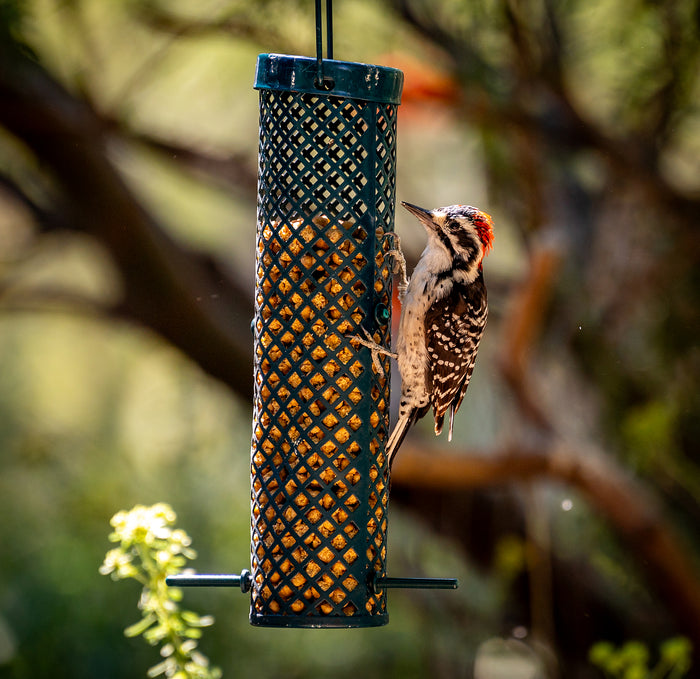
Nuttall’s Woodpecker
A small woodpecker with a barred black-and-white back, working trunks and branches.
Meet this bird