





























Why a Hummingbird’s Throat Goes From Black to Brilliant
Follow the light from feather to eye—with original photography and interactive demonstrations of hummingbird iridescence.

A hummingbird’s throat can look almost black, then flash purple or rose-pink as it turns. The bird has not changed feathers between those two moments. You have caught a change in how light reaches your eye.
Use Mark Miller’s original Costa’s Hummingbird photograph and the demonstrations below to follow that change—from a visible flash to the tiny structures inside a feather.
- A small head turn can redirect the brilliant reflection while the bird remains in sunlight.
- Tiny structures inside feather barbules produce iridescence; pigments are still present.
- Explore the light path, examine an original photograph and practice reading more than color.
Turn the feather. Keep the sun still.
A bright throat patch is called a gorget. In an adult male Anna’s Hummingbird, a small head movement can change its apparent color and intensity. The feathers remain in place; the light arriving at your eye changes. [3]
TRY IT · LIGHT, FEATHER, EYE
Find the angle that catches the flash
The light source and observer stay still. Tilt the illustrated feather surface and follow the colored reflection.
What reaches the observer
An illustrated violet patch, shown separately from the light path.
Light still reaches the feather. Its strongest colored reflection goes elsewhere, so the illustrated patch looks dark.
This flat-reflector model teaches direction, not a species’ exact color or measured brightness. Its angles and violet swatch are illustrative. Real feathers have many tilted barbules, broader reflections and wavelength-dependent effects. The diagram does not calculate their spectrum. [1]
The useful surprise is that a sunlit bird can still show a dark throat. Brightness at the bird and brightness toward you are different questions. Changing the bird’s head position, the illumination direction or your viewpoint changes that relationship. A single feather patch is more complex than a household mirror, but the mirror-like direction of the reflection is a useful first step. [1]
Inside the feather: structure makes the shimmer
The color-producing machinery is far smaller than the bird. A feather branches into barbs, and those carry still smaller barbules. Research on Anna’s Hummingbirds describes flattened, air-containing melanosomes arranged in layers inside these barbules. Keratin forms the surrounding feather material. [2]
LOOK INSIDE · THREE SCALES
From feather to tiny reflector
1. A branching feather
A feather is a branching structure. The drawing identifies the shaft and barbs; it is not an anatomical tracing of the photographed bird.
2. Smaller branches called barbules
The brilliant patches depend on structures within tiny barbules. Their shape and orientation help make the reflection directional. They are not miniature colored lamps. [2]
3. Layers that interact with light
These pigment-containing structures have air spaces and form repeated layers. The arrangement of materials with different optical properties produces the strong, selective reflection. This diagram shows the ingredients, not measured dimensions or a full optical calculation. [2]
Original educational drawings based on the cited research. All three views are schematic; none is a microscope image.
At the layers’ boundaries, light is partly reflected and partly transmitted. Reflected light waves can reinforce one another at some wavelengths more than others: interference. That selective reinforcement helps create the strong color. Change the geometry and the reflection changes. [5]
This is structural color. It does not mean the feather contains no pigment: melanin is part of the structure and absorbs light. The brilliant shimmer comes from the way the materials are organized and interact with light, rather than a purple or pink pigment simply switching on. [1]
Read the photograph, one feather patch at a time

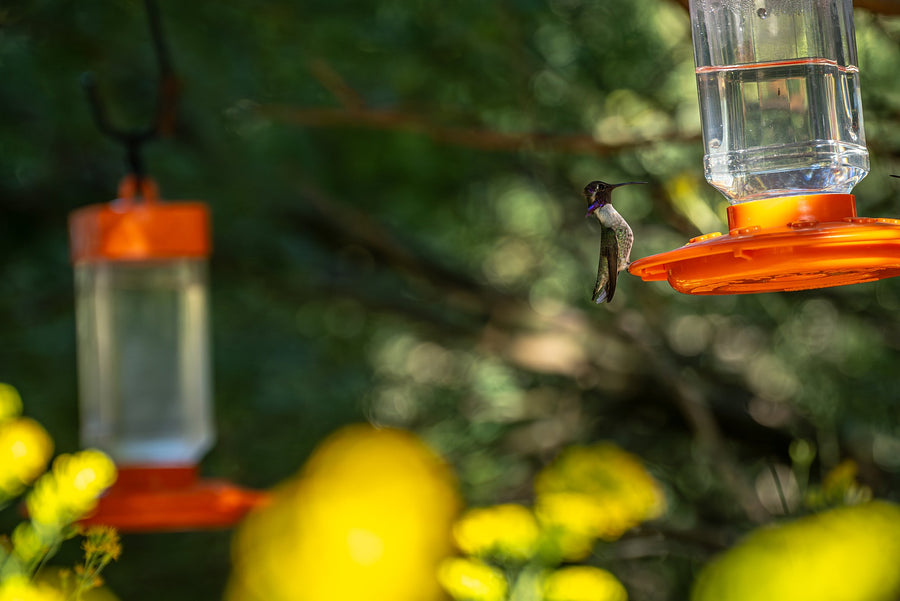
Begin at the crown, follow the dark area under the bill, then look at the purple feathers extending down the side of the throat. One photograph contains several appearances at once. That makes it a useful invitation to look at individual patches rather than treating the entire head as one color.
The photograph records the visible pattern. It does not measure the sun’s position, the angle of each barbule or the contribution of shadow to each dark area. Nor is it a before-and-after sequence. The light-path model explains a mechanism; the photograph gives you a real bird to examine.
A dark throat is a clue, not an identification
Anna’s Hummingbird
Adult males have a rose-pink crown and throat. Females and immature birds can have much less throat color. The absence of a full brilliant gorget is not always an angle effect. [3]
Costa’s Hummingbird
Adult males have an iridescent purple crown and throat, with elongated throat feathers flaring along the neck. Compare their shape as well as their color. [4]
Do not expect an Anna’s to become a Costa’s by turning its head. Species, sex, age and feather structure still matter. For the practical comparison, continue with Anna’s or Costa’s? Which Hummingbird Is Visiting Your Desert Garden?
Also avoid naming a Black-chinned Hummingbird from a dark throat alone. An adult male Black-chinned has a black throat with an iridescent purple band below it; other hummingbirds can look dark when their iridescence is poorly aligned with the observer. [6]
Watch for the turn, then make the photograph
Choose a comfortable place to observe a feeding area or perch. Let the bird move naturally. A familiar garden can give you repeated chances to understand the light without chasing the bird around it.
- Keep your position for a moment. Watch the throat as the bird looks in different directions. Does the flash appear across the whole patch or only along an edge?
- Make a short sequence. Several frames can preserve the transition more usefully than one bright portrait. Compare head position as well as apparent color.
- Protect the bright detail. Check the camera’s highlight warning or histogram. Try a slightly darker exposure if the brightest feathers lose visible detail; there is no single setting for every scene.
- Record what your photograph establishes. A pale throat may reflect the bird’s plumage, not simply an unfavorable angle. A dark frame alone cannot prove the identity or sex.
Use a longer lens or a crop rather than approaching a nest or repeatedly displacing a feeding bird. For a local outing, explore the garden setting at Sunnylands or the habitat guides for Coachella Valley Preserve and Whitewater Preserve. These are places to practice observation, not guarantees of a particular hummingbird.
The same attention to light connects with why winter light feels different. You are learning to notice what the light reveals, as well as what stands in front of the lens.
Check your understanding
ONE MOMENT · ONE EXPLANATION
A male hummingbird stays on the same sunlit perch. It turns its head and the brilliant throat suddenly looks dark. What best explains that immediate change?
On your next walk, watch for a turn rather than waiting only for a bright bird. The moment the color disappears can teach you as much as the moment it shines.
Frequently asked questions
Why does a hummingbird’s throat look black and then colorful?
Its iridescent reflection is directional. A head turn can redirect the strongest colored reflection toward or away from your eye, changing the appearance without replacing the feathers. Cornell Lab’s Anna’s guide illustrates this head-position effect.
Are hummingbirds glowing or producing their own light?
The throat flash described here is reflected light. Tiny feather structures interact with incoming light; they are not making light as a lamp would. The brilliant reflection can look luminous without being bioluminescence.
Is there any pigment in an iridescent hummingbird feather?
Yes. Melanin occurs in the melanosomes. Structural color describes how their organized arrangement, with air spaces and keratin, affects light; it does not mean that the feather contains no pigment. See the 2021 feather-development study.
Does a dark throat mean the bird is a Black-chinned Hummingbird?
No. Other hummingbirds can show dark-looking iridescent patches from an unfavorable angle. Adult male Black-chinned Hummingbirds have a black throat with a purple band below it. Compare the full bird, not one dark patch. Cornell Lab’s identification guide explains the pattern.
Does the interactive reproduce the exact color of Anna’s or Costa’s?
No. It teaches how a reflected direction changes when a surface tilts. The violet patch, brightness and angles are illustrative. Real gorgets contain many barbules and have more complex optical behavior. Use the unaltered photograph for the bird’s recorded appearance and the diagram to understand the mechanism.
Sources and photo notes
Research checked October 23, 2026. Original bird photography by Mark Miller. The two Costa’s views used for the header and body come from the same original photograph; they are not a sequence documenting a head turn. No colors have been added to the photograph.
The interactive is an original, simplified teaching model. Reflection follows a flat surface in two dimensions; the violet swatch and its brightness falloff are illustrative, not measured bird data. Structure drawings are not to scale. They do not reproduce microscope imagery or simulate a species-specific spectrum.
- Giraldo, Parra & Stavenga (2018) — Iridescent colouration of male Anna’s hummingbird caused by multilayered barbules. Journal of Comparative Physiology A 204, 965–975. Primary research on directional reflection, melanosome stacks and optical multilayers.
- D’Alba and colleagues (2021) — Morphogenesis of Iridescent Feathers in Anna’s Hummingbird. Integrative and Comparative Biology 61, 1502–1510. Primary research on feather development and hollow melanosome organization.
- Cornell Lab of Ornithology — Anna’s Hummingbird identification. Adult male plumage, female and immature differences, and changes with head position.
- Cornell Lab of Ornithology — Costa’s Hummingbird identification. Purple crown, flared gorget and other identification features.
- Cornell Lab, Marc Devokaitis (June 28, 2023) — What Is the Essence of Iridescence? Ask a Hummingbird. Interviews with researchers explaining light, feather layers and interference.
- Cornell Lab of Ornithology — Black-chinned Hummingbird identification. Black throat and iridescent purple band; useful context for avoiding identification by apparent darkness alone.