
Rufous Hummingbird
Selasphorus rufus
Coppery tones can be a clue; females and young birds can be hard to separate from Allen’s.
- Bird group
- Hummingbirds
- Where to look
- Flowering stops during migration
- Explore the region
- Coachella Valley bird guide
Through the lens.
Select any photograph for a closer look. Move through the gallery with the arrows or a swipe.

This is a regional bird guide; photographs may also come from places beyond the valley. Locations are noted when available.
Know what to notice.
The Rufous Hummingbird (Selasphorus rufus) is a dazzling and feisty migratory hummingbird known for its bold coloration and remarkable endurance. Though not a year-round resident of the Coachella Valley, it’s a regular and important spring and fall migrant, particularly noticeable during its northbound journey.
🌺 Identification:
-
Males: Brilliant coppery-orange body and tail, with an iridescent red-orange gorget (throat patch) that flares dramatically in the light.
-
Females and juveniles: Greenish-bronze backs with reddish sides and flanks, and often a small patch of orange on the throat.
-
Size: Around 3–3.75 inches long, with a straight, slender bill and fast, darting flight.
🧭 Migration & Range:
-
One of the longest migratory routes relative to body size of any bird—migrating from Mexico to as far north as southern Alaska.
-
Passes through Southern California, including the Coachella Valley and adjacent foothills, from late February to May (northbound), and again from late June to September (southbound).
🌿 Habitat in the Region:
-
Prefers flower-rich gardens, desert scrub, and chaparral edges where nectar is abundant.
-
Drawn to hummingbird feeders and tubular native flowers such as Penstemon, Chuparosa (Justicia californica), and Monkeyflower.
🐝 Behavior and Ecology:
-
Extremely territorial, especially males, which will chase away other hummingbirds and even larger birds.
-
Plays a key role as a pollinator, especially in desert ecosystems where few birds visit certain native flowers.
🔍 Notable Adaptations:
-
Can enter torpor—a temporary hibernation-like state—to survive cold nights or lack of food.
-
Exceptional memory and navigational skills, allowing it to revisit the same food sources along its migration route.
🌎 Ecological Role:
-
Helps maintain the reproductive cycles of many desert plant species.
-
Their migration is closely timed with blooming cycles, making them important indicators of ecological health and climate shifts.
Another bird to discover.
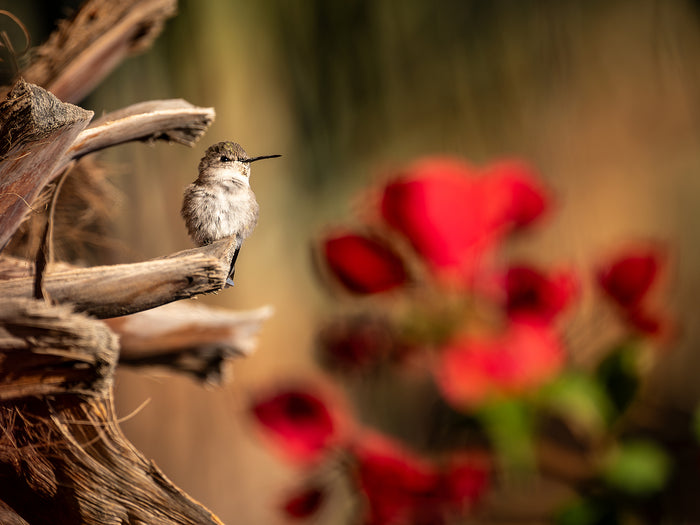
Anna’s Hummingbird
Look for an adult male’s rose-pink head and throat; color changes with the light.
Meet this bird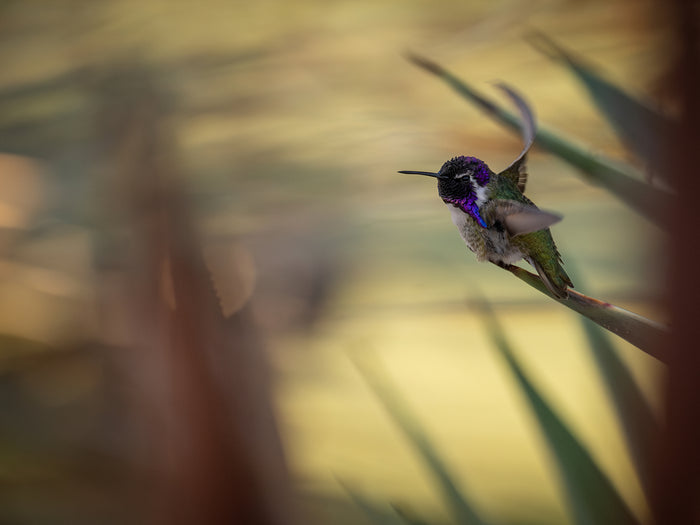
Costa’s Hummingbird
Adult males show a flared purple throat patch; females are much more subtly colored.
Meet this bird
See the bigger picture.
The Pacific Flyway: Coachella Valley’s Living Migration Path
Follow the larger migration story connecting desert oases, open water and the birds passing through the valley.
Read the story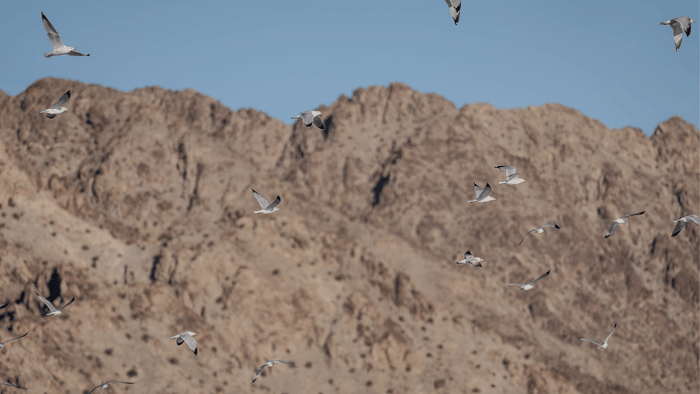
Layers of a Desert Lake: Birds of Lake Cahuilla in Winter
Explore a winter visit to Lake Cahuilla, from close encounters along the shore to movement above the water.
Read the story
Salton Sea Bird Watching: Where to Go & What to See
Continue south to the Salton Sea for a broader look at birding places, habitats and seasonal variety.
Read the story