
Red Bird of Paradise
Caesalpinia pulcherrima
A vivid desert garden shrub photographed in La Quinta Cove Red bird of paradise (Caesalpinia pulcherrima) brings orange, red, and yellow flowers above delicate, fernlike foliage. Mark Miller photographed this blooming shrub...
- In this guide
- Non-native
- Explore the collection
- Desert flora guide
A closer look.
Open a photograph to see the details. Use the arrows or swipe to explore the gallery.


Photographs from Desert Oasis Insider’s plant collection. Locations are shown where recorded in the original gallery.
Get to know this plant.
About this classification: Non-native
Grown here, with origins outside the local native flora. Non-native describes geographic origin; it does not automatically mean invasive.
A vivid desert garden shrub photographed in La Quinta Cove
Red bird of paradise (Caesalpinia pulcherrima) brings orange, red, and yellow flowers above delicate, fernlike foliage. Mark Miller photographed this blooming shrub on September 28, 2026, near a La Quinta Cove hiking area. The plant is a familiar sight in Coachella Valley landscaping, but it is not a native Coachella Valley wildflower.
- At a glance: Flowering ornamental shrub in the pea family (Fabaceae)
- Look for: Orange and yellow petals, long red stamens, and many small paired leaflets
- Where photographed: La Quinta Cove, California
- Field note: One of Mark’s photos shows a wasp visiting the plant
On this page
- How to identify it
- Bloom and growth
- In the Coachella Valley
- Mark’s field photos
- Frequently asked questions
How to identify red bird of paradise
The blossoms gather in upright clusters with warm orange and yellow petals and slender red stamens projecting outward. The leaves are bipinnate: each leaf divides into smaller branches lined with tiny oval leaflets. The shrub’s airy shape and bright flowers make it easy to recognize when in bloom.
Bloom and growth
In the low desert, red bird of paradise commonly flowers from early summer into fall. It typically grows about 5 to 8 feet tall and can spread roughly 6 feet, although conditions and pruning change its form. Frost can damage the top growth; plants often regrow when warmth returns.
In the Coachella Valley
This is a cultivated, heat tolerant ornamental used in local gardens and streetscapes. Seeing it beside a trail does not establish that it grew there naturally. It is distinct from the yellow flowering Mexican bird of paradise (Caesalpinia mexicana) and yellow bird of paradise (Caesalpinia gilliesii).
Mark’s field photos
The gallery shows the flower clusters, the full shrub against stormy skies, and a close view of an insect on its stem. Photographed by Mark Miller in La Quinta Cove on September 28, 2026.
Frequently asked questions
Is red bird of paradise native to the Coachella Valley?
No. It is a widely planted ornamental here, rather than a native local desert shrub.
Is this the same as Mexican bird of paradise?
No. Common names vary, but C. mexicana generally has yellow flowers, while the shrub photographed here has orange, red, and yellow blooms.
When does it bloom locally?
It commonly blooms from early summer into fall in the Coachella Valley. Weather and site conditions affect timing.
Does it attract pollinators?
Yes. Its showy flowers attract insects and hummingbirds. One of the photographs here captures an insect on the plant.
What should I look for to identify it?
Look for upright clusters of orange and yellow blossoms with long red stamens, together with finely divided leaves made of many small oval leaflets.
Sources
More plants from our gardens.
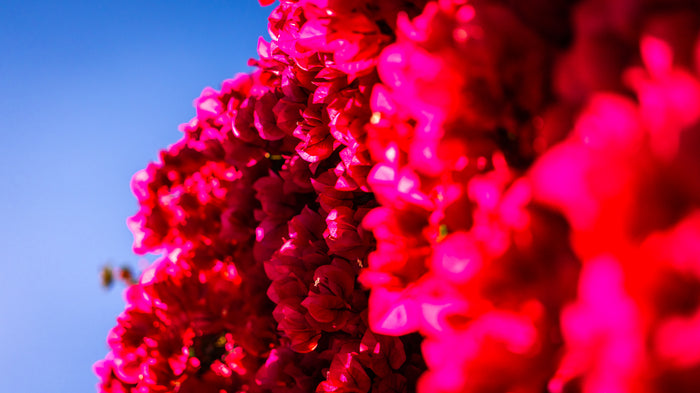
Bougainvillea
Colorful papery bracts bring vivid color to walls, courtyards and garden plantings.
Meet this plant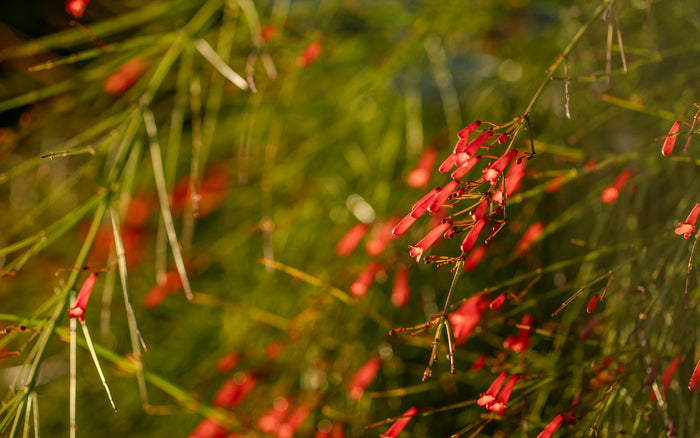
Firecracker Plant
Arching stems carry a cascade of red tubular flowers in garden settings.
Meet this plant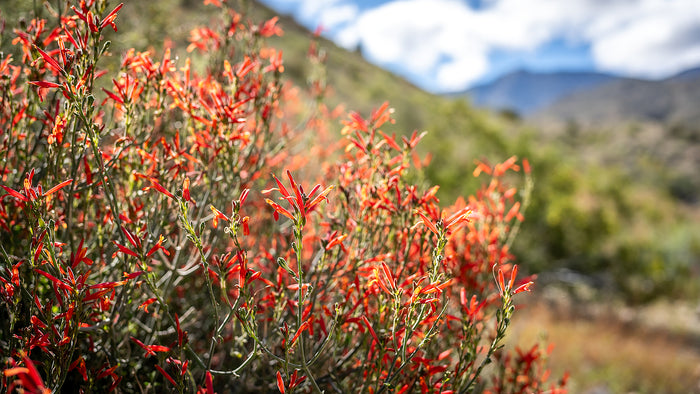
Chuparosa (Hummingbird Bush)
Red tubular flowers make chuparosa a natural place to watch for hummingbirds.
Meet this plantFollow the story outside.
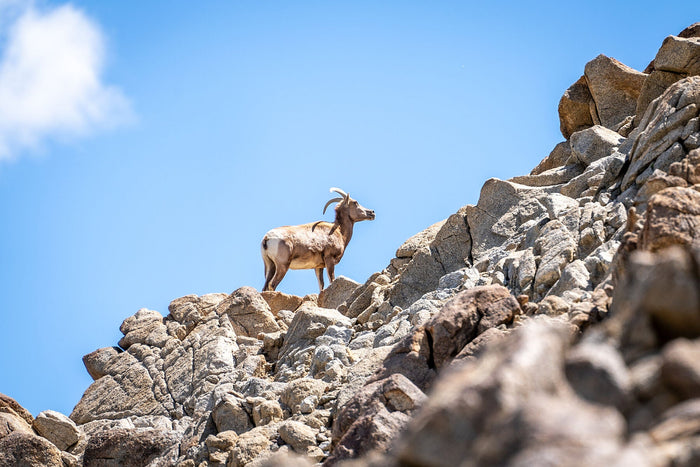
Bighorn Sheep of the Coachella Valley
Discover the bighorn sheep that share this landscape and the desert plants connected to their lives.
Read the story
La Quinta Cove Hiking Trails: Three Routes and What to Know Before You Go
Take the plant guide into the landscape with a closer look at the trails around La Quinta Cove.
Read the story
Hiking in Palm Desert: Trails, Views & Safety Guide
Continue exploring Palm Desert’s trails, open views and the outdoor spaces just beyond town.
Read the story